Interview scheduling sounds simple until a company starts hiring at scale.
A recruiter may need to coordinate hundreds of candidates, multiple interviewers, different time zones, several interview rounds, calendar conflicts, rescheduling requests, and candidate follow-ups, all while trying to keep the hiring process moving.
For enterprise recruitment teams, manually managing this process can consume significant recruiter time and create unnecessary delays. This is where interview scheduling software can help.
Modern platforms are moving beyond basic calendar booking. With AI-powered recruitment technology, an AI interview scheduling assistant can communicate with candidates, identify availability, coordinate calendars, schedule interviews, send reminders, and support rescheduling automatically.
Fill out the form today, and our Voiceoc team experts will connect with you shortly!
In this guide, we look at the best interview scheduling software for enterprises in 2026, including solutions for enterprise recruitment teams, growing companies, and startups. We also explain what to look for when choosing an automated interview scheduling tool and how Voiceoc approaches interview scheduling as part of a broader AI recruitment workflow.
What Is Interview Scheduling Software?
Interview scheduling software is a recruitment technology that helps recruiters and hiring teams coordinate interviews between candidates and interviewers.
Instead of managing every scheduling request manually through email, phone calls, or spreadsheets, recruiters can use software to automate activities such as:
- Collecting candidate availability
- Checking interviewer calendars
- Finding suitable time slots
- Scheduling interviews
- Sending confirmations
- Sending interview reminders
- Managing rescheduling
- Coordinating multiple interviewers
- Managing different time zones
- Updating candidates about interview details
Traditional scheduling tools primarily focus on calendar management. Newer AI-powered platforms can go further by combining scheduling with candidate communication, screening, interviewing, and recruitment workflow automation.
How Does Automated Interview Scheduling Work?
An automated interview scheduling tool typically connects candidate availability with interviewer calendars.
A simplified workflow looks like this:
Candidate Availability → Calendar Matching → Interview Slot Selection → Confirmation → Reminder → Interview → Follow-Up
For example, a candidate may receive a message asking them to select an available interview time. The system checks the relevant interviewer's calendar and offers suitable slots.
Once the candidate chooses a time, the platform can automatically create the calendar event and send confirmation details.
More advanced AI recruiting platforms can make this process conversational. Instead of requiring candidates to navigate multiple scheduling screens, an AI assistant can communicate with them through supported channels and help coordinate the interview.
Why Do Enterprises Need Interview Scheduling Software in 2026?
Enterprise hiring is rarely limited to one recruiter and one interviewer.
A single hiring process can involve recruiters, hiring managers, technical interviewers, HR teams, executives, and candidates across different locations.
This creates several scheduling challenges.
1. High Candidate Volume
When hundreds or thousands of candidates are being considered, manually scheduling every interview can quickly become a bottleneck.
Automation allows recruitment teams to handle more scheduling activity without increasing administrative work at the same rate.
2. Multiple Interview Rounds
Enterprise recruitment often includes several stages, such as:
- Initial screening
- Recruiter interview
- Technical interview
- Panel interview
- Hiring manager interview
- Final interview
Coordinating each stage manually creates additional opportunities for delays and scheduling conflicts.
3. Multiple Interviewers
A panel interview may require several people to be available at the same time.
Scheduling software can help identify suitable slots across multiple calendars rather than forcing recruiters to coordinate availability individually.
4. Different Time Zones
Global companies may interview candidates across multiple countries.
An automated scheduling platform can make time-zone management easier and reduce confusion between candidates and interviewers.
5. Candidate Experience
Long delays between application, screening, and interview scheduling can negatively affect the candidate experience.
Faster communication and easier scheduling can help recruitment teams keep qualified candidates engaged.
10 Best Interview Scheduling Software for Enterprises in 2026
There is no single scheduling platform that is perfect for every company. The right choice depends on hiring volume, recruitment workflows, integrations, AI capabilities, and the level of automation required.
Here are 10 platforms worth considering in 2026.
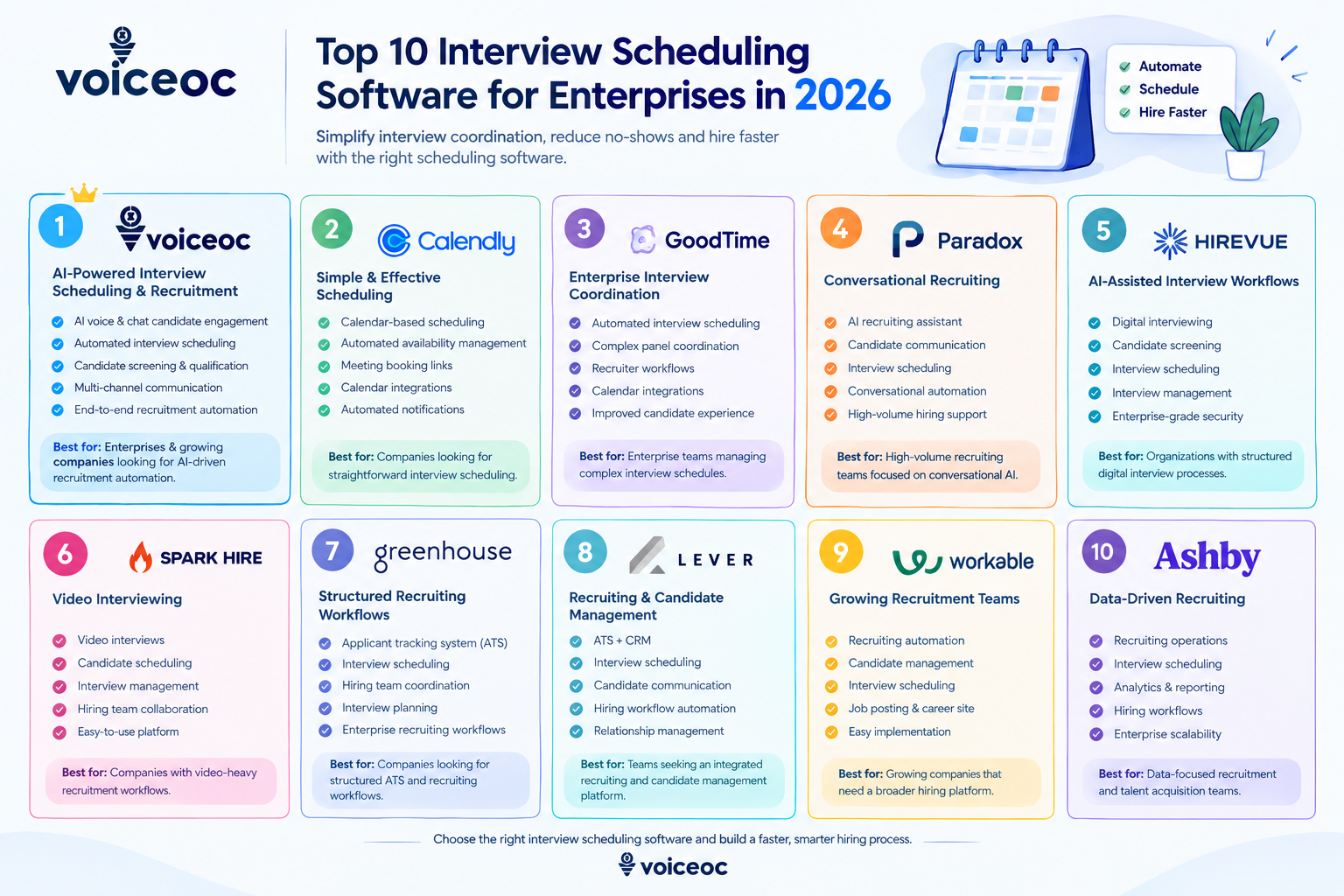
1. Voiceoc AI Recruiter — Best for AI-Powered Recruitment Automation
Voiceoc AI Recruiter, Eva takes a broader approach to recruitment automation by connecting candidate engagement, screening, interviewing, and scheduling into an AI-powered recruitment workflow.
Rather than treating interview scheduling as an isolated activity, Voiceoc is designed to help recruitment teams automate repetitive candidate interactions throughout the hiring journey.
With AI voice and chat capabilities, recruiters can use automation to handle parts of the candidate journey before and around the interview stage.
Key capabilities include:
- AI-powered candidate engagement
- Candidate screening and qualification
- AI voice and chat interactions
- Automated interview workflows
- Interview scheduling automation
- Candidate communication
- Automated reminders and follow-ups
- Recruitment workflow automation
- High-volume hiring support
- Candidate engagement across recruitment stages
This broader approach can be particularly useful for companies where scheduling is only one part of a larger recruitment bottleneck.
For example, a recruitment workflow can look like:
Resume Screening → Candidate Qualification → AI Voice/Chat Screening → AI Interview → Candidate Ranking → Human Review → Interview Scheduling → Human Interview → Hiring Decision
This means recruiters can spend less time on repetitive coordination and more time on activities that require human judgment.
For enterprises hiring at scale, this distinction is important. A scheduling tool can solve scheduling. An AI recruitment platform can potentially automate several connected stages of the hiring process.
Best for: Enterprises and growing companies looking for AI-powered recruitment and interview workflow automation.
2. Calendly — Best for Simple Interview Scheduling
Calendly is widely used for scheduling meetings based on availability.
For recruitment teams, it can simplify the process of allowing candidates to select available interview times.
Its strengths include:
- Calendar-based scheduling
- Automated availability management
- Meeting booking
- Scheduling links
- Calendar integrations
- Automated notifications
Calendly can be useful when the primary requirement is straightforward scheduling.
However, recruitment teams looking for deeper AI screening, candidate qualification, interview automation, and recruitment workflow capabilities may need additional technology alongside a scheduling platform.
Best for: Companies looking for straightforward automated scheduling.
3. GoodTime — Best for Enterprise Interview Coordination
GoodTime focuses heavily on interview scheduling and coordination for recruiting teams.
Enterprise hiring often involves complex scheduling requirements, including multiple interviewers and multiple interview stages.
A dedicated interview coordination platform can help recruiters reduce manual calendar management and organize interview workflows more efficiently.
GoodTime is particularly relevant for companies where interview coordination itself is a major operational challenge.
Best for: Enterprise recruitment teams managing complex interview schedules.
4. Paradox — Best for Conversational Recruiting
Paradox AI Recruiting Software focuses on conversational recruiting and automation.
Its technology can support candidate interactions and recruitment processes through conversational experiences.
For high-volume hiring environments, conversational automation can help organizations engage candidates more quickly and reduce repetitive recruiter interactions.
Its relevance to interview scheduling comes from combining candidate communication with recruitment automation rather than treating scheduling as a standalone activity.
Best for: High-volume recruiting teams interested in conversational AI.
5. HireVue — Best for AI-Assisted Interview Workflows
HireVue is known for digital interviewing and assessment technology.
Organizations conducting large numbers of interviews can benefit from technologies that help manage digital interview workflows and candidate evaluation.
For enterprise recruitment teams, interview technology can become particularly valuable when hiring processes include large candidate pools and standardized interview stages.
Best for: Organizations with structured digital interview and assessment processes.
6. Spark Hire — Best for Video Interviewing
Spark Hire focuses on video interviewing and recruitment workflows.
Video interviews can be useful when recruiters want candidates to complete interviews remotely while maintaining a structured hiring process.
The platform can support recruitment teams that use video as an important part of their candidate evaluation process.
Best for: Companies with video-heavy recruitment workflows.
7. Greenhouse — Best for Structured Recruiting Workflows
Greenhouse is an established applicant tracking and recruiting platform.
For companies with structured hiring processes, an ATS can provide a central place to manage candidates, interview stages, hiring teams, and recruitment workflows.
Interview scheduling is one part of the broader recruiting process.
Greenhouse can therefore be relevant for organizations looking for recruitment software rather than a standalone scheduling application.
Best for: Companies looking for structured applicant tracking and recruiting workflows.
8. Lever — Best for Recruiting and Candidate Management
Lever, another AI Recruitment Software, combines applicant tracking and recruiting relationship management capabilities.
For recruitment teams, this can help connect candidate management with the broader hiring process.
Organizations looking for recruitment software that combines candidate tracking, communication, and hiring workflows may consider Lever as part of their technology stack.
Best for: Companies looking for an integrated recruiting and candidate management platform.
9. Workable — Best for Growing Recruitment Teams
Workable provides recruitment functionality designed to help organizations manage candidates and hiring workflows.
Growing companies often need more than a calendar scheduling tool. They may require candidate management, job posting, applicant tracking, and interview coordination.
Workable can therefore be considered by companies looking for a broader recruitment platform.
Best for: Growing companies and recruitment teams that need a broader hiring platform.
10. Ashby — Best for Data-Driven Recruiting Teams
Ashby focuses on recruiting operations, applicant tracking, and recruiting analytics.
Data can play an important role in enterprise hiring because recruitment teams need visibility into metrics such as candidate pipelines, hiring stages, and recruitment performance.
For companies building data-driven recruiting operations, platforms that connect recruitment workflows with analytics can provide additional value.
Best for: Data-focused recruitment and talent acquisition teams.
What Should You Look for in the Best Interview Scheduling Software?
Choosing an interview scheduling platform based only on its ability to book calendar appointments can be limiting.
Enterprise recruitment teams should evaluate the complete recruitment workflow.
1. AI and Automation
Look for features such as:
- AI scheduling
- Automated candidate communication
- Automated reminders
- Automatic rescheduling
- AI recruiting assistants
- Recruitment workflow automation
The more repetitive coordination a platform can automate, the more useful it can become for high-volume hiring.
2. Calendar Integrations
The software should work smoothly with the calendars already used by your organization.
Calendar synchronization is particularly important when multiple recruiters and interviewers need to coordinate availability.
3. ATS Integrations
Interview scheduling should ideally connect with the applicant tracking system.
This allows recruitment teams to keep candidate information and interview stages connected rather than managing data across disconnected systems.
4. Multi-Interviewer Scheduling
Enterprise interviews can involve multiple participants.
The platform should be capable of coordinating:
- Panel interviews
- Hiring managers
- Technical interviewers
- Recruiters
- Executives
- Multiple interview rounds
5. Candidate Communication
Scheduling does not end when an interview is booked.
Candidates may need:
- Confirmation messages
- Interview instructions
- Reminders
- Rescheduling options
- Follow-up communication
A platform that supports automated candidate communication can reduce manual recruiter work.
6. Time-Zone Management
For distributed organizations, time-zone support is essential.
The scheduling experience should clearly communicate interview times to both candidates and interviewers.
7. Scalability
The solution should continue to work when hiring volume increases.
A platform suitable for a company conducting 20 interviews per month may not be sufficient for an organization coordinating hundreds or thousands of interviews.
AI Interview Scheduling Assistant vs. Traditional Scheduling
One of the biggest changes in recruitment technology is the move from basic scheduling software to AI-powered scheduling assistants.
With traditional scheduling, a recruiter may need to:
- Contact the candidate.
- Ask for availability.
- Check interviewer calendars.
- Find a suitable time.
- Confirm with the candidate.
- Send the calendar invitation.
- Send reminders.
- Handle rescheduling.
An AI interview scheduling assistant can automate many of these repetitive steps.
The AI can communicate with candidates, collect availability, identify appropriate interview slots, coordinate calendars, and send relevant updates.
The biggest advantage is not simply saving clicks. It is reducing the amount of recruiter involvement required for repetitive coordination.
Automated Interview Scheduling for High-Volume Hiring
High-volume recruitment makes scheduling challenges more visible.
Imagine a company hiring for 100 positions while receiving thousands of applications. After initial screening, hundreds of candidates may need interviews.
If every interview requires manual coordination, recruiters can spend a substantial amount of time on scheduling instead of candidate evaluation and hiring strategy.
An automated interview scheduling tool can help create a more scalable process.
For example:
Applications → Resume Screening → Candidate Qualification → AI Screening → Interview Selection → Automated Scheduling → Human Interview → Hiring Decision
This approach allows scheduling to become part of an automated recruitment workflow rather than an isolated administrative task.
Best Recruiting Software for Startups vs. Best Enterprise Recruitment Software
The best recruitment software can vary significantly depending on the size and hiring requirements of a company.
Best Recruiting Software for Startups
Startups often prioritize:
- Ease of use
- Affordable pricing
- Quick implementation
- Simple scheduling
- Candidate management
- Basic automation
- Integration with existing tools
A startup hiring a small number of employees may not need a highly complex enterprise recruitment ecosystem.
However, startups with aggressive hiring targets can also benefit from AI recruitment automation because small recruiting teams often have limited time and resources.
Best Enterprise Recruitment Software
Enterprise organizations typically need more advanced capabilities.
These may include:
- High-volume candidate management
- AI recruitment automation
- Advanced integrations
- Multiple interview stages
- Multi-interviewer scheduling
- Candidate communication
- Analytics and reporting
- Workflow automation
- Enterprise security
- Scalability
- Support for multiple locations and teams
This is why enterprises should evaluate interview scheduling software as part of the complete recruitment technology stack.
How Voiceoc Simplifies Interview Scheduling?
Voiceoc approaches interview scheduling as part of a larger AI recruitment workflow.
Recruiters often do not struggle with scheduling alone. They also spend time screening resumes, calling candidates, answering repetitive questions, conducting initial qualification conversations, arranging interviews, and following up with applicants.
Voiceoc AI Recruiter is designed to help automate these repetitive recruitment interactions.
To know more about AI Recruitment Software in detail, schedule a 30-min free consultation with us on Eva AI Recruiter!
AI-Powered Candidate Screening
Recruiters can use AI to support the initial screening and qualification process before candidates move deeper into the recruitment pipeline.
This can help recruitment teams focus human attention on candidates who meet the relevant criteria.
AI Voice and Chat Candidate Engagement
Candidates can interact through AI-powered voice and chat experiences, allowing recruitment teams to automate parts of candidate communication.
This can be especially useful for high-volume hiring where recruiters cannot manually communicate with every applicant at every stage.
Automated Interview Scheduling
Once candidates move to the interview stage, scheduling can become part of the automated workflow.
Instead of relying entirely on manual back-and-forth communication, recruitment teams can use automation to coordinate interview availability and candidate communication.
Candidate Reminders and Follow-Ups
Recruitment does not stop after an interview is scheduled.
Candidates may need reminders, updates, and follow-up communication. Automating these interactions can help recruitment teams maintain engagement while reducing repetitive administrative work.
Recruitment Workflow Automation
The larger advantage is connecting different recruitment activities.
Instead of using separate systems for every stage, an AI recruitment platform can bring together:
Screening → Qualification → Candidate Engagement → AI Interview → Scheduling → Human Interview → Follow-Up
This can help enterprises build a more consistent and scalable recruitment process.
Frequently Asked Questions
- What is the best interview scheduling software in 2026?
The best interview scheduling software depends on your requirements. For simple calendar-based scheduling, platforms such as Calendly can be useful. For complex enterprise interview coordination, dedicated recruitment scheduling platforms may be more appropriate. For organizations looking to combine scheduling with AI-powered screening, candidate engagement, and recruitment automation, Voiceoc AI Recruiter offers a broader approach.
- What is an AI interview scheduling assistant?
An AI interview scheduling assistant uses artificial intelligence to automate parts of the interview coordination process. It can communicate with candidates, collect availability, identify suitable times, coordinate calendars, send reminders, and support rescheduling.
- What is an automated interview scheduling tool?
An automated interview scheduling tool helps recruiters schedule interviews with less manual coordination. Depending on the platform, it can handle candidate availability, calendar matching, confirmations, reminders, and rescheduling.
- Can interview scheduling software integrate with an ATS?
Yes. Many modern recruitment platforms can integrate interview scheduling with applicant tracking systems. This allows interview information to remain connected to the candidate's recruitment record.
- How does AI improve interview scheduling?
AI can reduce repetitive scheduling tasks by helping communicate with candidates, identify suitable interview times, coordinate availability, send reminders, and support rescheduling. When scheduling is connected to AI recruitment workflows, it can also become part of a broader automated hiring process.
- What is the best recruiting software for startups?
The best recruiting software for startups depends on hiring volume, budget, workflow complexity, and the team's requirements. Startups typically benefit from software that is easy to implement, scalable, and capable of automating repetitive recruitment tasks.
- What is the best enterprise recruitment software?
The best enterprise recruitment software, Eva AI Recruiter is one that support large candidate volumes, multiple hiring teams, complex workflows, integrations, analytics, automation, and enterprise-level requirements. Organizations should evaluate whether they need a complete recruitment platform or a specialized tool for a specific process such as scheduling.
- Can AI schedule interviews automatically?
Yes. AI-powered recruitment platforms can automate significant parts of the scheduling process, including collecting candidate availability, identifying suitable time slots, coordinating calendars, sending confirmations, and managing reminders or rescheduling.
Final Thoughts
Interview scheduling is becoming an increasingly important part of recruitment automation in 2026.
For small hiring teams, basic scheduling software may be enough. But as organizations grow, recruitment becomes more complex. Multiple interviewers, different time zones, large candidate pipelines, repeated scheduling requests, and candidate follow-ups can quickly create administrative pressure.
This is why enterprises should look beyond basic calendar booking when evaluating the best interview scheduling software.
The strongest solutions can connect scheduling with the wider recruitment workflow.
Voiceoc AI Recruiter takes this approach by combining AI-powered candidate engagement, screening, voice and chat interactions, interview workflows, scheduling, and recruitment automation.
For companies hiring at scale, the goal is not simply to schedule interviews faster. It is to build a recruitment process where repetitive work is automated, candidates remain engaged, and recruiters can spend more time making better hiring decisions.
Ready to automate your recruitment workflow? Explore how Voiceoc AI Recruiter can help your team streamline candidate screening, engagement, interviews, and scheduling.