Recruiting has become increasingly complex. Hiring teams need to find qualified candidates quickly, manage large application volumes, communicate with applicants, schedule interviews, and maintain a positive candidate experience—all while controlling recruitment costs.
This is one reason AI recruitment software is becoming an important part of modern talent acquisition. According to SHRM's 2025 Talent Trends research, 43% of organizations were using AI for HR tasks, up from 26% in 2024. Recruiting was the leading HR use case, with 51% of organizations using AI to support recruiting activities.
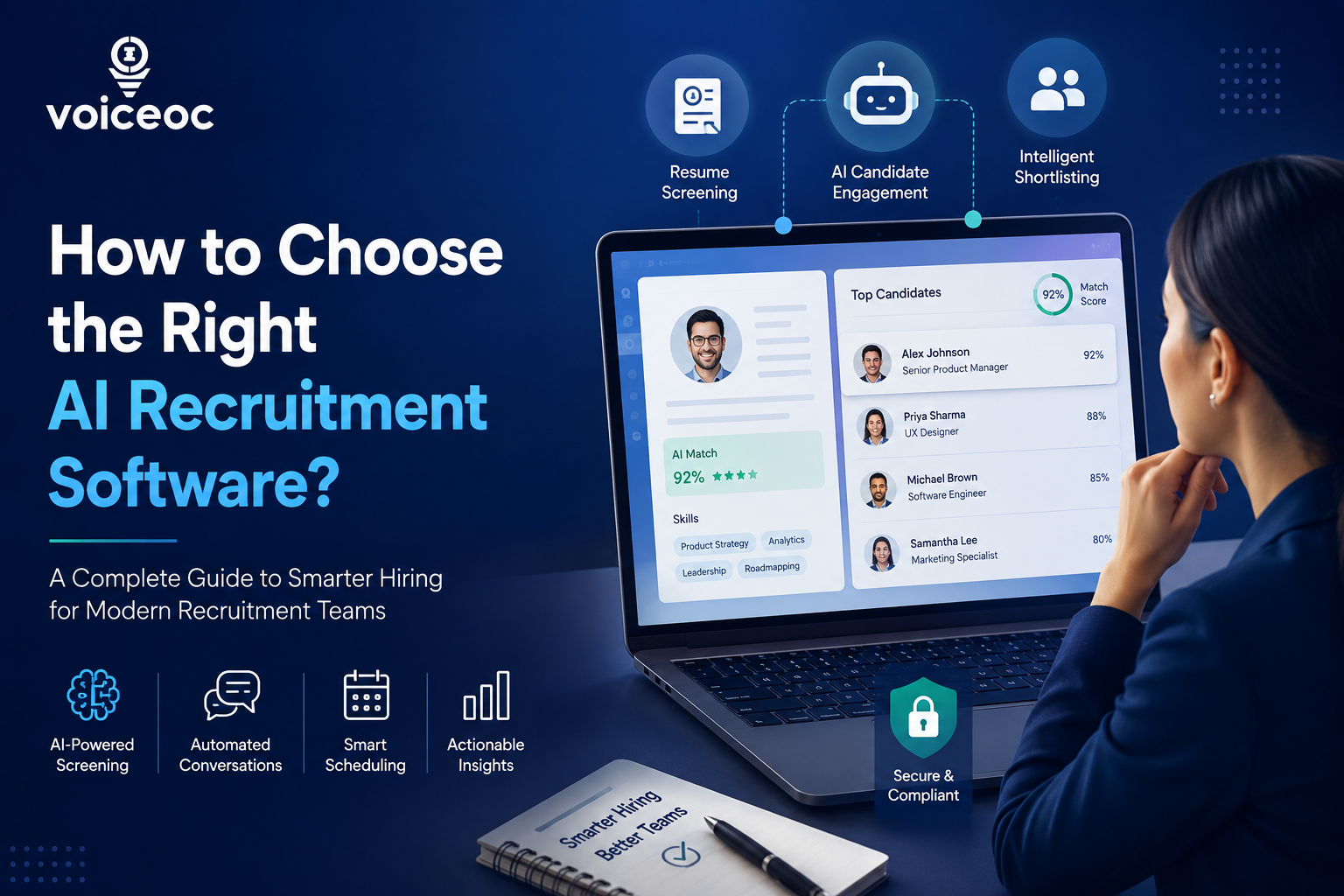
But choosing an AI recruitment platform is not as simple as selecting the tool with the most features. Different platforms specialize in different areas, including resume screening, candidate matching, AI interviews, candidate engagement, recruitment automation, and analytics.
The right solution should fit your hiring workflow, integrate with your existing systems, protect candidate data, and deliver measurable improvements in recruiter productivity.
So, how do you choose the right AI recruitment software?
What Is AI Recruitment Software?
AI recruitment software uses artificial intelligence to automate or assist with different stages of the hiring process.
Depending on the platform, it can help recruiters:
- Screen resumes and applications
- Match candidates with job requirements
- Identify relevant skills and experience
- Communicate with candidates
- Conduct initial screening conversations
- Schedule interviews
- Conduct AI-powered first-round interviews
- Rank or prioritize candidates
- Automate follow-ups
- Analyze recruitment performance
The goal is not necessarily to replace recruiters. Instead, AI can handle repetitive and time-consuming tasks while recruiters focus on activities that require human judgment, relationship-building, and decision-making.
LinkedIn's 2025 Future of Recruiting research found that 73% of talent acquisition professionals believe AI will change how companies hire. Among recruiting professionals experimenting with or integrating generative AI, LinkedIn reported an average 20% reduction in workload.
Why Are Companies Investing in AI Recruitment Software?
Recruitment teams are under pressure to improve hiring speed without compromising candidate quality.
SHRM reported that 69% of organizations were still struggling to fill full-time positions in 2025. At the same time, nearly 90% of HR professionals whose organizations use AI for recruiting said it saves time or increases efficiency.
Right AI Recruitment Automation software can help organizations address several common challenges:
- High application volumes
- Time-consuming resume screening
- Repetitive candidate qualification
- Slow candidate communication
- Interview scheduling bottlenecks
- Recruiter workload
- Inconsistent early-stage screening
- Increasing hiring costs
However, these benefits depend heavily on choosing the right platform.
10 Factors to Consider When Choosing AI Recruitment Software
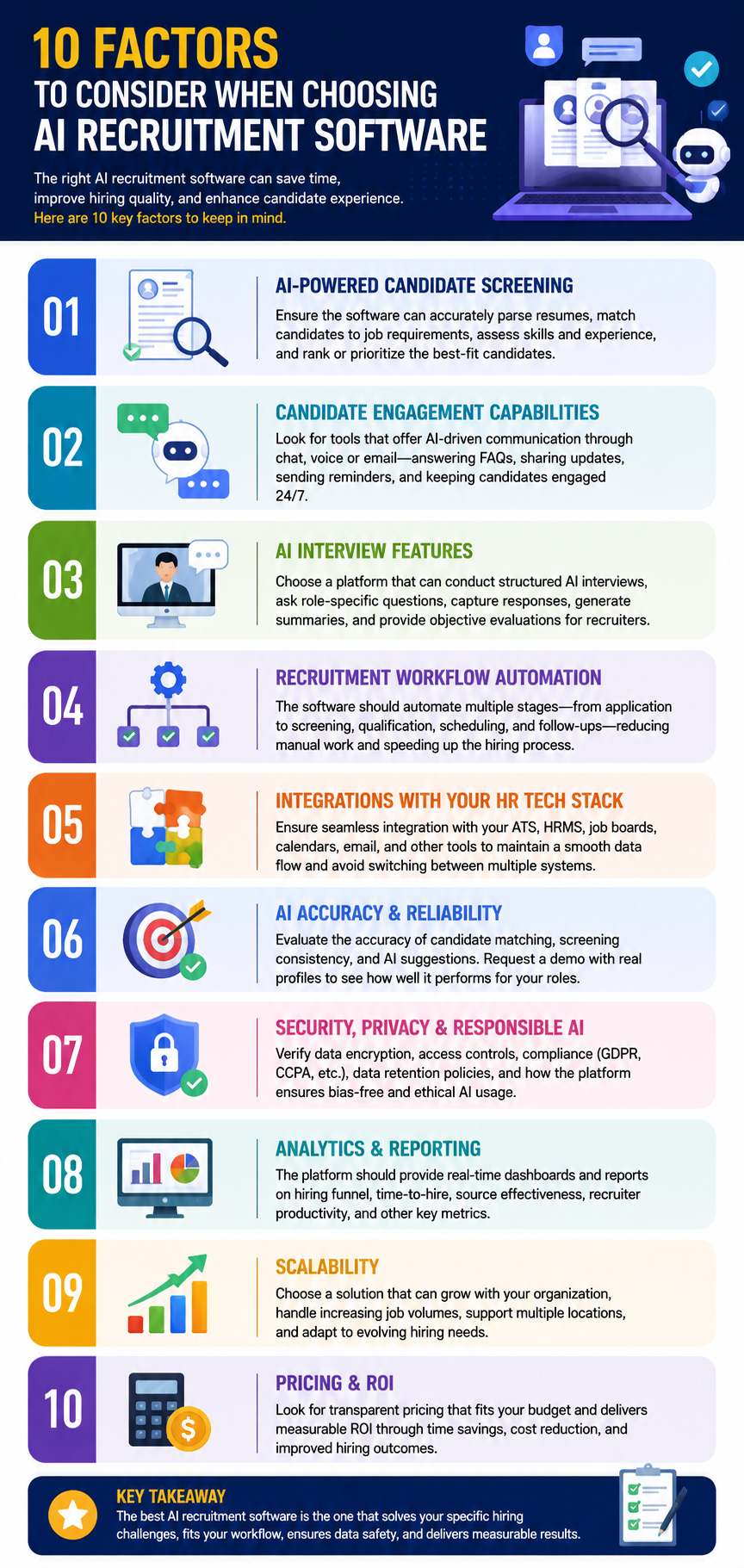
1. Start With Your Recruitment Challenges
Before comparing AI recruitment platforms, identify the biggest problems in your existing hiring process.
Ask your recruitment team:
- How much time is spent reviewing resumes?
- How long does candidate qualification take?
- Are recruiters repeatedly answering the same candidate questions?
- Is interview scheduling slowing down the process?
- Are candidates waiting too long for responses?
- Are recruiters struggling with high application volumes?
- Where are candidates dropping out of the hiring funnel?
For example, if your biggest problem is resume screening, a platform focused primarily on candidate matching may be sufficient.
If your recruitment team needs end-to-end automation, you may need a broader solution that supports screening, candidate engagement, interviews, scheduling, and workflow automation.
The best AI recruitment software is the one that solves your biggest operational problems—not simply the one with the longest feature list.
2. Evaluate AI-Powered Candidate Screening
Candidate screening is one of the most common applications of AI in recruitment.
SHRM found that 44% of organizations using AI in recruiting use it to screen resumes.
When evaluating screening capabilities, look for software that can:
- Parse resumes automatically
- Identify relevant skills
- Compare candidates against job requirements
- Understand experience and qualifications
- Apply predefined screening criteria
- Prioritize suitable candidates
- Process large application volumes
- Provide useful reasoning or summaries for recruiter review
Don't choose a platform simply because it says it offers "AI matching."
Ask whether the system can understand context and skills rather than relying only on exact keyword matches.
3. Look for Candidate Engagement Capabilities
Recruitment doesn't end after a candidate submits an application.
Candidates may have questions about the role, hiring process, interview requirements, or application status. Responding manually to every question can consume significant recruiter time.
A modern AI recruitment platform may provide automated candidate engagement through:
- Chat
- Voice
- Email or messaging workflows
- Automated notifications
- Interview reminders
- Follow-ups
- Candidate FAQs
- Screening conversations
This can help recruitment teams provide faster responses while maintaining consistent communication throughout the hiring process.
4. Evaluate AI Interview Features
If your recruiters spend significant time conducting repetitive first-round interviews, AI interview capabilities may be valuable.
Look for features such as:
- Automated first-round interviews
- Role-specific questions
- Structured interviews
- Candidate responses and transcripts
- Interview summaries
- Evaluation criteria
- Recruiter review dashboards
AI interviews can help standardize early-stage assessments, but human oversight remains important.
The purpose should be to make early-stage recruitment more efficient—not to remove human judgment from important hiring decisions.
5. Check End-to-End Recruitment Workflow Automation
A common mistake is evaluating AI features individually instead of looking at the entire recruitment workflow.
Consider a process such as:
Application → Resume Screening → Candidate Qualification → AI Interview → Shortlisting → Interview Scheduling → Follow-Up → Recruiter Review
The more repetitive handoffs a platform can automate, the more value it can potentially provide.
Ask vendors:
- Which recruitment steps can be automated?
- Can workflows be customized?
- Can different workflows be created for different roles?
- Can automation be triggered based on candidate responses?
- Which steps still require recruiter involvement?
This helps you understand whether you're buying an AI feature or a genuine recruitment automation platform.
6. Check Integrations With Your Existing HR Technology
Your AI recruitment software should fit into your existing technology ecosystem.
Depending on your organization, you may need integrations with:
- Applicant Tracking Systems (ATS)
- HRMS or HRIS platforms
- Job boards
- Calendars
- Email platforms
- Recruitment CRM systems
- Communication tools
Check whether the vendor offers native integrations, APIs, webhooks, or other integration options.
Poor integration can create another administrative burden instead of reducing one.
7. Assess AI Accuracy and Reliability
AI recruitment software should be evaluated on performance, not just marketing claims.
Ask vendors about:
- Candidate matching accuracy
- Screening consistency
- False positives
- False negatives
- Natural-language understanding
- Skills recognition
- AI interview quality
- Ability to understand different job requirements
A good way to test this is to conduct a pilot using real or representative job descriptions and candidate profiles.
Compare the AI's recommendations with assessments made by experienced recruiters.
8. Prioritize Security, Privacy, and Responsible AI
Recruitment platforms process sensitive personal information, including resumes, contact information, employment history, qualifications, and interview responses.
Before selecting a vendor, investigate:
- Data encryption
- Access controls
- Data retention policies
- Candidate consent
- Data storage practices
- Audit logs
- Security certifications
- Privacy compliance
- AI governance
- Human oversight
Responsible AI is particularly important in recruitment because automated systems can influence employment decisions.
For example, the U.S. Equal Employment Opportunity Commission states that employment practices cannot discriminate against applicants based on protected characteristics.
Therefore, organizations should understand how an AI recruitment system is designed, tested, monitored, and reviewed for potential bias.
9. Evaluate Analytics and Reporting
Automation is valuable, but recruitment leaders also need visibility into hiring performance.
Look for dashboards that provide information about:
- Applications received
- Candidates screened
- Screening-to-interview conversion
- Interview completion
- Candidate drop-off
- Time-to-screen
- Time-to-hire
- Recruiter productivity
- Hiring funnel performance
- Candidate sources
Good analytics should help answer questions such as:
Where are candidates getting stuck in our recruitment funnel?
and
Which recruitment activities are consuming the most recruiter time?
10. Compare Pricing, Scalability, and ROI
Don't evaluate AI recruitment software based only on its monthly or annual subscription price.
Consider the total value it can deliver.
For example, calculate how much recruiter time could be saved by automating:
- Resume screening
- Candidate qualification
- Interview scheduling
- Candidate FAQs
- Follow-ups
- First-round interviews
LinkedIn reported that recruiting professionals experimenting with or integrating generative AI saw an average 20% reduction in workload.
Your actual results will vary, so the best approach is to establish your own baseline before purchasing.
A simple ROI calculation can be:
AI Recruitment ROI = Time and Cost Savings + Additional Hiring Capacity − Software Cost
Also consider whether the platform can scale when your hiring volume increases.
Questions to Ask an AI Recruitment Software Vendor
Before signing a contract, ask vendors:
- What recruitment tasks can your AI automate?
- How does your candidate screening work?
- Can the platform conduct candidate conversations or interviews?
- Which ATS and HR systems can it integrate with?
- How do you protect candidate data?
- How do recruiters review AI-generated recommendations?
- How is pricing calculated?
- Can we run a pilot using our own recruitment workflow?
- What analytics and reporting are included?
- What implementation and customer support do you provide?
These questions can help you distinguish between a platform built for real recruitment workflows and one that simply adds AI to an existing tool.
How to Test AI Recruitment Software Before Buying?
A pilot is one of the best ways to evaluate an AI recruitment platform.
Start with two or three representative roles.
For example:
- Software Engineer
- Sales Representative
- Customer Support Executive
Then test the platform across your actual recruitment workflow.
Step 1: Test candidate screening
Upload representative resumes and compare AI recommendations with recruiter assessments.
Step 2: Test candidate engagement
Evaluate how accurately the AI answers questions and communicates with candidates.
Step 3: Test interviews
Run sample AI interviews and review the quality of responses, summaries, and evaluations.
Step 4: Test integrations
Connect the platform with your existing recruitment systems and assess data flow.
Step 5: Measure results
Compare your baseline with pilot results.
Track:
- Screening time
- Recruiter hours saved
- Candidates processed
- Time-to-interview
- Time-to-hire
- Candidate response time
This gives you evidence for making the final purchasing decision.
Common Mistakes When Choosing AI Recruitment Software
Avoid these common mistakes:
Choosing based only on the number of features
More features don't automatically mean better results.
Ignoring integrations
A powerful platform that doesn't fit your existing workflow can create additional work.
Focusing only on resume screening
Recruitment includes communication, qualification, interviews, scheduling, and follow-ups too.
Skipping the pilot
Always test the platform against your actual recruitment requirements.
Ignoring data privacy
Candidate information requires strong security and responsible data handling.
Expecting AI to replace recruiters
AI works best when it automates repetitive activities while recruiters retain control over important hiring decisions.
How Can Voiceoc Help Automate Recruitment?
Voiceoc is designed to help recruitment teams automate repetitive candidate interactions and early-stage hiring workflows.
Its AI recruitment capabilities can support processes such as:
Candidate Application → AI Screening → Candidate Conversation → Qualification → AI Interview → Recruiter Review
By automating repetitive screening and candidate interactions, recruitment teams can spend more time on strategic activities such as evaluating shortlisted candidates, collaborating with hiring managers, and making final hiring decisions.
The platform's voice and text-based AI capabilities can also help organizations engage with candidates through more conversational recruitment experiences.
For companies handling high application volumes, this type of automation can help recruiters increase their capacity without requiring every stage of the hiring process to be handled manually.
Final AI Recruitment Software Checklist
Before selecting an AI recruitment platform, make sure it:
- Solves your biggest recruitment bottlenecks
- Supports AI-powered candidate screening
- Provides candidate engagement capabilities
- Offers AI interviews if required
- Automates repetitive recruitment workflows
- Integrates with your existing HR technology
- Provides useful analytics
- Protects candidate data
- Supports responsible AI practices
- Can scale with hiring volume
- Has transparent pricing
- Provides implementation and customer support
- Allows you to measure ROI
Conclusion
Choosing the right AI recruitment software is about more than finding a platform with the latest AI features.
The right solution should fit your recruitment process, automate repetitive work, integrate with your existing systems, protect candidate information, and provide measurable improvements in recruiter productivity and hiring efficiency.
As AI adoption continues to grow, organizations should evaluate recruitment platforms based on real business outcomes rather than AI buzzwords. Start by identifying your biggest hiring bottlenecks, define measurable goals, test shortlisted platforms with realistic workflows, and choose the solution that provides the strongest combination of automation, accuracy, security, integration, scalability, and ROI.
For recruitment teams looking to automate candidate screening and early-stage hiring workflows, an AI-powered platform such as Voiceoc can be part of a broader strategy to make recruiting faster, more scalable, and more efficient.
Frequently Asked Questions
1. What is AI recruitment software?
AI recruitment software uses artificial intelligence to automate or assist with recruitment activities such as resume screening, candidate matching, candidate engagement, interviews, scheduling, and recruitment analytics.
2. What features should I look for in AI recruitment software?
Important features include AI candidate screening, candidate engagement, AI interviews, workflow automation, ATS/HRMS integrations, analytics, security, scalability, and responsible AI controls.
3. How does AI recruitment software help recruiters?
AI can automate repetitive tasks such as screening resumes, answering candidate questions, conducting initial qualification, scheduling interviews, and sending follow-ups. This can allow recruiters to spend more time on strategic and relationship-focused activities.
4. Is AI recruitment software a replacement for an ATS?
Not necessarily. Some AI recruitment platforms complement existing ATS and HR systems by adding intelligent screening, candidate engagement, interviews, and workflow automation.
5. How should I evaluate an AI recruitment platform?
Identify your recruitment bottlenecks, define measurable goals, compare relevant features, check integrations and security, run a pilot with representative hiring workflows, and calculate potential ROI before making a decision.