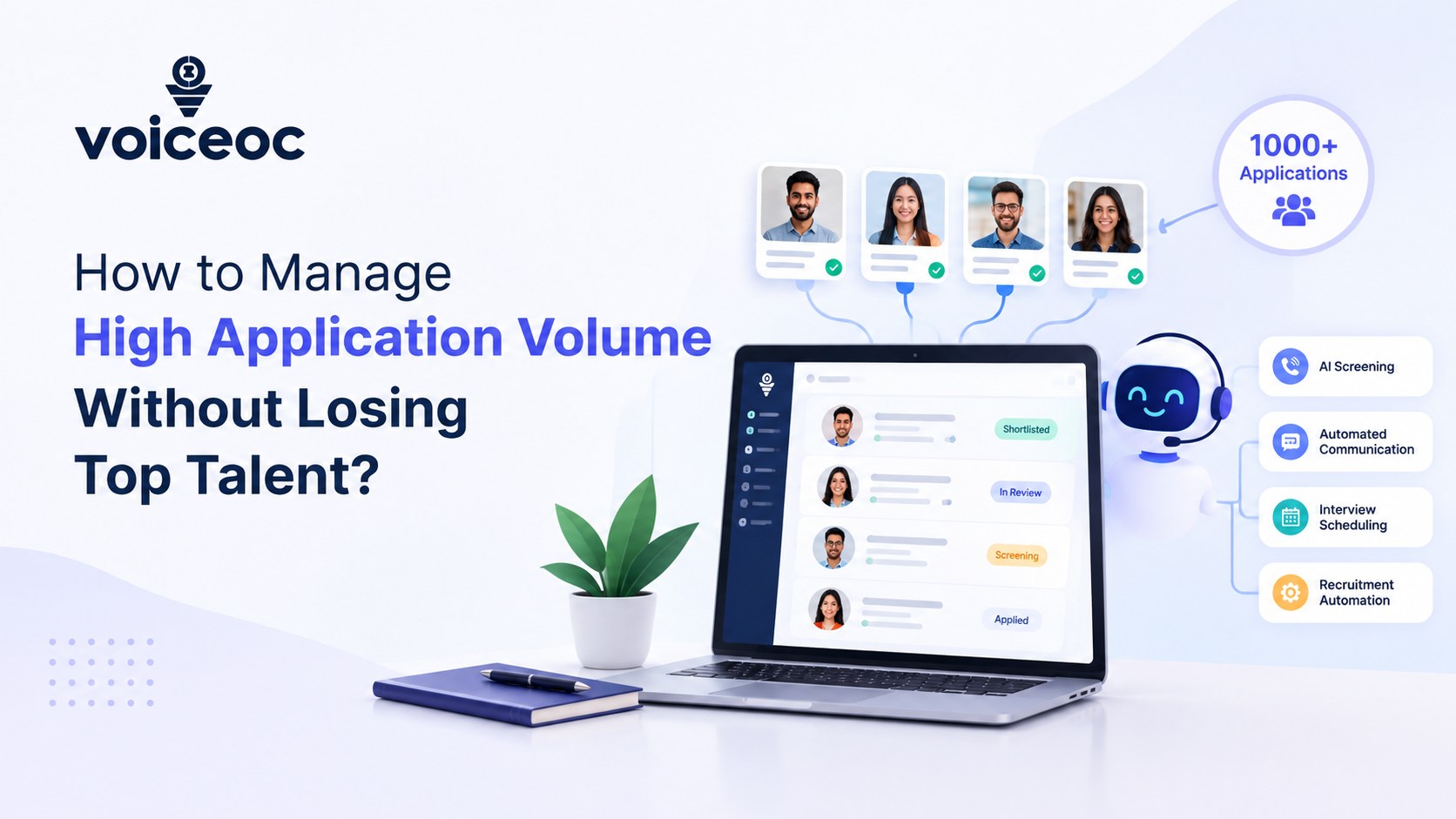
Recruiting becomes more challenging when hundreds or thousands of candidates apply for open positions. While a large applicant pool gives organizations more opportunities to find qualified professionals, it also creates pressure on recruitment teams to review resumes, conduct screening calls, respond to candidates, and schedule interviews within tight deadlines.
When these tasks rely heavily on manual processes, qualified candidates can be overlooked, communication can become inconsistent, and hiring timelines can stretch longer than expected. The challenge is not simply processing more applications. It is identifying the right candidates while maintaining a positive candidate experience.
This is why high-volume recruitment requires a structured approach that combines clear screening criteria, efficient workflows, timely communication, and appropriate automation.
Fill out the form today and our Voiceoc team will connect with you shortly!
According to LinkedIn's Future of Recruiting 2025 report, 73% of talent acquisition professionals agree that AI will change how organizations hire. The report also found that talent acquisition professionals who were experimenting with or integrating generative AI reported saving an average of 20% of their workweek. These findings highlight the potential for AI to reduce repetitive work and help recruiters focus on more valuable activities.
In this guide, we'll explore how organizations can manage high application volumes, improve candidate screening, and use recruitment automation without losing sight of the people behind every application.
What Is High-Volume Recruitment?
High-volume recruitment is the process of hiring large numbers of employees within a defined period. It is common in industries such as retail, healthcare, business process outsourcing (BPO), manufacturing, logistics, hospitality, and customer service.
For example, a retail company preparing for a seasonal rush may need to hire hundreds of employees across multiple locations. Similarly, a BPO organization may need to recruit customer service representatives for several new projects simultaneously.
In these situations, recruiters must process large applicant pools while maintaining consistent hiring standards.
High-volume candidate hiring typically involves several interconnected activities:
- Reviewing and organizing large numbers of applications.
- Identifying candidates who meet essential job requirements.
- Conducting initial screening conversations.
- Answering candidate questions and providing updates.
- Scheduling interviews and sending reminders.
- Tracking candidate progress across multiple hiring stages.
High-volume recruiting becomes difficult when the number of applications grows faster than the recruitment team's capacity to process them. Without an organized workflow, even companies that attract plenty of applicants can struggle to fill positions efficiently.
Why Is Managing a High Volume of Job Applications Difficult?
Before deciding how to manage a high volume of job applications, recruitment teams need to understand where the process breaks down.
1. Manual Resume Screening Creates Bottlenecks
Recruiters may spend considerable time reviewing resumes, checking qualifications, and comparing candidate experience against job requirements. When multiple roles attract large applicant pools, repetitive screening tasks can consume time that could otherwise be spent interviewing and engaging qualified candidates.
2. Qualified Candidates Can Be Overlooked
A resume that does not follow a conventional format may still represent a strong candidate. Inconsistent screening practices, unclear requirements, or excessive dependence on keyword matching can cause suitable applicants to be overlooked.
3. Slow Communication Damages Candidate Experience
Candidates expect clear information about application status, screening steps, and interview timelines. When recruitment teams struggle to respond promptly, applicants may lose interest or accept opportunities elsewhere.
SHRM's 2025 Talent Trends research found that 41% of organizations reported candidates ghosting them during the interview process. Although ghosting has multiple causes, the finding reinforces the importance of treating candidate engagement as an ongoing part of recruitment rather than an afterthought.
4. Interview Scheduling Consumes Recruiter Time
Coordinating availability between candidates, recruiters, and hiring managers can introduce unnecessary delays. Rescheduling, reminders, and follow-up messages add to the workload, particularly when teams manage multiple openings simultaneously.
The solution is not to rush every hiring decision. Instead, organizations need to remove avoidable administrative work and create a more consistent process for evaluating candidates.
7 Strategies to Manage High Application Volume Without Losing Top Talent
1. Define Clear Candidate Screening Criteria
The first step in high-volume recruitment is establishing exactly what makes a candidate suitable for a role.
Before applications arrive, hiring managers and recruiters should agree on the essential qualifications, relevant skills, required experience, and role-specific competencies. Distinguish between mandatory requirements and preferences that can be developed after hiring.
For example, when recruiting customer service representatives, a company might prioritize communication skills, problem-solving ability, language proficiency, and availability. Requiring an unnecessary degree or an overly specific background could exclude otherwise suitable applicants.
Clear criteria help recruiters evaluate candidates more consistently and reduce unnecessary back-and-forth with hiring managers.
A structured screening framework should include:
- Essential qualifications and job-related skills.
- Relevant experience and demonstrated competencies.
- Consistent screening questions.
- Standardized evaluation criteria.
- Clearly defined reasons for advancing or rejecting an application.
Documenting these requirements also makes it easier to configure candidate screening software and recruitment workflows.
2. Automate Repetitive Resume Screening Tasks
Manual resume review becomes difficult to sustain when organizations receive applications at scale. Automation can help organize incoming applications, extract relevant information, identify potential matches against predefined criteria, and route candidates into appropriate workflows.
For example, an AI-assisted screening process could help a recruiter identify applicants who appear to meet the minimum experience requirements for a sales position. The recruiter can then review those candidates in more detail instead of starting with an unorganized list of applications.
However, automation should not be treated as an infallible decision-maker. Resumes vary in format, and relevant experience may be described in different ways. Screening systems should be tested for accuracy and fairness, and recruiters should have a process for reviewing uncertain cases.
When evaluating candidate screening software, look for capabilities such as:
- Resume parsing and application organization.
- Configurable job-related screening criteria.
- Candidate qualification workflows.
- Integration with existing recruitment systems.
- Transparent evaluation processes and recruiter review options.
The goal is to reduce repetitive work without allowing a rigid filter to eliminate potentially qualified candidates.
3. Use AI to Qualify Candidates at Scale
Resume screening provides an initial view of a candidate's background, but it may not answer every important question.
Recruiters often need to confirm availability, relevant experience, location requirements, salary expectations, language proficiency, or interest in the position. Contacting every applicant manually can create a significant bottleneck.
AI-powered voice and chat tools can help conduct structured initial conversations, ask predefined questions, collect responses, and organize relevant information for recruiter review.
For example, a company hiring hundreds of support representatives could use an automated screening workflow to ask candidates about their customer service experience, shift preferences, language skills, and availability. Recruiters could then review the responses and determine which candidates should progress.
This approach can help organizations manage high-volume recruiting while providing candidates with a more consistent first interaction.
Nevertheless, automated screening should account for accessibility, language differences, and reasonable accommodations. Candidates should have an appropriate alternative when they cannot or do not wish to use a particular automated channel.
4. Conduct Structured First-Round Screening Interviews
Initial interviews help recruiters understand whether candidates meet the role's basic requirements before investing time in more detailed assessments.
When interview questions differ significantly between candidates, comparisons become difficult and decisions may be less consistent. A structured approach makes the process easier to manage.
Start by developing a set of job-related questions and defining what a satisfactory response should demonstrate. For customer-facing roles, questions might assess communication, conflict resolution, and customer handling. For technical positions, they might focus on relevant experience and practical problem-solving.
AI voice interview tools can support this stage by conducting initial conversations, collecting responses, and organizing information for human review, where these features are available.
Recruiters should retain responsibility for evaluating context, interpreting nuanced answers, and making consequential decisions. AI-generated summaries should support assessment rather than replace direct evidence from the candidate.
Must Read: Best AI Recruiting Platforms for Startups, Staffing Firms, and Enterprises
5. Keep Candidates Engaged With Timely Communication
Candidate experience is particularly important when hundreds of applicants move through the same recruitment pipeline.
Even when recruiters cannot provide individual updates at every moment, they can establish clear communication standards. Candidates should know that their applications have been received, what the next step involves, and when they can reasonably expect an update.
Recruitment teams can improve communication by:
- Sending application acknowledgments.
- Providing screening instructions and interview details.
- Sharing reminders before scheduled interviews.
- Notifying candidates when hiring timelines change.
- Communicating decisions as promptly as possible.
Recruitment automation can support these tasks through scheduled notifications and predefined communication workflows. AI chat assistants can also help answer common questions about interview stages, required documents, and scheduling.
Automation should make communication more consistent, not less personal. Sensitive conversations, detailed feedback, and complex candidate concerns often require direct human interaction.
6. Automate Interview Scheduling and Follow-Ups
Interview coordination is another common bottleneck in high-volume hiring. Recruiters may need to arrange multiple interviews across departments, time zones, locations, and hiring managers.
Interview scheduling automation can help candidates select available time slots, send confirmations, issue reminders, and support rescheduling. When integrated with the broader recruitment workflow, it can reduce the need to coordinate every interaction manually.
To improve the process:
- Define interview stages and the people responsible for each stage.
- Establish availability rules and scheduling preferences.
- Automate confirmations and reminders where appropriate.
- Provide candidates with a clear way to request changes.
- Monitor missed interviews and scheduling delays.
Recruiters should also ensure that scheduling systems respect time zones, candidate availability, and accessibility requirements.
These improvements can help teams move candidates through the pipeline more efficiently without creating unnecessary friction.
7. Keep Human Recruiters Involved in Important Decisions
The purpose of automation is not to remove human judgment from hiring. It is to give recruiters more time to exercise that judgment effectively.
AI tools can support repetitive tasks, organize information, and conduct structured initial interactions. Human recruiters remain essential for assessing context, exploring a candidate's experience, evaluating team needs, and making final hiring decisions.
Organizations should establish safeguards before deploying AI recruitment systems. These include reviewing screening criteria for potential bias, testing system performance across relevant candidate groups, protecting personal information, and documenting how hiring decisions are made.
Candidates should have appropriate channels to request clarification or human review when necessary.
A balanced approach helps companies scale recruitment while preserving accountability, fairness, and meaningful human involvement.
How Recruitment Automation Improves High-Volume Hiring?
Recruitment automation connects repetitive hiring activities into a more organized workflow. Instead of managing each task independently, organizations can coordinate application review, initial screening, candidate communication, and interview scheduling through defined processes.
For example, a candidate might submit an application, receive an acknowledgment, complete an initial screening conversation, and receive an interview invitation after recruiter review. Each step can trigger the next appropriate action without requiring a recruiter to manually initiate every communication.
The benefits may include:
- Reduced time spent on repetitive administrative tasks.
- More consistent candidate communication.
- Faster movement between recruitment stages.
- Better visibility into candidate progress.
- More recruiter time for interviews and relationship building.
LinkedIn's 2025 Future of Recruiting report found that 37% of surveyed talent acquisition professionals said their organizations were experimenting with or actively integrating generative AI into hiring. Among those groups, respondents reported an average 20% reduction in their workweek through AI use. These results are based on survey responses and should not be interpreted as a guaranteed outcome for every organization.
The most effective automation strategy starts with a specific bottleneck, measures its impact, and expands only after the workflow demonstrates value.
How AI Recruitment Software Helps Recruiters Handle Thousands of Applications?
AI Recruitment Software can help organizations coordinate different stages of the hiring process, from candidate qualification to initial interviews and interview scheduling.
Rather than relying exclusively on resume filters, recruitment teams can use a combination of application data, structured screening questions, voice or chat interactions, and human review to build a more complete picture of each applicant.
For high-volume hiring, the important capabilities are not simply the number of tasks a platform can automate. Recruiters should also consider how accurately the system captures candidate information, whether workflows can be configured for different roles, how the system integrates with existing tools, and how decisions remain transparent.
Also Read: How is AI Transforming the Candidate Experience?
Before adopting a solution, organizations should evaluate:
- The number and types of roles being recruited for.
- The volume of applications processed per hiring cycle.
- The screening and communication tasks causing the greatest delays.
- Integration, security, and privacy requirements.
- Reporting capabilities and measurable business outcomes.
The right AI recruitment software should help teams improve operational efficiency while keeping candidate quality and fairness central to the process.
How Eva by Voiceoc Supports High-Volume Recruitment?
Eva by Voiceoc is an AI Recruiter designed to help recruitment teams streamline repetitive candidate interactions and hiring workflows.
When organizations need to engage large applicant pools, managing initial screening conversations, answering candidate questions, and coordinating interviews can place considerable pressure on recruiters. Eva's AI voice and chat capabilities can support these activities, helping teams handle candidate interactions more systematically.
Depending on the configured workflow, relevant use cases include:
AI-powered candidate qualification: Use structured questions to collect job-related information and help recruiters identify candidates who warrant further review.
Initial screening conversations: Support first-round screening through AI voice or chat interactions, allowing recruitment teams to manage more candidate conversations without coordinating each one manually.
Candidate communication: Help address repetitive candidate queries and support timely interactions throughout the recruitment process.
Interview scheduling and workflow automation: Reduce administrative coordination by supporting interview scheduling and other repetitive hiring activities.
By automating suitable tasks, Eva can help recruiters devote more attention to candidate evaluation, hiring manager collaboration, and important hiring decisions.
For organizations exploring ways to manage high application volumes, the next step is to identify where their recruitment process slows down and assess whether an AI Recruiter can address those bottlenecks.
Explore Eva by Voiceoc to learn how AI-powered recruitment workflows can support your hiring process.
For more information, schedule a 30-min free consultation with Voiceoc experts on Voiceoc Eva AI Recruiter!
Metrics to Measure High-Volume Recruiting Performance
Recruitment automation should be evaluated through measurable outcomes rather than assumptions about efficiency.
Track the following metrics before and after implementing a new workflow:
- Time to screen: The time required to move an application through initial screening.
- Time to fill: The number of days between opening a requisition and accepting an offer, using a consistent definition.
- Screening completion rate: The percentage of candidates who complete the required initial screening steps.
- Qualified-candidate conversion rate: The percentage of screened candidates who meet the defined criteria and progress to the next stage.
- Candidate drop-off rate: The percentage of candidates who leave the process before completion.
- Interview attendance rate: The percentage of scheduled interviews that candidates attend.
- Recruiter administrative hours: The time recruiters spend on repetitive coordination and communication tasks.
SHRM's 2025 recruiting benchmark research reported a median time-to-fill of approximately 45 days for both executive and nonexecutive positions. The report also found that extra-large organizations took longer, reporting 61 days for nonexecutive positions and 60 days for executive positions. These figures provide useful context, although actual timelines vary by role, industry, and hiring process.
Use these benchmarks as context rather than universal targets. A successful process should improve efficiency without reducing the quality of hires or creating a worse candidate experience.
Conclusion
Managing high application volumes requires more than processing resumes faster. Organizations need clear screening criteria, structured interviews, timely communication, efficient scheduling, and consistent evaluation standards.
Candidate screening software, recruitment automation, and AI Recruitment Software can help reduce repetitive work and create more organized hiring workflows. However, technology delivers the most value when it supports human judgment instead of replacing it.
For companies navigating high-volume hiring, the goal is to build a recruitment process that can scale with business needs while treating candidates fairly and consistently.
With the right workflow and appropriate human oversight, recruiters can spend less time on repetitive administration and more time identifying, engaging, and hiring the people who will help their organizations grow.