The hiring process has changed dramatically in recent years. Candidates no longer judge an employer only by salary, benefits, or job title. They also evaluate how easy it is to find a job, apply, communicate with recruiters, schedule interviews, receive updates, and understand where they stand in the hiring process.
This entire journey is known as the candidate experience.
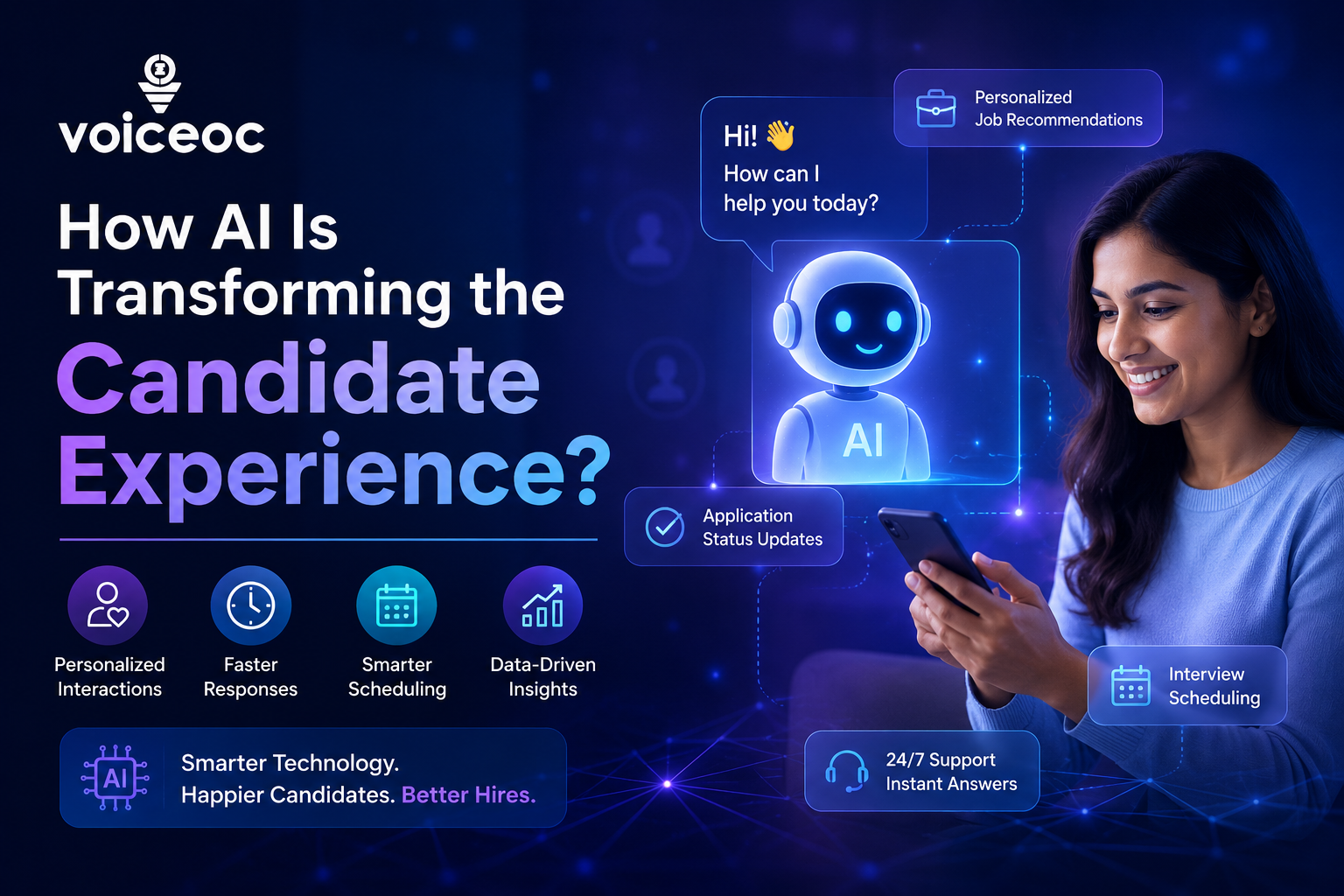
As hiring teams manage increasing application volumes and growing expectations from job seekers, artificial intelligence (AI) is transforming the candidate experience by making recruitment faster, more personalized, responsive, and accessible.
From AI-powered resume screening and candidate matching to automated communication, interview scheduling, chatbots, and intelligent recruitment assistants, AI is helping organizations remove some of the biggest sources of friction in hiring.
According to LinkedIn's 2025 Future of Recruiting report, 73% of talent acquisition professionals believe AI will change the way organizations hire. Among recruiting teams already experimenting with or integrating generative AI, the technology saves approximately 20% of their workweek on average.
But AI in recruitment is not simply about automating tasks.
The bigger opportunity is to create a better candidate experience while allowing recruiters to spend more time building meaningful relationships with candidates.
What Is Candidate Experience?
Candidate experience refers to every interaction a job seeker has with an organization throughout the recruitment process.
It starts when a candidate discovers a job opening and continues through:
- Finding and understanding the job description
- Applying for the position
- Receiving application confirmation
- Communicating with recruiters
- Completing assessments
- Scheduling interviews
- Participating in interviews
- Receiving application updates
- Getting feedback or a final decision
- Completing the onboarding process
A positive candidate experience makes applicants feel informed, respected, and valued.
A poor candidate experience can have the opposite effect. Long application forms, slow responses, unclear job descriptions, repeated interviews, poor communication, and generic rejection messages can quickly damage a candidate's perception of an employer.
The impact can extend beyond recruitment. According to iCIMS, 51% of people are less likely to purchase from a brand after having a negative application or interview experience.
This means candidate experience is also an employer branding and customer experience issue.
Why Candidate Experience Matters More Than Ever?
The modern recruitment market is highly competitive.
Candidates may apply to multiple companies at the same time, compare employers online, communicate with recruiters through multiple channels, and expect quick responses.
At the same time, recruiters are dealing with large candidate pools and administrative workloads.
SHRM's 2025 research found that 69% of organizations continue to experience difficulty recruiting for full-time positions. The same research found that 41% of organizations reported candidates ghosting during the interview process.
This creates a difficult situation:
Candidates want faster and more personalized communication, while recruiters have limited time to provide it manually.
AI can help bridge this gap.
Instead of asking recruiters to manually handle every candidate interaction, organizations can use AI recruitment technology to automate repetitive processes while keeping recruiters involved in important decisions.
How Is AI Transforming the Candidate Experience?
AI is influencing almost every stage of the recruitment journey. Here are some of the most important ways it is changing how candidates interact with employers.
1. AI Makes Job Searches More Relevant
One of the first challenges candidates face is finding relevant jobs.
Traditional job boards often depend heavily on keyword matching. A candidate may have the right skills but use different terminology from the job description and therefore fail to discover a relevant position.
AI-powered recruitment systems can analyze skills, experience, qualifications, job preferences, and other contextual information to identify better matches.
For example, instead of matching only the keyword "customer success," an AI recruitment platform may recognize related experience such as:
- Customer relationship management
- Account management
- Client onboarding
- Customer retention
- SaaS support
- Customer lifecycle management
This creates a more intelligent AI candidate matching experience.
For candidates, the benefit is simple: fewer irrelevant opportunities and more relevant jobs.
For recruiters, better matching can reduce the time spent searching through large talent pools.
LinkedIn's 2025 Future of Recruiting research also highlights the growing importance of skills-based hiring. The report found that 93% of talent acquisition professionals believe accurately assessing candidate skills is important for improving quality of hire.
2. AI Creates Faster Candidate Communication
One of the biggest frustrations candidates experience during recruitment is waiting.
A candidate may submit an application and hear nothing for days or weeks.
Even when recruiters eventually respond, the message may be generic.
AI-powered recruitment communication can reduce this communication gap.
An AI recruiting assistant can automatically:
- Confirm application submission
- Answer frequently asked questions
- Explain recruitment steps
- Provide information about job requirements
- Notify candidates about application status
- Share interview instructions
- Remind candidates about upcoming interviews
- Collect additional information
- Direct candidates to the appropriate recruiter
This creates a more responsive recruitment process without requiring recruiters to manually respond to every routine question.
SHRM reports that 51% of organizations currently use AI to support recruiting activities. Common applications include creating job descriptions, screening resumes, candidate searches, customizing job postings, and communicating with applicants.
3. AI Enables 24/7 Candidate Support
Recruitment does not happen only during business hours.
Candidates may search for jobs late at night, during weekends, or from different time zones.
A traditional recruitment team cannot realistically provide 24/7 support.
An AI-powered candidate assistant can.
Candidates can ask questions such as:
"What qualifications are required for this position?"
"What is the interview process?"
"Can I reschedule my interview?"
"What documents do I need to submit?"
"What happens after I apply?"
An AI assistant can respond immediately based on approved recruitment information.
This creates a more accessible and convenient candidate experience.
4. AI Simplifies the Application Process
Long and complicated application forms are a major source of candidate frustration.
Candidates may abandon an application if they are required to repeatedly enter information already available on their resume.
AI can help simplify this process.
AI-powered recruitment platforms can extract information from resumes and applications, identify relevant skills and experience, and reduce unnecessary manual data entry.
For example, instead of asking candidates to manually enter every previous job, an AI system can analyze their resume and automatically identify:
- Job titles
- Companies
- Years of experience
- Skills
- Certifications
- Educational qualifications
- Relevant projects
This can make applications faster and less repetitive.
The goal should not be to remove useful evaluation steps. Instead, AI should eliminate unnecessary friction.
5. AI Improves Resume Screening
Recruiters can receive hundreds or even thousands of applications for a single position.
Manually reviewing every resume can be time-consuming and inconsistent.
AI-powered resume screening can analyze candidate profiles against predefined job requirements and help recruiters identify potentially relevant candidates faster.
AI can evaluate factors such as:
- Required skills
- Relevant experience
- Educational qualifications
- Certifications
- Industry experience
- Job history
- Technical skills
- Transferable skills
This can reduce the time recruiters spend on repetitive screening.
SHRM's 2025 Talent Trends research found that 44% of organizations using AI for recruiting use it for resume screening, while 89% of HR professionals whose organizations use AI for recruiting report that it saves time or increases efficiency.
However, AI screening should support—not replace—human judgment.
Recruiters should be able to review recommendations, understand the evaluation criteria, and make final hiring decisions.
6. AI Personalizes Candidate Engagement
Candidates increasingly expect personalized communication.
A generic message such as:
"Thank you for applying. We will contact you if you are selected."
does not create much engagement.
AI can help organizations personalize candidate communication based on recruitment context.
For example, a candidate who has completed an assessment may receive a different message from someone who has just submitted an application.
AI can also help recruiters personalize outreach based on:
- Skills
- Previous experience
- Job preferences
- Location
- Application stage
- Interview history
- Role requirements
This allows organizations to move from mass recruitment communication toward more relevant candidate engagement.
SHRM specifically highlights AI's ability to provide targeted outreach and shorter waiting periods as an important part of improving candidate experience.
7. AI Makes Interview Scheduling Easier
Interview scheduling can create unnecessary back-and-forth between candidates, recruiters, and hiring managers.
For example:
Recruiter: "Are you available Tuesday?"
Candidate: "No, I am available Wednesday."
Recruiter: "What time?"
Candidate: "Anytime after 2 PM."
Recruiter: "How about 3 PM?"
This process can take multiple messages.
AI-powered scheduling can automate much of this process.
Candidates can select available time slots based on recruiter and interviewer calendars, while automated reminders can reduce missed interviews.
AI can also help candidates:
- Reschedule interviews
- Confirm appointments
- Receive interview reminders
- Get interview instructions
- Understand interview formats
This creates a smoother and more convenient experience.
8. AI Supports Candidates During Interviews
AI is also changing the interview experience itself.
AI-powered interview platforms can support structured interviews, skills assessments, interview scheduling, and candidate evaluation.
Depending on the technology and organization's recruitment policy, AI can help assess predefined skills or competencies and provide structured information to recruiters.
This can help reduce some of the inconsistencies associated with completely unstructured interviews.
However, organizations need to be careful.
AI should not become a black box that makes unexplained decisions about someone's career.
Candidates should understand when AI is being used and organizations should maintain appropriate human oversight.
LinkedIn's research emphasizes that AI should augment human judgment rather than replace it.
9. AI Provides Faster Application Updates
One of the biggest candidate frustrations is not knowing what is happening after submitting an application.
Candidates often ask:
"Has my application been reviewed?"
"Am I still being considered?"
"When will I hear back?"
AI-powered recruitment systems can automate status updates and notifications.
For example:
Application received → Screening → Assessment → Interview → Hiring Manager Review → Final Decision
Candidates can receive updates as they move through these stages.
Even when the final decision is negative, timely communication is better than leaving candidates waiting indefinitely.
This is particularly important because a candidate's perception of an employer can be influenced by how the organization communicates throughout the process.
10. AI Can Improve Candidate Accessibility
AI can also make recruitment more accessible.
Conversational AI can allow candidates to interact using natural language rather than navigating complex recruitment portals.
Voice-enabled AI can further support candidates who prefer speaking rather than typing.
Multilingual AI can help organizations communicate with candidates across different languages and geographic markets.
This can be particularly valuable for large organizations recruiting across multiple regions.
A well-designed AI recruiting assistant can provide candidates with consistent information regardless of when or where they interact with the organization.
11. AI Helps Recruiters Spend More Time With Candidates
One of the most important benefits of AI is not what it does to candidates directly—it is what it frees recruiters to do.
Recruiters spend significant amounts of time on administrative tasks such as:
- Resume screening
- Candidate searches
- Scheduling
- Follow-up emails
- Status updates
- Interview coordination
- Data entry
- Basic candidate questions
AI can automate or assist with many of these activities.
LinkedIn's 2025 Future of Recruiting report found that recruiting teams using or experimenting with generative AI save about 20% of their workweek on average.
This additional time can be redirected toward:
- Candidate conversations
- Relationship building
- Interview preparation
- Employer branding
- Hiring manager collaboration
- Strategic workforce planning
- Candidate engagement
In other words, the best use of AI is not necessarily to make recruitment less human.
It can help recruiters become more human where human interaction matters most.
AI Candidate Experience: The Numbers You Should Know
The adoption of AI in recruitment is accelerating.
Here are several statistics that demonstrate how quickly the industry is changing:
73% of talent acquisition professionals believe AI will change hiring
LinkedIn's 2025 Future of Recruiting report found that 73% of talent acquisition professionals agree that AI will change the way organizations hire.
37% of recruiting organizations are experimenting with or integrating generative AI
LinkedIn reported that 37% of recruiting organizations were actively integrating or experimenting with generative AI, up from 27% the previous year.
89% of AI users report efficiency gains
SHRM found that nearly 9 in 10 HR professionals whose organizations use AI to support recruiting say it saves time or increases efficiency.
51% of organizations use AI for recruiting
SHRM's 2025 Talent Trends research found that just over half of organizations use AI to support recruiting activities.
51% of people are less likely to buy from a company after a negative hiring experience
iCIMS found that 51% of people are less likely to be consumers of a brand following a negative application or interview experience.
82% of candidates want to know how AI evaluates them
iCIMS reported that 82% of candidates want to know the criteria AI uses in evaluations, highlighting the importance of transparency.
74% of companies say candidates are using AI during their job search
New iCIMS and Aptitude Research data from 2026 found that 74% of companies report candidates are now using AI in their job search. However, only 18% of companies say they are using AI broadly across hiring processes.
These numbers highlight an important shift: AI is becoming part of both sides of the hiring process.
Candidates are using AI to prepare resumes, research employers, and prepare for interviews, while employers are using AI for sourcing, screening, communication, and workflow automation.
The Candidate Experience Is Becoming a Two-Sided AI Ecosystem
An interesting development in modern recruitment is that both candidates and recruiters are adopting AI.
Candidates may use AI to:
- Improve resumes
- Write cover letters
- Research companies
- Prepare for interviews
- Identify relevant jobs
- Practice interview questions
Recruiters may use AI to:
- Create job descriptions
- Source candidates
- Screen resumes
- Match candidates to jobs
- Communicate with applicants
- Schedule interviews
- Analyze recruitment data
iCIMS reported in 2024 that 51% of Millennials and 55% of Gen Z candidates were using generative AI to write resumes, cover letters, or other job-application-related queries.
By 2026, iCIMS and Aptitude Research reported that nearly three-quarters of companies said candidates were using AI during their job search.
This means recruitment organizations need to rethink what a modern candidate experience looks like.
What Are the Challenges of Using AI in Candidate Experience?
AI can significantly improve recruitment, but implementation needs to be thoughtful.
1. Lack of Transparency
Candidates may feel uncomfortable if they do not know how AI is being used.
Organizations should clearly communicate when AI is involved in recruitment and explain its role where appropriate.
2. Algorithmic Bias
AI systems can potentially reproduce biases present in training data or historical recruitment decisions.
Organizations should regularly evaluate AI systems for fairness and maintain human oversight.
3. Data Privacy
Recruitment systems handle sensitive candidate information, including resumes, contact information, employment history, and sometimes assessment data.
Organizations need strong data governance and appropriate security practices.
LinkedIn identified data privacy and security concerns as one of the leading challenges associated with generative AI in hiring.
4. Over-Automation
Not every candidate interaction should be automated.
Candidates may want a human recruiter when discussing compensation, complex questions, rejection feedback, or other sensitive parts of the hiring process.
5. Generic AI Communication
AI-generated messages can feel impersonal if organizations use the same templates for every candidate.
The objective should be personalized automation, not automated impersonality.
How Companies Can Improve Candidate Experience With AI?
Organizations looking to introduce AI into recruitment should start with the candidate journey rather than the technology.
Step 1: Identify Candidate Friction
Analyze where candidates are dropping out or experiencing delays.
Look at:
- Application abandonment
- Response times
- Interview scheduling delays
- Candidate questions
- Recruitment funnel conversion
- Offer acceptance
- Candidate feedback
Step 2: Automate Repetitive Interactions
Start with high-volume, low-complexity processes such as:
- FAQs
- Application confirmations
- Scheduling
- Reminders
- Status updates
- Resume screening
Step 3: Add Personalization
Use candidate information to make communication more relevant.
Step 4: Keep Humans in the Loop
Establish clear points where recruiters take over.
Step 5: Measure the Results
Track metrics such as:
- Candidate satisfaction
- Application completion rate
- Time to response
- Time to screen
- Interview scheduling time
- Candidate conversion rate
- Offer acceptance rate
- Candidate drop-off rate
- Recruiter productivity
Step 6: Continuously Improve
Use candidate feedback and recruitment analytics to identify additional opportunities for improvement.
How Voiceoc AI Recruiter Can Improve Candidate Experience?
For organizations looking to modernize recruitment, an AI recruiter can become a central layer between candidates and recruiting teams.
Voiceoc AI Recruiter can help organizations automate candidate interactions and streamline recruitment workflows using AI-powered conversations.
Instead of forcing candidates to wait for a recruiter to answer routine questions or manually coordinate every step, an AI recruiting assistant can provide faster responses and support candidates throughout the recruitment journey.
Potential use cases include:
- AI-powered candidate screening
- Candidate qualification
- Automated candidate engagement
- Recruitment FAQs
- Interview scheduling
- Candidate follow-ups
- Application communication
- Conversational candidate interactions
- Candidate information collection
- Recruitment workflow automation
The goal is not simply to automate recruitment.
The goal is to make recruitment faster, more responsive, and more candidate-friendly while allowing recruiters to focus on decisions and conversations that require human judgment.
The Future of AI-Powered Candidate Experience
The future of recruitment will likely move beyond isolated AI tools toward connected, intelligent recruitment workflows.
Instead of using one AI tool for resume screening, another for scheduling, another for communication, and another for analytics, organizations are increasingly looking toward integrated AI systems that can coordinate multiple recruitment activities.
The 2026 iCIMS and Aptitude Research study highlights this direction: although 69% of companies report using AI in some capacity, only 18% say they are using AI broadly across hiring processes. The research points toward a shift from isolated AI applications toward more connected AI across sourcing, screening, interviewing, and candidate engagement.
This could lead to a recruitment experience where:
Candidate discovers job → AI answers questions → Candidate applies → AI screens information → Candidate receives updates → Interview is scheduled → Recruiter reviews qualified candidates → Human interview takes place → Candidate receives timely communication.
The entire journey becomes faster and more connected.
Final Thoughts
AI is transforming the candidate experience by removing friction from one of the most important, and often frustrating, business processes: hiring.
From AI resume screening and candidate matching to automated communication, interview scheduling, conversational AI, and personalized candidate engagement, AI can make recruitment more efficient without making it less human.
The most successful organizations will not be those that automate every candidate interaction.
They will be the organizations that understand where AI adds value and where human interaction matters most.
As candidates become more comfortable using AI themselves, expectations for recruitment will continue to rise. Candidates will expect faster responses, simpler applications, personalized communication, transparent processes, and convenient interactions.
For employers, this creates a clear opportunity.
Use AI to remove repetitive work. Use data to improve the recruitment journey. And use human recruiters to build the relationships that technology cannot replace.
That is the foundation of a modern AI-powered candidate experience.
Frequently Asked Questions
What is AI in candidate experience?
AI in candidate experience refers to using artificial intelligence throughout the recruitment journey to improve communication, personalization, screening, scheduling, candidate engagement, and application processes.
How does AI improve the candidate experience?
AI can improve candidate experience by providing faster responses, 24/7 support, personalized communication, automated interview scheduling, simpler applications, quicker screening, and timely application updates.
Can AI replace recruiters?
AI can automate many repetitive recruitment tasks, but it should not completely replace recruiters. Human recruiters remain important for relationship building, complex decision-making, interviews, candidate feedback, and sensitive conversations.
How does AI help with candidate screening?
AI-powered candidate screening can analyze resumes and candidate information against predefined job requirements, helping recruiters identify potentially relevant candidates faster and reduce manual screening workloads.
Is AI recruitment fair?
AI recruitment can improve consistency, but it is not automatically unbiased. Organizations need to monitor AI systems for potential bias, use representative data, maintain human oversight, and provide appropriate transparency around how AI is used.
What is an AI recruiting assistant?
An AI recruiting assistant is an AI-powered system that can interact with candidates, answer recruitment questions, collect information, support screening, schedule interviews, send updates, and automate other recruitment workflows.
What is the future of candidate experience?
The future of candidate experience will likely combine AI-powered automation with human interaction. AI will increasingly handle repetitive and high-volume processes, while recruiters focus on strategic decisions, relationship building, interviews, and personalized candidate engagement.