Recruiting has changed significantly in the last few years. Hiring teams are now dealing with larger application volumes, faster hiring expectations, and candidates who expect quick communication throughout the recruitment process.
This is where AI recruiting software is becoming increasingly useful.
Instead of relying entirely on recruiters to review resumes, conduct initial screening calls, schedule interviews, and follow up with candidates, AI-powered recruiting platforms can automate many repetitive parts of the hiring workflow.
Fill out the form today and connect with Voiceoc experts to know about Voiceoc AI Recruiter for Startups, Staffing Firms, & Enterprises!
But with so many tools available, finding the best AI recruiting software for your organization can be difficult. A startup may need a simple and affordable platform, while a staffing firm may prioritize candidate management and automation. Large enterprises, on the other hand, may require advanced integrations, scalability, security, and enterprise-level recruitment workflows.
In this guide, we look at eight AI recruiting platforms worth considering in 2026, starting with Voiceoc AI Recruiter.
What Is AI Recruiting Software?
AI recruiting software uses artificial intelligence to assist with different stages of the recruitment process. Depending on the platform, this can include resume screening, candidate matching, sourcing, qualification, interviewing, scheduling, candidate communication, and recruitment analytics.
Modern platforms are also moving beyond individual AI features toward AI agents that can perform multiple connected tasks within a recruitment workflow.
For example, an AI recruiting platform may receive an application, analyze the candidate's resume, check whether the person meets the basic requirements, conduct an initial conversation, schedule an interview, and send the recruiter a summary for review.
The goal isn't necessarily to remove recruiters from the process. Instead, AI can handle repetitive, time-consuming tasks while recruiters focus on candidate relationships, hiring decisions, and strategic work.
How AI Recruiting Software Helps Modern Hiring Teams
Recruitment teams often spend a significant amount of time on activities that don't necessarily require human judgment.
Common examples include:
- Reviewing large numbers of resumes
- Checking candidates against basic job requirements
- Conducting repetitive screening calls
- Scheduling interviews
- Sending follow-up messages
- Answering common candidate questions
- Updating candidate records
- Preparing interview summaries
- Keeping candidates engaged throughout the hiring process
AI recruiting software can help automate several of these activities.
For example, Workable's 2026 AI recruiting offering includes AI-powered sourcing, candidate screening, natural-language search, and an AI recruiting agent designed to handle sourcing, screening, and candidate engagement.
Read More: Know Top AI Recruitment Tools Every HR Team Must Know in 2026
The exact level of automation varies between platforms, so companies should evaluate tools based on their actual hiring workflow rather than simply looking for the platform with the most AI features.
Key Features to Look for in the Best AI Recruiting Software
Before choosing an AI recruitment platform, hiring teams should look beyond the word "AI" and evaluate what the software can actually automate.
Some important features include:
AI Resume Screening
The platform should be able to analyze resumes against predefined job requirements and help recruiters identify relevant candidates faster.
Candidate Qualification
AI can ask predefined questions and determine whether candidates meet basic requirements before they move further into the process.
AI Interviews
Some platforms can conduct structured interviews at scale, allowing recruiters to gather additional candidate information before human interviews.
Automated Interview Scheduling
Scheduling can become a major bottleneck when recruiters have to coordinate candidates and hiring managers manually. Automated scheduling for recruitment can reduce unnecessary back-and-forth.
Candidate Communication
AI-powered chat, messaging, email, or voice communication can help candidates receive timely updates and answers.
ATS and CRM Integration
For organizations with existing recruitment systems, integrations are important. AI should fit into the existing hiring workflow rather than create another disconnected system.
Analytics and Reporting
Recruiting teams should be able to understand metrics such as candidate volume, screening outcomes, interview progress, and hiring funnel performance.
With these factors in mind, let's look at some of the leading platforms.
8 Best AI Recruiting Software in 2026
1. Voiceoc AI Recruiter
Voiceoc offers an AI Recruiter called Eva, designed to automate the repetitive work involved in the early stages of hiring.
Eva can analyze resumes, screen candidates against job requirements, conduct AI voice interviews, schedule interviews, provide candidate insights, and keep selected candidates engaged before joining.
One of the key differences is the use of AI voice and conversational interactions in the recruitment workflow. Instead of relying only on forms or text-based screening, candidates can interact with the AI recruiter through voice and other communication channels.
The platform can be particularly relevant for companies handling high application volumes where recruiters don't have enough time to manually screen every candidate.
The workflow can cover:
- AI resume screening
- Candidate qualification
- AI voice interviews
- Skill-based evaluation
- Interview scheduling
- Candidate communication
- Candidate insights and summaries
- Pre-joining engagement
Voiceoc describes Eva as handling the first stages of hiring so recruiters can focus on the candidates who require human attention.
For organizations looking for AI recruiting software for high-volume hiring, this approach can help reduce the amount of manual screening and coordination handled by recruitment teams.
2. HireVue
HireVue is a recruitment technology platform known for video interviewing and candidate assessments.
Its platform includes video interviews, assessments, job simulations, coding challenges, and AI-supported evaluation capabilities. HireVue positions its assessment technology around evaluating job-related skills and competencies rather than relying solely on resumes.
HireVue can be useful for organizations that want a more structured assessment process, particularly when they need to evaluate candidates at scale.
Its platform is especially relevant for businesses that want to combine interviewing and assessments within a larger talent acquisition workflow.
3. Paradox
Paradox focuses heavily on conversational AI for recruiting.
Its AI assistant, Olivia, can help with job search and applications, applicant screening, interview scheduling, candidate preparation, video interviewing, offers, onboarding, and candidate communication.
Paradox is particularly focused on high-volume hiring environments where recruiters need to communicate with large numbers of applicants quickly.
Its conversational approach allows candidates to interact through chat and text rather than relying entirely on traditional application forms. The platform also supports automated scheduling and integrations with existing HR systems.
For companies where candidate engagement and high-volume recruitment are major priorities, Paradox can be an option to consider.
4. Eightfold AI
Eightfold AI takes a broader talent intelligence approach to recruitment.
Its Talent Acquisition platform uses AI to help organizations discover, engage, and hire talent. The platform includes capabilities covering sourcing, interviewing, candidate evaluation, and talent insights.
Eightfold has also expanded its use of AI agents across recruiting. Its current platform includes an AI Interviewer and candidate-focused AI capabilities designed to support interactions across channels such as SMS, WhatsApp, web, and voice.
This makes Eightfold particularly relevant for larger organizations looking at AI as part of a broader talent acquisition strategy rather than as a standalone screening tool.
5. Workable
Workable combines applicant tracking, sourcing, recruitment workflows, and AI capabilities within one platform.
Its 2026 AI capabilities include Workable Agent, AI-powered candidate sourcing, natural-language search, resume screening, candidate summaries, and candidate matching. Workable says its AI Agent can work at the top of the hiring funnel by sourcing, screening, and qualifying candidates.
Workable can be a practical option for growing organizations that want an ATS combined with AI-powered recruitment features.
The platform also publishes transparent pricing, with its current standard plan listed at $299 per month for the smallest employee tier, while additional AI functionality can involve AI credits.
Because pricing and product packaging can change, companies should check the current plan details before making a purchasing decision.
6. Manatal
Manatal is an AI-enabled recruitment platform that combines applicant tracking and recruitment automation.
Its AI capabilities include resume processing, candidate matching, candidate scoring, profile enrichment, and AI interviewing. Manatal also offers an AI Interviewer that can conduct screening interviews with multiple candidates simultaneously.
This makes Manatal relevant for recruitment teams and agencies looking to introduce AI into candidate sourcing, screening, and interviewing without building the entire workflow themselves.
The platform states that its recruitment software is used by more than 10,000 recruitment teams across more than 135 countries.
7. iCIMS
iCIMS is an enterprise-focused talent acquisition platform with AI capabilities integrated across the hiring lifecycle.
iCIMS AI supports areas such as candidate sourcing, matching, candidate engagement, ranking, interview preparation, and recruitment workflows. Its platform also includes high-volume hiring capabilities designed for larger organizations.
For organizations looking for enterprise recruitment software, iCIMS is worth evaluating because its platform is designed around larger-scale talent acquisition requirements.
The company says more than 4,400 organizations across 200 countries use its platform, including a quarter of the Fortune 500.
8. Recruiterflow
Recruiterflow is an AI-native ATS and CRM focused heavily on recruiting and staffing firms.
Its AI capabilities include candidate sourcing, candidate matching, call transcription, CRM updates, outreach, job-change alerts, and workflow automation through its AIRA agents.
Recruiterflow is particularly relevant to software for staffing firms and recruitment agencies because it combines ATS and CRM functionality with recruitment-specific automation.
The platform says it is trusted by more than 2,100 search firms globally.
How to Choose the Right AI Recruiting Software for Your Business?
There is no single recruitment platform that will fit every organization. The right option depends on hiring volume, team size, recruitment process, existing technology, and the amount of automation required.
AI Recruiting Software for Startups
Startups often have smaller recruitment teams and need software that is easy to implement without creating significant administrative overhead.
When evaluating software for startups, consider:
- Ease of setup
- Pricing
- ATS functionality
- Candidate sourcing
- Automated screening
- Interview scheduling
- Scalability
- Integrations
A startup hiring a few people every month may not need an extensive enterprise platform. However, a startup expecting rapid growth may benefit from choosing software that can handle increasing candidate volumes from the beginning.
AI Recruiting Software for Staffing Firms
Staffing firms and recruitment agencies have different requirements because they often manage multiple clients, roles, candidates, and placements simultaneously.
When evaluating software for staffing firms, look for:
- Candidate database management
- ATS and CRM functionality
- Automated sourcing
- Candidate matching
- Outreach automation
- Recruitment workflows
- Client management
- Reporting
- AI-powered candidate screening
Platforms such as Recruiterflow are specifically designed around recruitment and staffing workflows, while other platforms may be more employer-focused.
Enterprise Recruitment Software
Large organizations usually need more than basic AI screening.
Enterprise recruitment software may need to support large candidate volumes, multiple recruiters, complex approval workflows, integrations, reporting, security requirements, and global hiring operations.
iCIMS, Eightfold, HireVue, and other enterprise-focused platforms provide capabilities designed for larger talent acquisition environments.
For enterprises, it is also important to evaluate how AI decisions are presented to recruiters and where human review remains part of the workflow.
How Much Does AI Recruiting Software Cost?
AI recruiting software pricing varies significantly.
Some platforms use subscription-based pricing, while others charge according to users, employees, candidates, AI usage, or specific modules.
For example, Workable currently lists plans starting at $299 per month for its smallest employee tier, with additional AI credits and functionality available depending on the plan.
Enterprise platforms often use custom pricing based on organization size, hiring volume, integrations, and required features.
Before choosing a platform, calculate the total cost rather than looking only at the monthly subscription. Consider implementation, integrations, additional AI usage, onboarding, support, and potential costs associated with scaling.
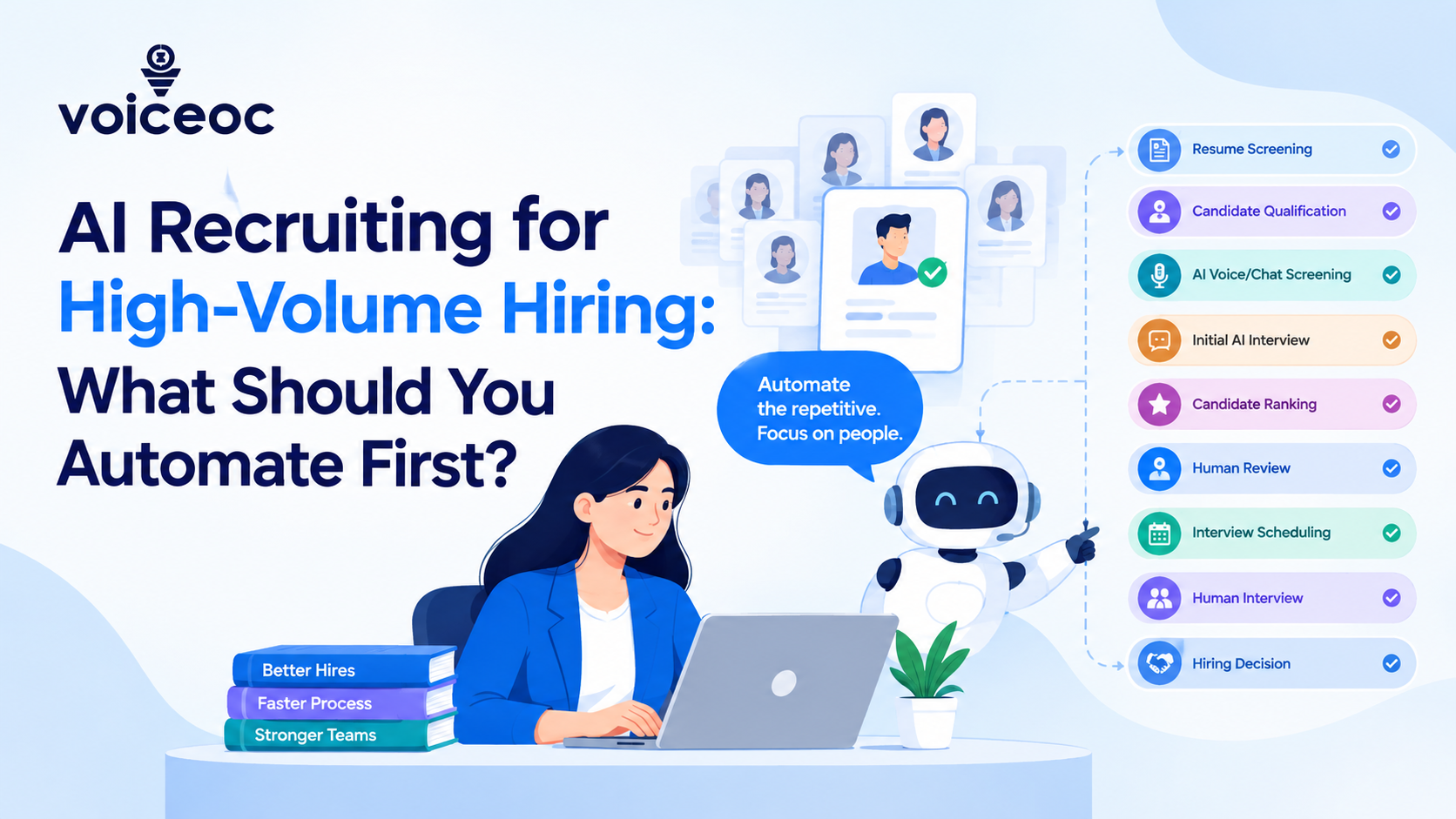
What Can You Automate With AI Recruiting Software?
AI can potentially automate or assist with several recruitment activities, including:
- Resume parsing
- Candidate screening
- Candidate matching
- Qualification questions
- Candidate sourcing
- Interview scheduling
- Initial interviews
- Candidate communication
- Interview summaries
- Recruitment follow-ups
- Candidate database updates
- Pre-joining engagement
However, not every task should be completely automated.
Recruiters should continue to review important decisions, particularly where candidate context, organizational fit, or nuanced judgment is required. Even platforms that emphasize AI automation generally position AI as a way to support recruiters rather than eliminate human oversight.
Voiceoc AI Recruiter: Automating Screening, Interviews, and Candidate Engagement
Voiceoc takes an automation-first approach to the early recruitment funnel.
Its AI Recruiter, Eva, can move candidates through multiple steps, starting with resume analysis and qualification and continuing through AI interviews and interview scheduling. It can also provide recruiters with candidate insights and support engagement after selection.
This is particularly relevant for companies receiving hundreds or thousands of applications for a role.
Instead of recruiters manually reviewing every resume and conducting every initial screening conversation, Eva can handle repetitive first-stage activities and pass relevant candidate information to the recruitment team.
Voiceoc also supports multilingual interactions, with its current product information highlighting languages including English, Hindi, Malayalam, Arabic, Tamil, and Spanish.
For companies looking for AI recruitment software that combines resume screening, voice-based candidate qualification, AI interviews, and scheduling in one workflow, Voiceoc AI Recruiter is one platform to evaluate.
Final Thoughts: Choosing the Right AI Recruiting Platform in 2026
The best and right AI recruiting software is not necessarily the platform with the largest list of features. It is the one that addresses the specific bottlenecks in your hiring process.
A startup may prioritize affordability and simplicity. A staffing firm may need an ATS, CRM, sourcing, and outreach automation. An enterprise may prioritize scalability, integrations, governance, and advanced talent intelligence.
The platforms covered in this guide approach AI recruiting differently. Voiceoc focuses on automating early-stage screening, AI voice interviews, scheduling, and candidate engagement. HireVue emphasizes assessments and video interviewing. Paradox focuses heavily on conversational hiring. Eightfold provides broader talent intelligence, while Workable combines an ATS with AI sourcing and screening. Manatal combines recruitment management with AI capabilities, iCIMS focuses on enterprise talent acquisition, and Recruiterflow targets recruitment and staffing firms.
The best approach is to identify where your recruiters spend the most time, determine which activities can realistically be automated, and then choose an AI recruiting platform that fits into your existing hiring workflow.
Frequently Asked Questions
- What is the best AI recruiting software in 2026?
The right AI recruiting software depends on your organization's hiring volume, workflow, team size, and automation requirements. Platforms such as Voiceoc AI Recruiter, HireVue, Paradox, Eightfold, Workable, Manatal, iCIMS, and Recruiterflow offer different approaches to AI-powered recruitment.
- What is the best AI recruiting software for staffing firms?
Staffing firms generally need software that combines candidate management, sourcing, matching, communication, automation, and reporting. Recruiterflow is specifically positioned as AI-native recruiting software for search and recruiting firms, while other platforms may also fit depending on the agency's workflow.
- What is the best recruiting software for startups?
Startups should look for software that is easy to implement, reasonably priced, scalable, and capable of automating time-consuming recruitment tasks. The ideal choice will depend on the startup's hiring volume and recruitment process.
- What is the best enterprise recruitment software?
Enterprise recruitment software typically needs to support large candidate volumes, multiple hiring teams, integrations, analytics, security, and complex workflows. Platforms such as iCIMS and Eightfold provide enterprise-oriented talent acquisition capabilities.
- How does AI recruiting software improve the hiring process?
AI recruiting software can reduce manual work by assisting with resume screening, candidate matching, sourcing, qualification, interviewing, scheduling, communication, and other repetitive recruitment activities.
- Can AI recruiting software automate candidate screening and interviews?
Yes. Depending on the platform, AI can screen resumes, ask qualification questions, conduct structured interviews, summarize responses, and provide recruiters with candidate insights. Voiceoc, Manatal, HireVue, Eightfold, and other platforms provide different forms of AI-assisted screening or interviewing.