Large hiring teams often manage hundreds or thousands of applications while coordinating screening calls, interviews, candidate communication, and hiring manager feedback. When these processes depend heavily on manual work, recruiters can struggle to maintain hiring speed and provide a consistent candidate experience.
This is where AI recruitment automation can make a difference. Modern recruitment platforms help organizations streamline repetitive tasks, qualify candidates, coordinate interviews, and manage recruitment workflows more efficiently.
According to SHRM's 2025 Talent Trends research, 69% of organizations reported difficulty recruiting for full-time positions, while AI adoption in HR tasks increased from 26% in 2024 to 43% in 2025.
Fill up the form today and out Voiceoc team experts will connect with you shortly!
For organizations handling high-volume recruitment, choosing the right recruitment automation tools can help reduce administrative workloads and give recruiters more time to focus on evaluating qualified candidates.
In this guide, we explore seven recruitment tools, their key capabilities, and how to choose the right AI recruitment software for your hiring team.
Why Do Large Hiring Teams Need Recruitment Automation Tools?
Recruitment becomes more complicated as application volumes increase. A process that works for ten applicants may become difficult to manage when hundreds of candidates apply for multiple positions simultaneously.
Common challenges include:
- Manual candidate screening: Reviewing resumes and checking qualifications can consume significant recruiter time.
- Interview coordination: Scheduling meetings across candidates, recruiters, and hiring managers creates administrative work.
- Delayed communication: Candidates may lose interest when they receive late responses or miss important updates.
- Inconsistent screening: Different recruiters may evaluate candidates using different questions or criteria.
- Limited recruiter capacity: Administrative tasks leave less time for candidate engagement and hiring decisions.
SHRM's 2025 recruiting benchmark reported a median time-to-fill of approximately 44 days for nonexecutive positions. Its research also found that extra-large organizations took around 61 days to fill nonexecutive roles. These figures highlight why large hiring teams need efficient, well-managed recruitment workflows.
Recruitment automation tools can help address these challenges by automating selected tasks while allowing recruiters to retain control over hiring decisions.
7 Best Recruitment Automation Tools for Large Hiring Teams
The following platforms serve different recruitment needs. Some focus on AI-powered candidate engagement, while others provide applicant tracking, structured hiring, or enterprise talent acquisition capabilities.
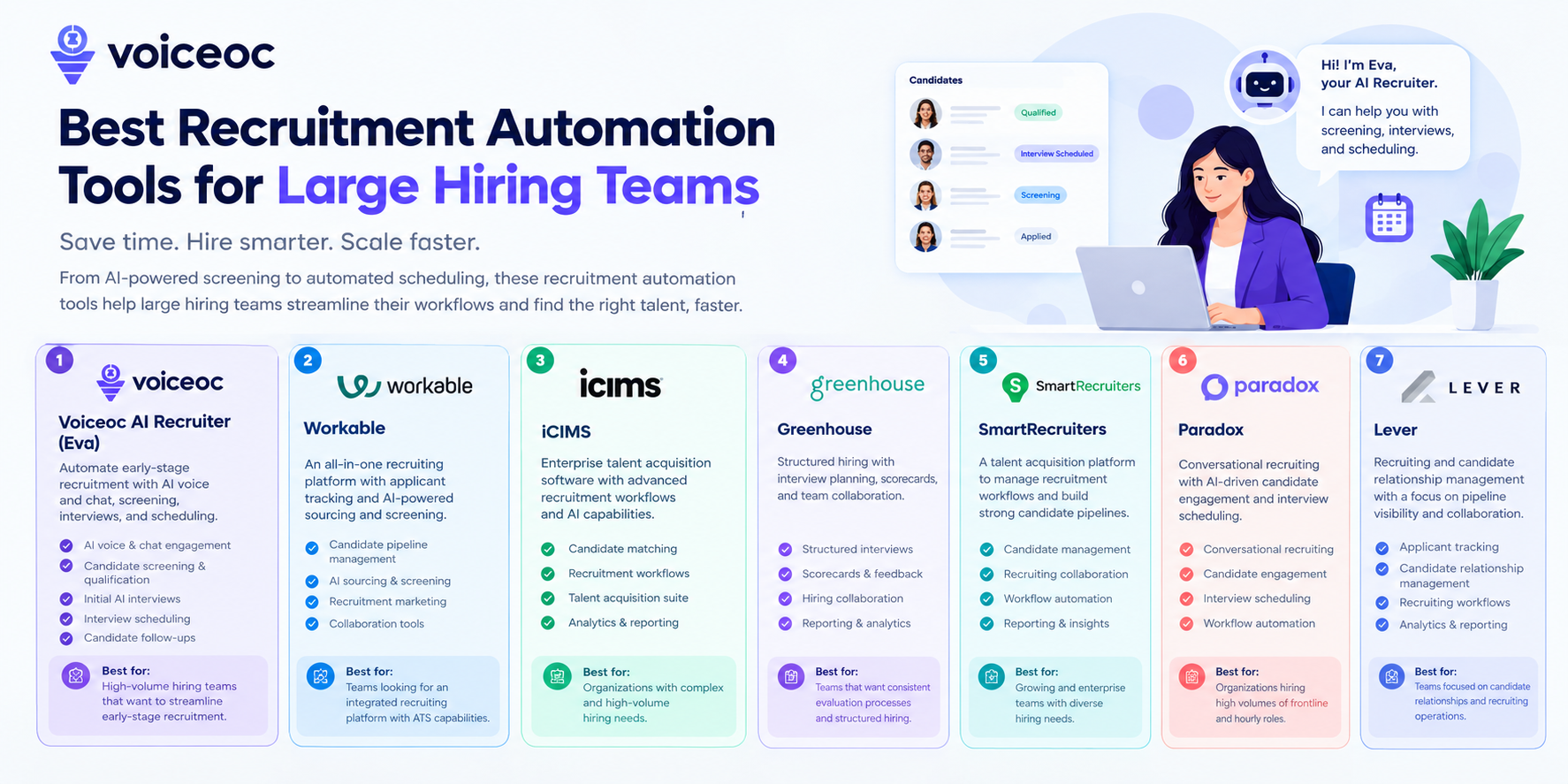
1. Voiceoc AI Recruiter (Eva)
Best for: Automating early-stage recruitment and candidate engagement.
Voiceoc offers Eva, an AI Recruiter designed to help recruitment teams streamline repetitive tasks during the initial stages of hiring.
Eva uses AI voice and chat capabilities to support candida
te engagement, screening, qualification conversations, and initial interviews. These capabilities can help recruiters manage early-stage interactions without manually conducting every initial conversation.
Key capabilities include:
- AI voice and chat-based candidate engagement.
- Candidate screening and qualification conversations.
- Initial AI interviews to gather job-related information.
- Interview scheduling support.
- Candidate follow-ups and engagement throughout relevant hiring stages.
For large hiring teams, these workflows can help reduce repetitive communication and make it easier to process candidates across multiple open positions.
For example, a company hiring customer support representatives across several locations could use an AI recruiter to conduct initial qualification conversations before recruiters review candidates for the next stage.
Eva is particularly relevant for organizations seeking to automate early-stage recruitment while keeping human recruiters involved in candidate evaluation and final hiring decisions.
Explore Voiceoc AI Recruiter (Eva) to learn how it could fit into your recruitment workflow.
Connect with Voiceoc experts and get a 30-min free consultation with us on Voiceoc Eva AI Recruiter!
2. Workable
Best for: Recruiting teams looking for an integrated hiring platform.
Workable combines recruiting and HR capabilities, including applicant tracking, candidate sourcing, and AI-supported recruitment workflows.
Its recruiting features can help teams organize applicants, manage hiring pipelines, and coordinate recruitment activities. Workable also offers AI-powered sourcing, screening, and candidate engagement capabilities.
For organizations that want to manage several recruitment activities within one platform, Workable is worth evaluating.
Large hiring teams should assess its workflow configuration, integrations, reporting, and scalability against their specific requirements.
3. iCIMS
Best for: Enterprise talent acquisition and complex hiring workflows.
iCIMS provides talent acquisition software designed to support organizations with complex recruiting requirements.
Its AI capabilities support activities such as candidate matching, sourcing, engagement, and coordination. The platform also offers recruitment workflow tools to help teams manage candidates throughout the hiring process.
Organizations recruiting across multiple departments, locations, or job categories may find iCIMS relevant when evaluating enterprise recruitment automation tools.
Before selecting the platform, assess implementation requirements, integration compatibility, and the level of automation needed for your hiring operations.
4. Greenhouse
Best for: Structured hiring and consistent candidate evaluation.
Greenhouse focuses on structured hiring and recruitment workflow management.
Its capabilities include interview planning, scorecards, hiring team collaboration, and recruitment reporting. These features help organizations establish consistent evaluation processes across recruiters and hiring managers.
For large companies hiring across multiple departments, structured interviews can make it easier to align interviewers around job-related competencies and evaluation criteria.
Greenhouse is worth considering when the primary goal is to improve hiring consistency and coordinate recruitment activities across a larger team.
5. SmartRecruiters
Best for: Organizations with extensive talent acquisition requirements.
SmartRecruiters provides talent acquisition software for managing recruitment activities and hiring workflows.
Its platform supports candidate management, recruitment collaboration, and configurable hiring processes. These capabilities can help organizations coordinate recruitment across different teams and business units.
Enterprises evaluating recruitment automation tools should consider how well SmartRecruiters fits their existing systems, hiring processes, reporting needs, and organizational structure.
It may be particularly relevant for businesses looking to manage recruitment operations through a centralized talent acquisition platform.
6. Paradox
Best for: Conversational recruiting and high-volume candidate engagement.
Paradox focuses on conversational recruiting and candidate interactions.
Its recruiting assistant, Olivia, supports conversational workflows that help candidates engage with employers and complete relevant recruitment steps. The platform is particularly associated with candidate communication and interview scheduling automation.
For organizations hiring large numbers of frontline, hourly, or other high-volume roles, conversational recruitment can help reduce the friction associated with initial candidate interactions.
Teams should evaluate its integration with their applicant tracking system and determine whether its capabilities address their specific hiring bottlenecks.
7. Lever
Best for: Recruitment pipeline management and candidate relationships.
Lever combines applicant tracking and candidate relationship management capabilities.
The platform helps recruiting teams manage candidate pipelines, organize hiring activities, and maintain relationships with prospective applicants.
For large hiring teams, these capabilities can support better visibility into recruitment pipelines and help recruiters coordinate their work across multiple open positions.
Lever is worth evaluating when candidate relationship management, pipeline visibility, and recruitment workflow organization are major priorities.
Key Features to Look for in AI Recruitment Software
Not every recruitment platform automates the same activities. Before choosing a solution, identify the tasks that consume the most time and evaluate whether the software can address them.
1. Automated Candidate Screening
Look for tools that help recruiters evaluate applications against job-related qualifications and screening criteria. Screening support should improve workflow efficiency without relying on unverified assumptions about candidates.
2. AI Voice and Chat Interviews
AI-powered conversations can support initial candidate qualification and collect relevant information before a recruiter interview. Evaluate whether the platform supports the communication channels and interview workflows your organization needs.
3. Interview Scheduling Automation
Scheduling features should reduce manual coordination between candidates and hiring teams. Calendar integrations, availability management, and reminders can help simplify this process.
4. Candidate Communication
Automated updates, reminders, and follow-ups can help candidates understand the next steps in the recruitment process and reduce communication gaps.
5. Integrations and Reporting
Check whether the platform integrates with your existing applicant tracking system, HR software, and scheduling tools. Recruitment reporting should help you monitor application processing, interview progress, and hiring outcomes.
6. Responsible AI and Human Oversight
Evaluate data privacy, accessibility, bias monitoring, and human review capabilities. AI should support job-related assessment rather than independently determine who gets hired without appropriate oversight.
How to Choose the Right Recruitment Automation Tools?
The best solution depends on your organization's hiring volume, existing technology, and recruitment priorities.
Use these considerations when comparing platforms:
- Assess hiring volume: Estimate monthly applications, screening conversations, and interviews.
- Identify bottlenecks: Determine whether screening, communication, scheduling, or pipeline management creates the most delays.
- Check integrations: Confirm compatibility with your current ATS, HR systems, and calendars.
- Evaluate scalability: Choose a solution that can accommodate additional roles, locations, and recruitment teams.
- Consider candidate experience: Ensure automated communication is clear, accessible, and easy to navigate.
- Review security and governance: Understand how candidate data is processed, retained, and protected.
- Measure business value: Compare implementation and subscription costs against measurable improvements in recruiter productivity and hiring operations.
For example, a company receiving thousands of applications may prioritize screening and candidate engagement automation. An organization struggling with inconsistent interviews may place greater emphasis on structured evaluation and hiring manager collaboration.
The right AI recruitment software should solve a clearly defined problem rather than introduce automation that your team does not need.
How AI Recruitment Automation Works in Practice?
A large hiring team can use AI recruitment automation to support a structured hiring workflow:
- Application collection: Candidates submit applications through the company's recruitment system.
- Initial screening: Applications are reviewed against relevant job requirements.
- Candidate qualification: Voice or chat interactions gather additional job-related information.
- Initial interviews: AI supports predefined interview workflows where appropriate.
- Recruiter review: Recruiters assess the collected information and determine which candidates progress.
- Interview scheduling: Qualified candidates are coordinated with recruiters and hiring managers.
- Candidate updates: Automated communication helps candidates stay informed about next steps.
Tools such as Eva by Voiceoc can support early-stage candidate engagement, qualification, and initial interview workflows. The exact process depends on the organization's requirements and the capabilities enabled in its recruitment system.
Human recruiters remain essential for contextual judgment, assessing complex situations, and making final hiring decisions.
Benefits of Recruitment Automation for Enterprises
When implemented thoughtfully, recruitment automation can offer several operational benefits:
- Reduced administrative workload: Recruiters spend less time on repetitive coordination and communication.
- More efficient early-stage screening: Teams can process initial candidate interactions through structured workflows.
- Consistent recruitment processes: Standardized questions and criteria can help align screening activities.
- Improved candidate communication: Timely updates and reminders help candidates navigate the hiring process.
- Greater recruiter capacity: Recruiters can devote more attention to qualified candidates and hiring managers.
- Better process visibility: Recruitment metrics help teams identify delays and opportunities for improvement.
Results vary by organization, hiring volume, implementation quality, and workflow design. Businesses should establish baseline metrics before introducing automation so they can evaluate its actual impact.
Frequently Asked Questions
- What are the best recruitment automation tools for large hiring teams?
Voiceoc AI Recruiter, Workable, iCIMS, Greenhouse, SmartRecruiters, Paradox, and Lever are options to evaluate based on your hiring workflows, automation requirements, and existing systems.
- How does AI recruitment automation work?
AI recruitment automation uses software to support tasks such as candidate screening, qualification conversations, initial interviews, scheduling, and candidate communication.
- What features should AI recruitment software include?
Important features include screening support, AI voice or chat interactions, interview scheduling, candidate communication, integrations, reporting, and responsible AI controls.
- Can recruitment automation replace human recruiters?
No. Automation can reduce repetitive work, but recruiters remain important for candidate relationships, contextual evaluation, complex decisions, and final hiring decisions.
Conclusion
Large hiring teams need efficient workflows to manage growing application volumes without compromising candidate experience or hiring quality. The right recruitment automation tools can help streamline screening, candidate communication, interview coordination, and other repetitive activities.
When comparing AI recruitment software, consider your hiring volume, integration requirements, scalability, security, and need for human oversight.
For organizations looking to automate early-stage recruitment, Voiceoc AI Recruiter (Eva) offers voice-based and chat-based candidate engagement, screening, qualification, and initial interview capabilities.
Explore Voiceoc to learn more about Eva and determine whether its recruitment automation capabilities fit your hiring needs.