Hiring 100, 500, or even thousands of employees in a short period creates a very different challenge from filling a few open positions. Recruitment teams have to process large numbers of applications, identify qualified candidates, conduct initial screening, schedule interviews, answer candidate questions, and keep applicants informed throughout the process.
When all of this work is handled manually, recruiters can quickly become overloaded.
This is where AI recruiting for high-volume hiring can make a measurable difference. Instead of replacing recruiters, AI recruitment software can take over repetitive, time-consuming tasks and allow hiring teams to focus on candidate evaluation, relationship building, and final hiring decisions.
But not every recruitment task needs to be automated immediately.
The better approach is to identify the stages where automation can remove the most repetitive work while maintaining a human touch where it matters.
In this guide, we'll explore what to automate first in high-volume recruiting, how an AI recruiter can support the hiring workflow, and where Voiceoc AI Recruiter fits into the process.
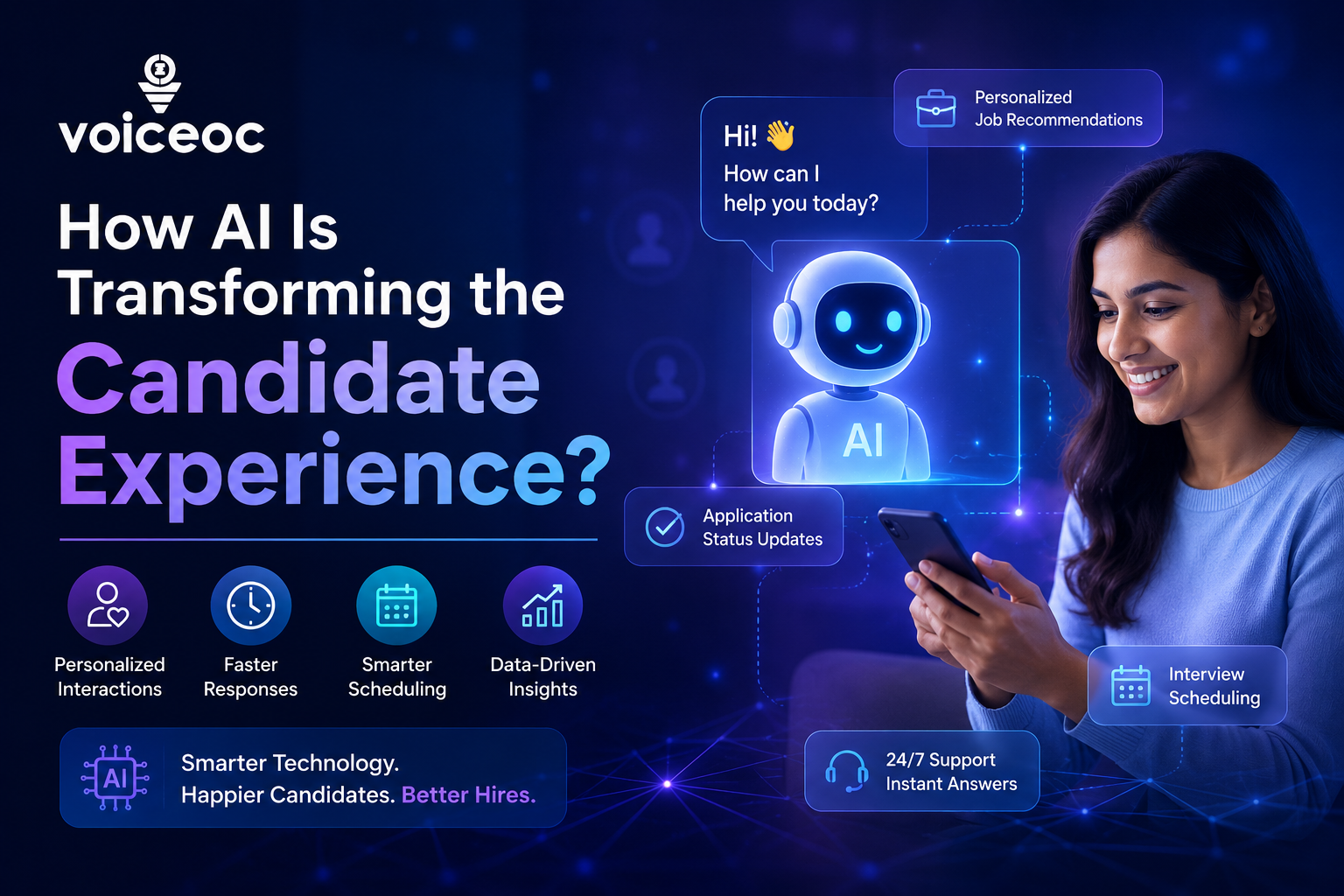
Also Read: How AI is Transforming the Candidate Experience for Better Employment?
What Is High-Volume Recruiting?
High-volume recruiting refers to hiring a large number of candidates for one or multiple positions within a relatively short period.
It is common in industries and organizations hiring for roles such as:
- Customer service representatives
- Sales professionals
- Retail employees
- Healthcare staff
- Delivery and logistics workers
- Hospitality employees
- Manufacturing workers
- IT and support roles
- Entry-level positions
- Seasonal and temporary workers
The challenge isn't simply receiving more applications. It is managing every stage of the candidate journey efficiently.
For example, a company hiring 100 employees may receive thousands of applications. Recruiters need to review those applications, identify candidates who meet basic requirements, conduct screening conversations, schedule interviews, and maintain communication with applicants.
Doing every step manually can create bottlenecks.
AI recruitment software helps recruitment teams increase their capacity by automating repetitive activities while allowing recruiters to remain responsible for important hiring decisions.
Why High-Volume Hiring Is Difficult for Recruitment Teams?
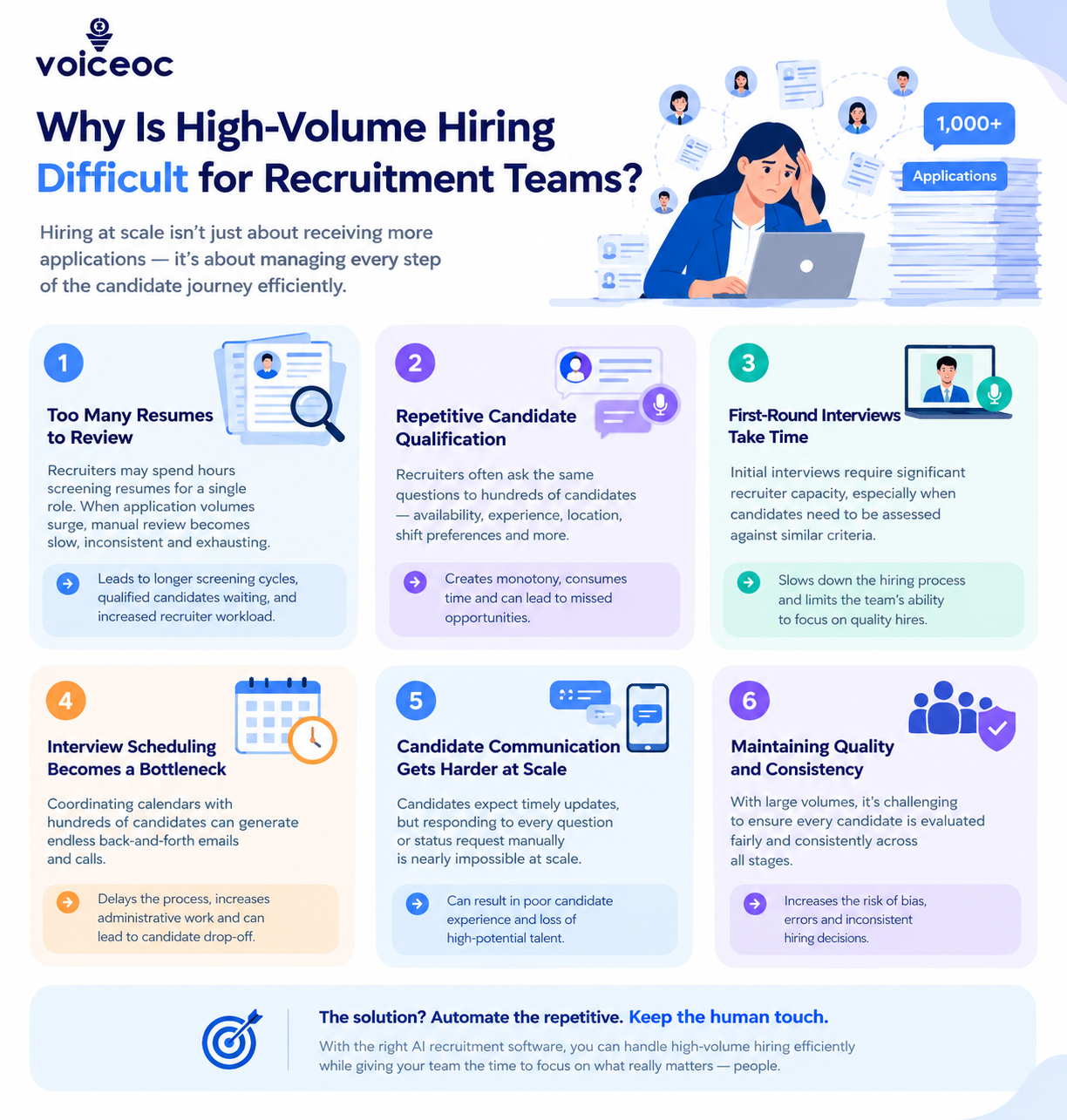
High-volume recruitment creates several operational challenges.
1. Too Many Resumes to Review
Recruiters may spend hours reviewing resumes for a single position. When application volumes increase, manually checking every resume becomes difficult to sustain.
The result can be:
- Longer screening cycles
- Recruiter workload increases
- Qualified candidates waiting longer
- Inconsistent screening
- Candidate drop-off
AI-powered resume screening can help recruiters process applications against predefined job requirements and identify candidates who meet the basic criteria.
2. Repetitive Candidate Qualification
Many recruitment processes require recruiters to ask the same questions repeatedly.
For example:
- Are you available to work full-time?
- How many years of experience do you have?
- Are you comfortable working remotely?
- What is your current location?
- When can you start?
- Are you comfortable with the required shift?
These conversations are important, but they are also repetitive.
An AI recruiter can handle these initial qualification conversations and collect structured information before a recruiter becomes involved.
3. First-Round Interviews Take Time
Initial interviews can consume a significant amount of recruiter capacity, particularly when candidates need to be assessed against similar criteria.
AI voice agents can conduct structured first-round interviews based on predefined questions and evaluation criteria.
Recruiters can then review the collected responses rather than conducting every initial conversation themselves.
4. Interview Scheduling Becomes a Bottleneck
Scheduling may seem like a small administrative task, but at scale it can generate hundreds of messages and emails.
Candidates and recruiters may exchange multiple messages simply to find a suitable time.
Automated interview scheduling can reduce this back-and-forth and allow candidates to select available interview slots.
5. Candidate Communication Gets Harder at Scale
Candidates expect timely communication.
However, when recruiters are managing hundreds or thousands of applicants, responding individually to every question or status request becomes challenging.
This is another area where AI recruitment automation can support hiring teams.
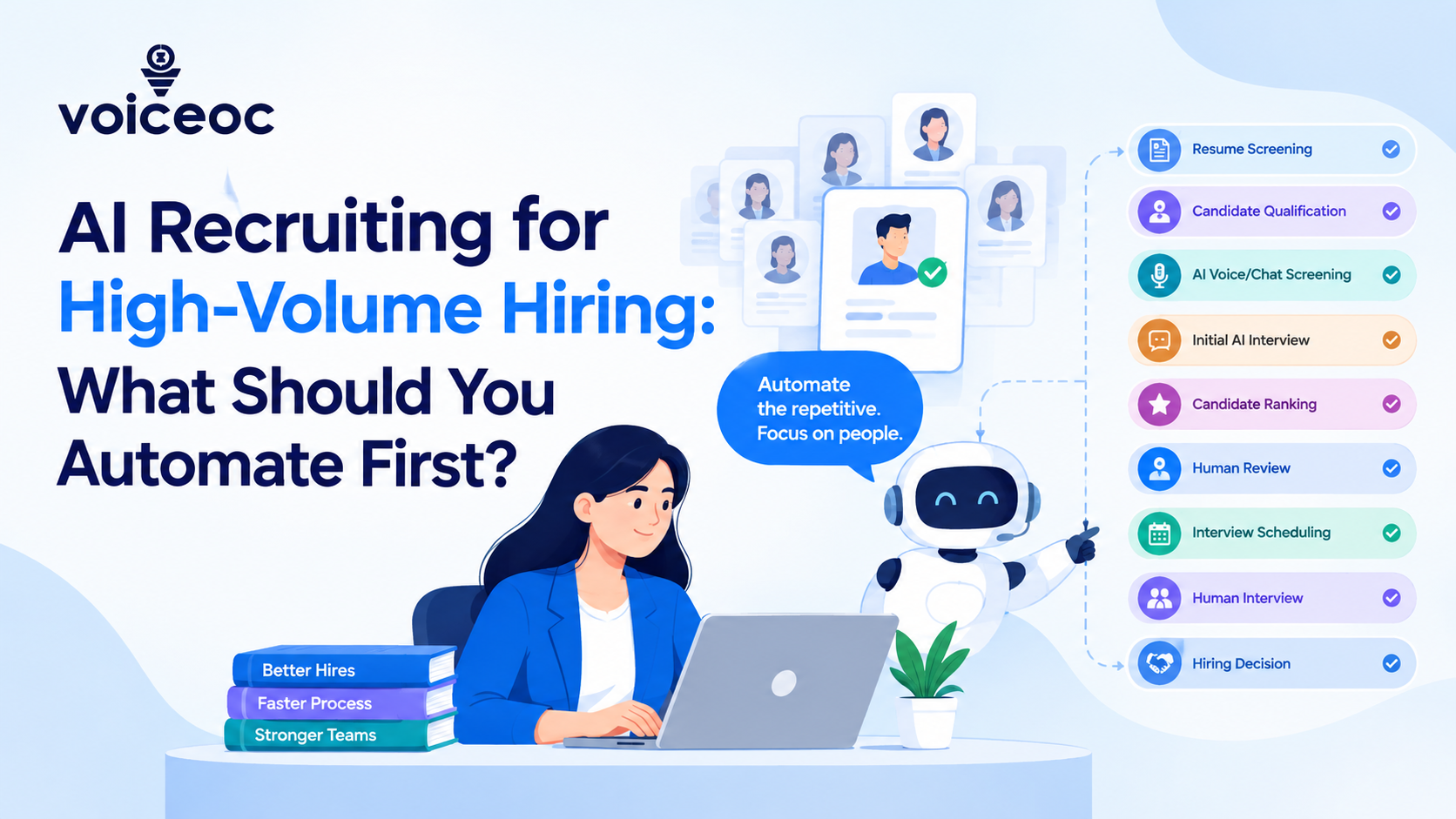
What Should You Automate First in High-Volume Hiring?
The key to successful recruitment automation is not automating everything at once.
Start with the activities that are:
- Highly repetitive
- Time-consuming
- Rules-based or structured
- Easy to measure
- Frequent enough to create a bottleneck
Here are the recruitment stages that are typically strong candidates for automation.
1. Resume Screening
Resume screening is one of the first areas recruitment teams can consider automating.
Instead of manually reviewing every application, AI recruitment software can analyze resumes against predefined requirements.
Depending on the system and configuration, this can include factors such as:
- Relevant skills
- Work experience
- Education
- Certifications
- Location
- Years of experience
- Job-specific qualifications
The goal isn't necessarily to make the hiring decision automatically.
Instead, AI can help recruiters organize a large applicant pool and bring potentially relevant candidates to their attention faster.
This becomes especially useful when a company receives thousands of applications for a single hiring campaign.
2. Candidate Pre-Screening
Once applications have been reviewed, the next step is often candidate qualification.
An AI recruiter can communicate with candidates through channels such as voice or chat and ask predefined qualification questions.
For example, a company hiring customer support representatives might want to understand:
- Previous customer service experience
- Language proficiency
- Work availability
- Shift preferences
- Location
- Notice period
- Salary expectations
Rather than having recruiters conduct hundreds of similar conversations, an AI recruiter can handle the initial interaction and collect the responses.
Recruiters can then focus their time on candidates who meet the required criteria.
3. AI Voice Interviews
For high-volume hiring, first-round interviews can become one of the biggest capacity constraints.
An AI voice recruiter can conduct structured interviews with candidates at scale.
For example, candidates could receive an automated voice interview covering questions related to:
- Role-specific experience
- Communication skills
- Availability
- Situational responses
- Technical knowledge
- Job requirements
A structured approach can also help recruitment teams maintain greater consistency across initial screening conversations.
Human recruiters can remain involved in reviewing responses and deciding which candidates should move forward.
4. Interview Scheduling
Once candidates qualify for the next stage, scheduling should be another automation priority.
Instead of recruiters manually coordinating calendars, an automated recruitment workflow can allow candidates to select from available interview slots.
This can reduce:
- Email exchanges
- Phone calls
- Scheduling delays
- Missed communication
- Administrative workload
For high-volume recruitment, saving a few minutes per candidate can add up quickly.
If a team schedules interviews with hundreds of candidates, even small reductions in manual work can create substantial time savings.
5. Candidate FAQs and Status Questions
Recruiters often receive repetitive candidate questions throughout the hiring process.
Examples include:
“What is the job location?”
“What are the working hours?”
“When will my interview take place?”
“What documents do I need?”
“What happens after the interview?”
An AI chat assistant can provide responses to common questions based on approved recruitment information.
This gives candidates access to information without requiring recruiters to answer the same questions repeatedly.
6. Candidate Follow-Ups
Candidate communication shouldn't stop after an application or interview.
Recruitment teams may need to send:
- Interview reminders
- Application updates
- Next-step instructions
- Document requests
- Interview confirmations
- Selection notifications
- Pre-joining communication
These workflows can often be automated using predefined triggers.
This is particularly useful in high-volume recruitment, where manually tracking every candidate's status can become difficult.
What Should Stay Human?
Automation doesn't mean removing recruiters from the hiring process.
Some parts of recruitment benefit significantly from human involvement.
Final Candidate Evaluation
Recruiters and hiring managers should remain involved in important hiring decisions.
AI can organize information and support screening, but organizations should establish appropriate human oversight before making employment decisions.
Complex Candidate Conversations
Candidates may have questions or circumstances that require context, judgment, or empathy.
These situations are better handled by a human recruiter.
Relationship Building
Recruitment isn't only about identifying qualified applicants.
Strong candidates may have multiple opportunities available to them, making communication and relationship building important parts of the hiring process.
Final Interviews and Hiring Decisions
For many organizations, AI can support the earlier stages while human recruiters and hiring managers handle deeper interviews and final decisions.
The most practical model is often AI-assisted recruitment rather than fully automated hiring.
How Voiceoc AI Recruiter Supports High-Volume Hiring?
Voiceoc AI Recruiter is designed to help recruitment teams automate repetitive stages of the hiring workflow.
The platform combines AI voice agents, AI chat assistants, and recruitment workflow automation to support candidate interactions at scale.
For a high-volume hiring campaign, the workflow can look like this:
Step 1: Applications Enter the Pipeline
Candidates submit their resumes or applications through the organization's recruitment process.
Step 2: AI Helps Screen Applications
Candidate information can be evaluated against predefined job requirements to help recruiters identify potentially relevant applicants.
Step 3: AI Qualifies Candidates
Voiceoc AI Recruiter can engage candidates through AI-powered voice and chat interactions to collect information required for initial qualification.
Step 4: AI Conducts Initial Interviews
Qualified candidates can move into structured first-round AI voice interviews.
This allows recruitment teams to expand screening capacity without requiring recruiters to conduct every initial interview manually.
Step 5: Candidates Are Scheduled
Candidates who meet the relevant criteria can move toward the next stage, with interview scheduling automated as part of the recruitment workflow.
Step 6: Recruiters Review and Take Over
Recruiters can focus on candidates who have progressed through the automated stages and take over for the human-led stages of the process.
This creates a workflow where AI handles repetitive tasks while recruiters remain involved where human judgment and interaction are most important.
A Practical High-Volume AI Recruitment Workflow
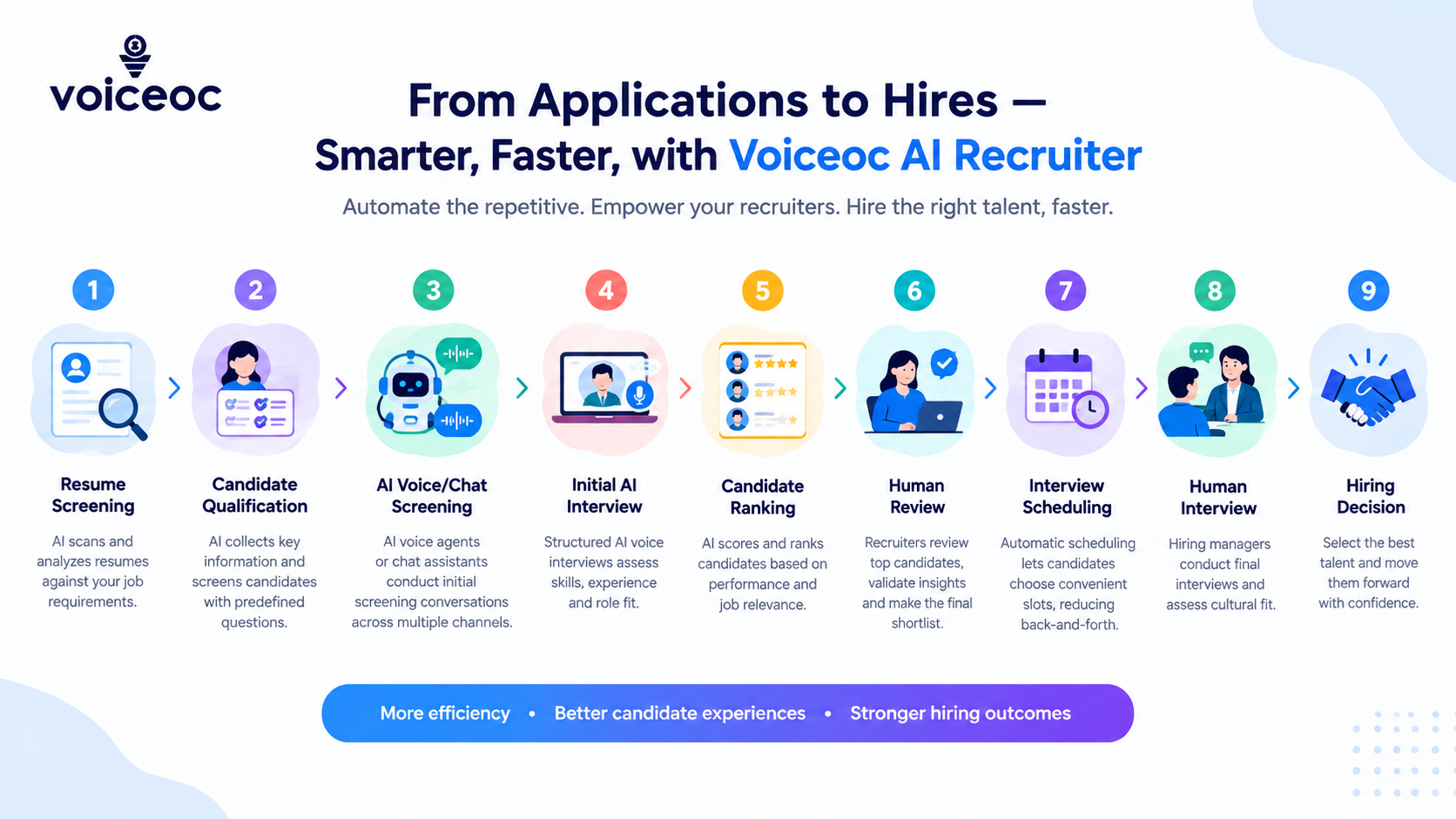
A simplified AI-powered recruitment workflow could look like this:
Applications → Resume Screening → Candidate Qualification → AI Voice Screening → First-Round Interview → Candidate Evaluation → Interview Scheduling → Human Interview → Hiring Decision → Pre-Joining Engagement
The exact workflow will depend on the organization's hiring requirements, systems, compliance obligations, and role complexity.
The important principle is to automate the repetitive stages first.
How to Decide What to Automate?
Before implementing AI recruitment automation, recruitment teams should examine their existing process.
Ask:
Where are recruiters spending the most time?
If recruiters spend several hours every day reviewing resumes or making qualification calls, those activities may be strong candidates for automation.
Which tasks are repetitive?
If recruiters ask the same questions to hundreds of candidates, automation can potentially reduce that workload.
Where are candidates waiting?
Look for delays between application, screening, interviews, and scheduling.
Which tasks have clear rules?
Structured processes are generally easier to automate than tasks requiring nuanced human judgment.
What should be measured?
Define metrics before implementing automation.
Potential metrics include:
- Time-to-screen
- Time-to-interview
- Time-to-hire
- Application-to-interview conversion
- Candidate response rate
- Interview completion rate
- Recruiter hours saved
- Candidate drop-off rate
- Cost per hire
These metrics can help teams understand whether automation is improving the recruitment process.
AI Recruiting Doesn't Mean Replacing Recruiters
One of the biggest misconceptions about AI recruitment is that automation is designed to eliminate recruiters.
In practice, recruitment teams can use AI to redistribute their time.
Instead of spending most of their day on repetitive screening calls, resume reviews, scheduling, and candidate FAQs, recruiters can spend more time on activities that require human involvement.
For example:
AI handles:
Resume processing → Initial qualification → Repetitive screening → Interview scheduling → Candidate FAQs → Routine follow-ups
Recruiters handle:
Candidate relationships → Complex conversations → Detailed evaluation → Hiring manager collaboration → Final interviews → Hiring decisions
This division of responsibilities can create a more scalable recruitment operation.
The Future of High-Volume Recruiting
As hiring volumes increase, recruitment teams need ways to scale their processes without simply increasing administrative workload.
AI recruitment software is becoming part of that conversation because it can support repetitive activities across the candidate journey.
The opportunity isn't necessarily to automate recruitment from beginning to end.
Instead, organizations can identify the stages where automation creates the most value and introduce AI while maintaining appropriate human oversight.
For high-volume hiring, that often means starting with resume screening, candidate qualification, initial interviews, scheduling, communication, and follow-ups.
As the technology and workflows mature, AI can become a larger part of the recruitment infrastructure while recruiters continue to guide the decisions that require human context.
Final Thoughts
High-volume hiring becomes difficult when every candidate interaction requires manual effort.
The answer isn't always to hire more recruiters. In many cases, recruitment teams can first examine which repetitive activities can be automated.
AI recruiting for high-volume hiring can help organizations process applications faster, conduct initial candidate interactions at scale, automate scheduling, and maintain communication throughout the hiring journey.
With Voiceoc AI Recruiter, organizations can bring AI voice agents, AI chat assistants, candidate screening, interview automation, scheduling, and recruitment workflows into a more connected process.
The goal is simple: let AI handle repetitive recruitment work while recruiters focus on people, decisions, and the hiring outcomes that matter.