Hiring at scale sounds like a good problem to have. More applications mean more potential candidates, more choices, and a better chance of finding the right talent. But for recruitment teams managing hundreds or even thousands of applications, the reality is often very different.
Recruiters spend hours reviewing resumes, contacting applicants, asking basic screening questions, coordinating interviews, and following up with candidates. While these activities are necessary, they can slow down the entire hiring process.
And there is another problem: good candidates do not always wait.
A qualified applicant who applies today may receive an interview invitation from another company tomorrow. If your recruitment process takes several days just to complete the initial screening, you could lose candidates before your team even gets a chance to speak with them.
This is where high-volume recruitment automation becomes important.
With the right AI recruitment software and automation workflows, companies can manage large application volumes, screen candidates faster, improve communication, and keep their hiring process moving without compromising the candidate experience.
But automation should not mean removing people from recruitment. It should mean giving recruiters more time to focus on the conversations and decisions that actually matter.
Let's explore how companies can automate high-volume recruitment in 2026 without losing their best candidates.
Why Is High-Volume Recruitment Becoming More Challenging in 2026?
High-volume hiring requires recruitment teams to manage multiple applications, vacancies, and candidate interactions simultaneously. This is particularly common in industries such as retail, healthcare, hospitality, banking, customer support, logistics, and IT services.
For example, imagine a company hiring 100 customer support executives across multiple locations.
The recruitment team receives 2,000 applications. Every applicant needs to be reviewed, qualified, contacted, and potentially scheduled for an interview.
Managing this process manually creates several challenges.
1. Managing too many applications
Recruiters often receive more resumes than they can realistically review in a short period. Finding candidates who meet the job requirements becomes increasingly difficult when applications continue arriving.
2. Delayed candidate communication
Candidates expect timely updates after applying. When recruiters are occupied with other tasks, messages and follow-ups can get delayed.
3. Repetitive screening activities
Recruiters repeatedly ask similar questions about experience, availability, qualifications, salary expectations, and job preferences. These conversations take valuable time.
4. Interview scheduling difficulties
Coordinating availability between candidates and hiring managers can involve several messages, emails, and reminders.
5. Candidate drop-offs
Long waiting periods and poor communication can cause qualified candidates to lose interest or accept opportunities elsewhere.
The challenge is not simply finding more candidates. It is managing the entire recruitment journey efficiently.
Where Do Traditional Recruitment Processes Fail?
Traditional recruitment processes often depend heavily on manual coordination.
A typical hiring workflow looks like this:
- A company publishes a job opening.
- Applications start coming in.
- Recruiters manually review resumes.
- Shortlisted candidates receive calls or emails.
- Recruiters conduct initial screening conversations.
- Qualified applicants move to the interview stage.
- Interviews are scheduled manually.
- Recruiters follow up with candidates and hiring managers.
While this process works for smaller hiring requirements, it becomes difficult to manage when application volumes increase.
Consider a recruiter handling 500 applications for multiple open positions. Even if each resume takes just a few minutes to review, the time required adds up quickly.
The same problem continues throughout the hiring process. Recruiters spend time contacting candidates, checking availability, answering common questions, and coordinating interviews instead of focusing on candidate evaluation.
This is why businesses are increasingly exploring recruitment automation tools that can handle repetitive activities and support recruiters throughout the hiring funnel.
How to Automate High-Volume Recruitment Without Losing Candidates?
Recruitment automation works best when it supports every important stage of the hiring process rather than focusing on just one activity.
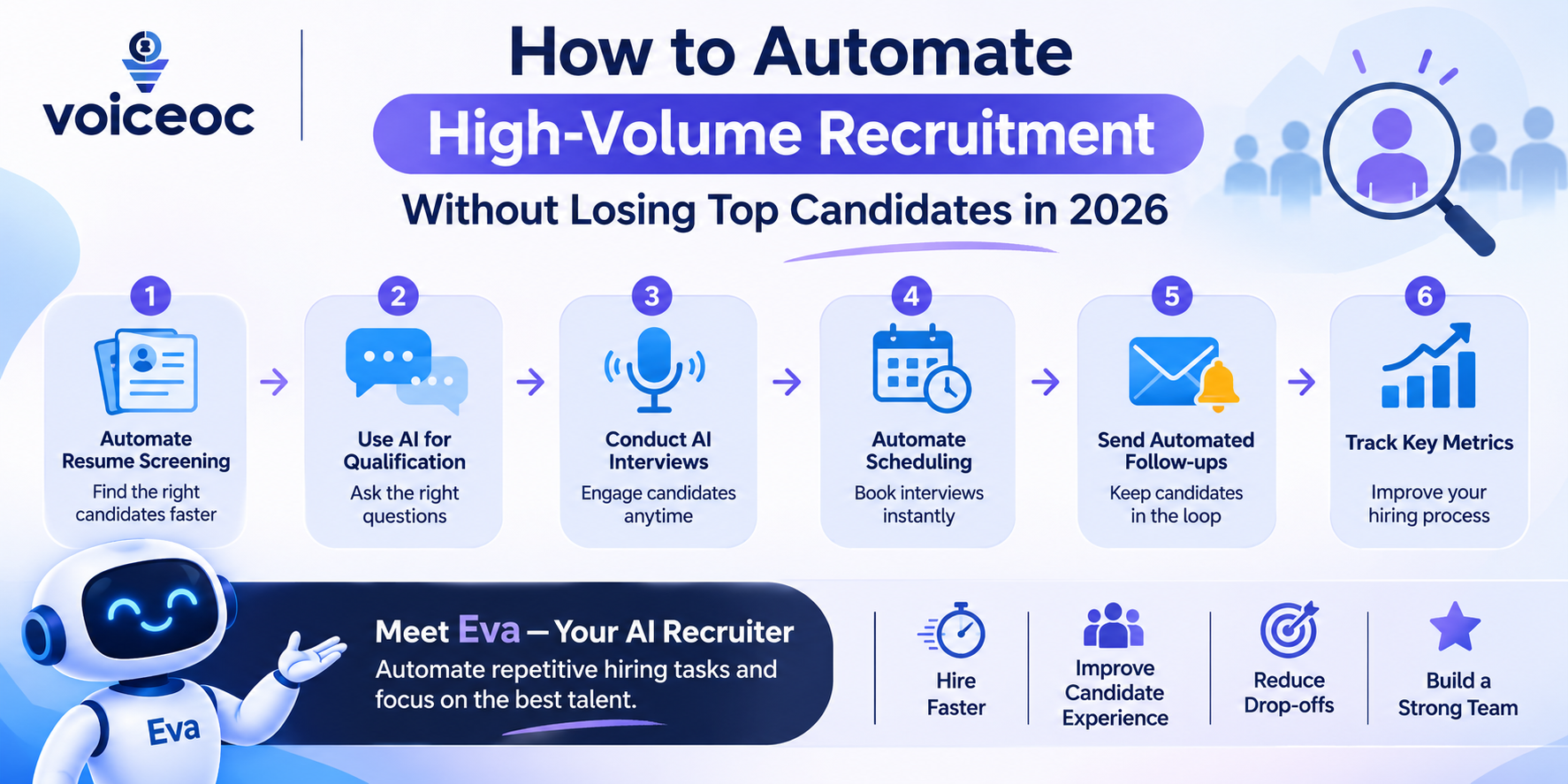
Here are six practical ways companies can automate high-volume recruitment while maintaining a positive candidate experience.
1. Automate Resume Screening and Candidate Shortlisting
Resume screening is often one of the most time-consuming stages of high-volume recruitment.
When hundreds of applications arrive for a single position, recruiters need to identify which candidates match the job requirements before moving forward.
AI-powered resume screening tools can help automate this initial review.
These systems can analyse candidate information against predefined job requirements, including:
- Relevant work experience
- Educational qualifications
- Technical and professional skills
- Industry experience
- Certifications
- Other role-specific requirements
Based on these criteria, recruitment teams can organise applications and identify candidates who may be suitable for further evaluation.
However, automated screening should not be treated as the final hiring decision. Recruiters should be able to review candidate profiles, understand screening results, and account for relevant experience that automated systems might overlook.
Why it matters: Automated candidate screening reduces repetitive resume review and helps recruiters move qualified applicants to the next stage sooner.
2. Use AI for Initial Candidate Qualification
A resume may tell you what a candidate has done, but it does not always answer whether they are suitable for a particular role.
For example, a recruiter hiring sales executives may need to understand:
- How much relevant sales experience does the candidate have?
- Are they comfortable with the required working hours?
- Can they join within the expected timeframe?
- Are they comfortable with the offered location?
- Do they have experience meeting sales targets?
Calling every applicant individually to collect this information can take considerable time.
This is where AI recruitment software can support the qualification process.
AI-powered voice and chat assistants can interact with candidates, ask predefined job-related questions, and collect structured responses.
Recruiters can then review the collected information and identify candidates who meet the initial requirements.
The advantage is simple: instead of spending hours asking the same questions repeatedly, recruiters receive organised candidate information that helps them decide whom to contact next.
3. Introduce AI Voice and Chat Interviews
One of the biggest challenges in high-volume recruitment is connecting with candidates at the right time.
Recruiters generally work within fixed business hours, but candidates may be available in the evenings, during weekends, or outside regular office timings.
This can create unnecessary delays.
AI voice interviews and chat-based screening offer another way to engage candidates.
AI voice agents can conduct initial screening conversations, ask relevant questions, and capture candidate responses. Chat assistants can help candidates interact through messaging channels and receive answers to common recruitment-related questions.
These capabilities can support:
- Initial candidate screening
- Basic qualification conversations
- Role-related questions
- Candidate information collection
- First-round structured interviews
- After-hours candidate engagement
For example, a candidate applying for a customer support position could complete an initial voice screening conversation without waiting for a recruiter to become available.
The recruitment team can then review the responses and decide whether the candidate should progress.
The important point is that AI should support the early stages of recruitment while human recruiters remain involved in meaningful candidate assessments and final decisions.
4. Automate Interview Scheduling and Reminders
Scheduling interviews sounds simple until recruiters need to coordinate multiple candidates and hiring managers.
A recruiter may have to send availability requests, wait for responses, suggest alternative time slots, confirm appointments, and send reminders.
When hiring volumes increase, these small tasks create a significant administrative workload.
Interview scheduling automation helps reduce this back-and-forth communication.
With an automated workflow, recruitment teams can:
- Collect candidate availability.
- Coordinate interview slots.
- Send interview confirmations.
- Share interview details.
- Send automated reminders.
- Communicate schedule changes.
Automated reminders are particularly useful because missed interviews create additional work for recruiters and delay hiring decisions.
By simplifying interview coordination, companies can keep candidates informed and help the hiring process move forward.
5. Improve Candidate Engagement With Automated Follow-Ups
A candidate's experience does not end after submitting an application.
They want to know whether their application has been received, what happens next, and whether they have progressed to the next stage.
Unfortunately, candidate communication is often one of the first things to suffer when recruitment teams become busy.
This can leave applicants waiting without any information about their status.
AI-powered candidate engagement tools can help maintain communication throughout the recruitment journey.
For example, automated assistants can:
- Acknowledge applications.
- Answer frequently asked recruitment questions.
- Share interview instructions.
- Send interview reminders.
- Provide relevant process updates.
- Collect additional candidate information.
Automated communication should be timely, relevant, and transparent. Candidates should also have a way to contact a human recruiter when they need assistance.
A well-managed communication process helps candidates feel informed rather than forgotten.
6. Use Recruitment Analytics to Identify Bottlenecks
Automating recruitment activities is only part of the solution. Companies also need to understand whether their hiring process is actually improving.
Recruitment analytics can help identify where candidates are getting delayed or dropping out.
Some important recruitment metrics to monitor include:
- Time-to-hire: The time taken to complete the hiring process.
- Time-to-screen: How long it takes to complete initial candidate screening.
- Application-to-interview conversion rate: The percentage of applicants progressing to interviews.
- Candidate drop-off rate: The percentage of candidates who leave the recruitment process.
- Interview attendance rate: The percentage of scheduled interviews candidates attend.
- Recruiter productivity: The number of applications or candidates managed by the recruitment team.
For example, if a company receives plenty of applications but very few candidates attend interviews, the problem may not be sourcing. It could be delayed communication, poor qualification, or scheduling difficulties.
Tracking these metrics helps recruitment teams make informed improvements instead of automating processes without understanding their actual problems.
How Does AI Recruitment Software Improve Hiring Efficiency?
The real value of AI recruitment software comes from connecting different recruitment activities into a smoother workflow.
Instead of managing screening, candidate communication, and interview coordination through disconnected manual processes, businesses can use automation to support multiple stages of hiring.
Here are some of the key benefits.
Faster initial screening
AI-powered screening workflows help recruitment teams process applications and collect candidate information more efficiently.
Reduced administrative workload
Automating repetitive conversations, reminders, and coordination tasks gives recruiters more time for important hiring activities.
Better candidate communication
Candidates can receive timely responses and updates without depending entirely on recruiter availability.
Consistent qualification processes
Predefined questions and structured screening workflows help teams follow a more consistent initial evaluation process.
Improved recruiter productivity
Recruiters can focus more on evaluating suitable candidates, conducting meaningful interviews, and making hiring decisions.
Better hiring visibility
Recruitment analytics help teams understand performance across different stages and identify areas that need improvement.
However, choosing the right recruitment automation tools is important. Businesses should look beyond basic automation and evaluate whether a platform supports their hiring volume, communication requirements, workflows, and existing recruitment systems.
How Can Companies Maintain the Human Touch in Automated Recruitment?
One concern businesses often have about recruitment automation is whether it will make hiring feel impersonal.
This is a valid concern.
Candidates do not want to feel like they are communicating with a system that cannot understand their questions or concerns.
The solution is not to avoid automation. It is to use it thoughtfully.
Here are a few ways to maintain a positive candidate experience.
Keep human recruiters involved in important decisions.
AI can support initial screening and qualification, but hiring decisions should involve appropriate human oversight.
Make communication clear and transparent.
Candidates should know when they are interacting with an AI assistant and understand what happens after each stage.
Provide access to human assistance.
For complex questions, concerns, or special circumstances, candidates should be able to connect with a recruiter.
Use structured and relevant screening questions.
Questions should be related to the role and should give candidates a fair opportunity to demonstrate their suitability.
Review automated screening outcomes.
Recruitment teams should regularly evaluate screening criteria for accuracy, consistency, and potential bias.
The goal is to let technology handle repetitive tasks while recruiters focus on the human side of hiring.
How Voiceoc Eva Helps Automate High-Volume Recruitment
Managing thousands of applications requires more than simply collecting resumes. Recruitment teams need a way to engage candidates, conduct initial screening, qualify applicants, and coordinate the next steps without creating unnecessary delays.
This is where Voiceoc Eva AI Recruiter comes in.
Eva is designed to help businesses automate repetitive recruitment activities through AI-powered voice and chat interactions.
Instead of relying entirely on recruiters to initiate every conversation, Eva can support candidate engagement and early-stage recruitment workflows.
What Can Eva Help Recruitment Teams Automate?
AI Voice Screening
Eva can engage candidates through voice conversations, ask predefined screening questions, and collect relevant responses.
AI Chat-Based Candidate Engagement
Candidates can interact through chat to receive answers to recruitment-related questions and share relevant information.
Candidate Qualification
Eva supports structured qualification conversations that help recruitment teams understand candidate suitability against initial job requirements.
Initial AI Interviews
AI-powered conversations can support structured first-round screening, helping recruiters review candidate responses before proceeding to human interviews.
Interview Scheduling
Eva can support interview coordination and scheduling workflows, reducing repetitive communication between recruiters and candidates.
Candidate Follow-Ups
Automated candidate engagement helps maintain communication and keep applicants informed throughout the hiring journey.
For organisations managing high-volume hiring, these capabilities can help reduce repetitive work and create a more organised recruitment process.
The idea is not to replace recruiters. It is to give them more time to focus on the people behind the applications.
With Voiceoc Eva, businesses can move towards a recruitment process where AI manages repetitive interactions and recruiters focus on better hiring decisions.
If your recruitment team is struggling to manage large application volumes, explore how Voiceoc Eva can support your hiring workflow.
Final Thoughts: Automate Recruitment, Not Human Connection
High-volume recruitment is not just about processing more applications. It is about identifying the right candidates, engaging them at the right time, and moving them through the hiring process without unnecessary delays.
Manual recruitment processes can make this difficult, particularly when teams are managing multiple vacancies simultaneously.
By adopting high-volume recruitment automation, businesses can simplify resume screening, automate candidate qualification, introduce AI voice and chat interviews, improve interview scheduling, and maintain consistent communication.
However, successful recruitment automation requires the right balance between technology and human involvement.
AI should take care of repetitive activities, while recruiters remain responsible for meaningful candidate interactions, evaluations, and final hiring decisions.
In 2026, companies that approach recruitment automation strategically will be better positioned to manage growing hiring demands without compromising candidate experience.
Ready to make high-volume hiring more manageable? Explore Voiceoc Eva AI Recruiter and see how AI-powered recruitment automation can support your hiring process.
Frequently Asked Questions (FAQs)
1. What is high-volume recruitment automation?
High-volume recruitment automation is the use of AI and recruitment technology to manage repetitive hiring activities such as candidate screening, qualification, communication, interview scheduling, and follow-ups. It helps companies manage large numbers of applications more efficiently.
2. How can AI help companies manage thousands of job applications?
AI can support resume screening, candidate qualification, voice and chat interviews, automated communication, and interview coordination. These capabilities help recruitment teams organise applications and focus on candidates who meet the initial job requirements.
3. What is the best way to automate candidate screening?
The best approach is to combine structured job-related screening criteria with AI-powered resume analysis and candidate qualification conversations. Recruiters should review the results and retain human oversight of important hiring decisions.
4. Can AI recruitment software conduct initial interviews?
Yes. AI recruitment software can support structured first-round interviews through voice or chat conversations. It can ask predefined questions and collect candidate responses for recruiter review.
5. How does recruitment automation improve candidate experience?
Recruitment automation can improve candidate experience by providing timely application acknowledgements, answering common questions, sending interview reminders, and maintaining communication throughout the hiring process.
6. Will recruitment automation replace human recruiters?
No. Recruitment automation is primarily intended to reduce repetitive administrative work. Human recruiters remain important for evaluating candidates, understanding individual circumstances, conducting meaningful interviews, and making final hiring decisions.
7. What features should companies look for in AI recruitment software?
Companies should evaluate AI-powered candidate screening, voice and chat interviews, candidate qualification, automated scheduling, candidate engagement, reporting, integration capabilities, scalability, and human oversight features.