Whenever a recruiter posts a particular job on LinkedIn and other job portal platforms, they start getting several applications immediately.
Candidates often apply based only on the job title, without reading the roles and responsibilities.
This makes it very difficult for recruiters to find the right applications for the interview.
So here Voiceoc AI Recruiter comes into play, which focuses on doing the AI-powered screening and finding the right candidates.
Not only that, but this Voiceoc AI Recruitment software works on:
- Reading & analyzing the resumes automatically
- Screens every applicant for minimum qualifications
- Evaluating resumes skill by skill
- Interviews every shortlisted candidate
- Schedules Interviews automatically
- Delivers a proper shortlist with interview insights
- Focuses on the best-fit candidates
- Keeps selected candidates engaged to reduce drop-offs
Let’s thoroughly understand how Voiceoc AI Recruiter fits into the task of helping HR team members schedule 100 interviews from 10,000 applications.
Move to the section and understand the challenge first, and then provide a step-by-step guide to introduce the right AI Recruitment Software.
Take an Example: Hiring 100 Customer Support Representatives
The Situation
Imagine there is a growing company that wants to hire 100 support team members within 30 days. The company posts the job on LinkedIn and multiple job portals.
Within a few days, it received 10,000 applications.
The recruitment team starts facing issues: manually reviewing 10,000 resumes, checking qualifications, conducting initial screening calls, and scheduling interviews could take weeks.
Where Voiceoc AI Recruiter Fits In
Instead of starting with manual screening, the organization starts utilizing the Voiceoc AI Recruiter platform that handles the initial stages of the recruitment process.
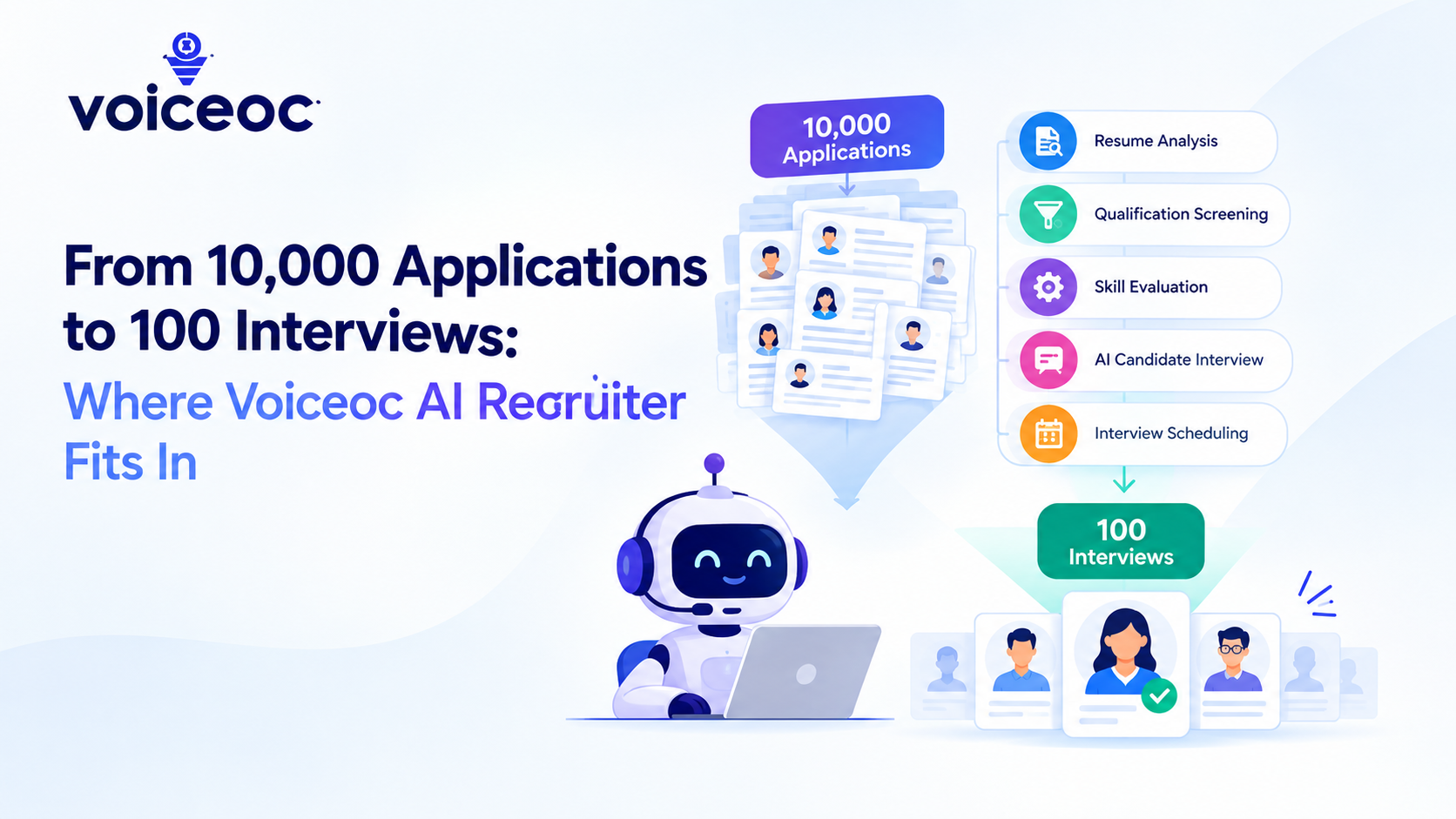
10,000 Applications
↓
Resume analysis
Voiceoc AI Recruitment platform analyzes the resumes and identifies the relevant experience, skills, and qualifications.
↓
Minimum qualification screening
Candidates who don’t meet the basic requirements are filtered out.
↓
Skill-based evaluation
The remaining candidates are evaluated against the specific requirements of the customer support role.
↓
AI-powered candidate interviews
Voiceoc engages shortlisted candidates and conducts the initial screening, asking relevant questions about experience, availability, communication skills, and other job-specific criteria ↓
Candidate ranking & insights
Recruiters receive a more focused pool of candidates along with relevant screening and interview insights.
↓
Interview scheduling
Instead of spending several hours coordinating availability, interviews can be scheduled automatically by software itself.
↓
100 interviews
The recruitment team focuses its entire time on interviewing and evaluating the candidates who have already passed the initial screening stages.
The Result
The biggest change isn't simply going from 10,000 applications to 100 interviews.
It's changing the recruiter's job from:
“Which of these 10,000 resumes should I open?”
to:
“Which of these qualified candidates should we interview and hire?”
The Entire Voiceoc AI Recruitment Funnel Process
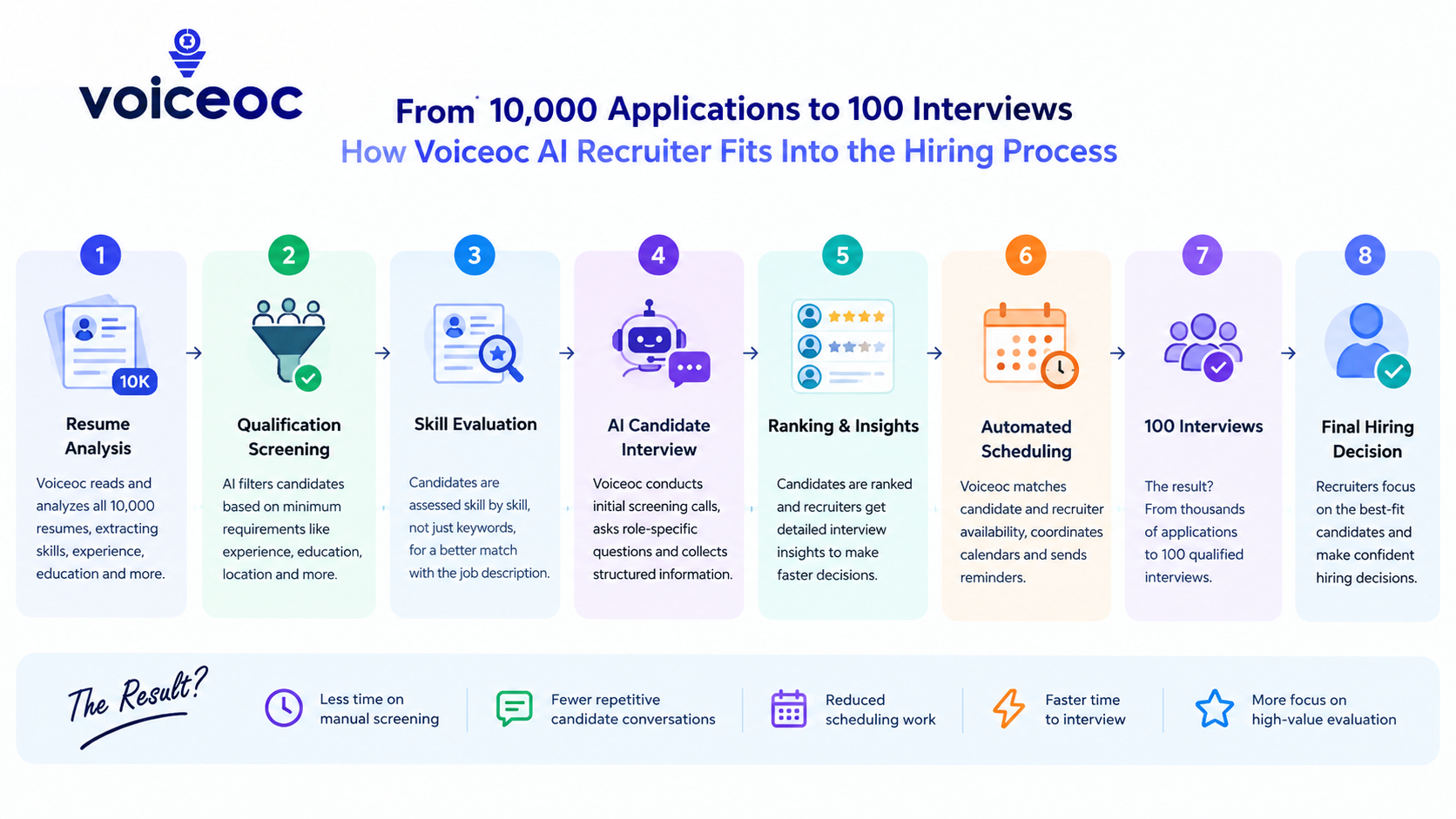
Step 1 — Voiceoc Analyzes All 10,000 Resumes
The first challenge begins when 10,000 applications start coming in.
For a recruiter, opening every resume, checking the candidate's experience, identifying relevant skills, and comparing each profile with the job description can quickly become one of the most time-consuming parts of the hiring process.
This is where Voiceoc AI Recruiter can take over the initial screening workload.
Instead of requiring recruiters to manually open thousands of resumes, the AI-powered recruitment system can analyze candidate profiles and extract the information that matters for the specific position.
It can look at factors such as:
- Skills and technical capabilities
- Previous work experience
- Job titles and responsibilities
- Education and certifications
- Relevant qualifications
- Industry experience
- Other criteria defined for the role
The important part is that the resumes are evaluated in the context of the job requirements.
For example, suppose the company is hiring customer support representatives and the job requires two or more years of customer service experience, strong communication skills, CRM experience, and flexibility to work rotational shifts.
Instead of simply searching for the word "customer support" across 10,000 resumes, the screening process can be structured around the actual requirements of the role.
This allows recruiters to move away from manually searching through thousands of resumes and toward a more focused pool of potentially suitable candidates.
Step 2 — AI Filters Candidates Based on Minimum Requirements
Not every person who applies for a job is necessarily qualified for it.
Some candidates may apply after reading only the job title. Others may not meet the minimum experience, education, skill, or availability requirements mentioned in the job description.
When applications reach thousands, manually identifying these mismatches becomes a major burden for recruitment teams.
Voiceoc AI Recruiter can help address this problem by applying the minimum qualification criteria defined for the position.
For example, if a role requires:
- At least two years of relevant experience
- A specific educational qualification
- Experience with a particular software or skill
- Availability to join within a specified timeframe
the AI can use these requirements as part of the initial screening process.
Candidates who clearly don't meet the basic criteria can be filtered out before recruiters spend valuable time reviewing their profiles.
This doesn't mean the AI makes the final hiring decision. Instead, it helps reduce the amount of manual work involved in identifying candidates who are more aligned with the role.
The recruiter can then focus attention on the candidates who have a stronger initial match.
Step 3 — Voiceoc Evaluates Candidates Skill by Skill
Matching a resume to a job description shouldn't always be about finding exact keywords.
A candidate might have the right experience but describe their skills differently. Another candidate might mention a particular technology without having enough practical experience using it.
This is where skill-level evaluation becomes important.
Voiceoc AI Recruiter can evaluate candidates against the specific skills and requirements associated with a position.
For example, imagine the company is hiring a software developer for a role requiring:
- Python
- AWS
- SQL
- Machine learning
- Three or more years of development experience
Rather than treating every candidate as simply "qualified" or "not qualified," the screening process can examine how closely each candidate aligns with the individual requirements.
One candidate may have strong Python and SQL experience but limited AWS exposure.
Another may have all four technical skills but only one year of relevant experience.
A third candidate may have the required experience and strong technical alignment across most of the requirements.
This type of structured evaluation gives recruiters more context when deciding which candidates should move to the next stage.
The goal is simple: find candidates who match the role, not simply candidates who contain the right keywords.
Step 4 — Voiceoc Conducts the Initial Candidate Interview
Resume screening is only one part of recruitment.
A resume can tell a recruiter about someone's background, but it doesn't always answer the questions that matter before moving a candidate to an interview.
For example:
- Is the candidate actually interested in the role?
- Do they have the required experience?
- Are they comfortable with the working conditions?
- When can they join?
- Do they meet role-specific requirements?
- Are there any important gaps in their profile?
This is where Voiceoc AI Recruiter can extend the screening process beyond the resume.
Instead of asking recruiters to conduct thousands of initial qualification calls, an AI recruiter can engage candidates and ask predefined or role-specific screening questions.
For example:
AI Recruiter: How many years of experience do you have in customer support?
Candidate: I have four years of experience.
AI Recruiter: Are you comfortable working rotational shifts?
Candidate: Yes.
AI Recruiter: How soon would you be available to join?
Candidate: I can join within 30 days.
These conversations can help collect structured information directly from candidates before they reach the human interview stage.
The benefit is not simply automation. It is consistency.
Every candidate can be asked relevant screening questions based on the requirements of the role, while recruiters don't have to repeatedly conduct the same initial qualification conversation with every applicant.
The recruiter can then spend more time on candidates who have already passed the initial screening stages.
Step 5 — Candidates Are Ranked, and Recruiters Get Interview Insights
After resume analysis, qualification screening, skill evaluation, and initial candidate interviews, recruiters need a clear way to decide who should move forward.
This is where all the information collected during the earlier stages becomes valuable.
Instead of looking at thousands of individual resumes and manually comparing candidates, recruiters can work with a much more focused candidate pool.
Candidate profiles can be reviewed based on relevant information such as:
- Skills
- Experience
- Qualification criteria
- Screening responses
- Interview responses
- Role-specific requirements
For example, imagine that the original 10,000 applications have now been narrowed down to a smaller group of candidates who meet the core requirements and have successfully completed the initial screening.
The recruiter no longer needs to ask:
"Which of these 10,000 people should I look at first?"
The question becomes:
"Which of these qualified candidates should move forward?"
That shift can make a significant difference to the recruiter's workflow.
AI handles the high-volume screening and information-gathering work, while recruiters can use the resulting candidate insights to make more informed decisions about who deserves the next stage of the hiring process.
Step 6 — Voiceoc Automates Interview Scheduling
Finding the right candidates is only half of the challenge.
Once candidates are shortlisted, recruiters often have to deal with another repetitive task: scheduling interviews.
This can involve multiple emails or messages between the recruiter and candidate just to find a suitable time.
The conversation might look something like:
"Are you available Tuesday at 3 PM?"
"No, I'm not available then. How about Wednesday?"
"Wednesday doesn't work for me. Are you available Thursday?"
When this happens across dozens or hundreds of candidates, scheduling can consume a significant amount of recruiter time.
Voiceoc AI Recruiter can help automate this part of the workflow by coordinating the scheduling process.
Depending on the recruitment setup, this can include:
- Collecting candidate availability
- Finding suitable interview slots
- Coordinating interview schedules
- Sending confirmations
- Providing reminders
- Reducing unnecessary back-and-forth communication
The result is a smoother transition from candidate screening to candidate interview.
Instead of recruiters spending their time coordinating every interview manually, automation can handle much of the administrative work.
Step 7 — From Thousands of Applications to 100 Interviews
Now let's bring the entire process together.
Our hypothetical company started with 10,000 applications for 100 customer support positions.
Instead of asking recruiters to manually process every application, the recruitment workflow can progressively narrow the candidate pool.
The workflow looks like this:
10,000 Applications
↓
Resume Analysis
Voiceoc analyzes candidate resumes and identifies relevant skills, experience, education, and qualifications.
↓
Qualification Screening
Candidates are evaluated against the minimum requirements of the role.
↓
Skill Evaluation
Candidates are assessed against the specific skills and experience required for the position.
↓
AI Candidate Screening
Voiceoc engages suitable candidates in an initial screening conversation and collects relevant information.
↓
Candidate Shortlist
Recruiters receive a more focused pool of candidates along with relevant screening and interview insights.
↓
Automated Interview Scheduling
Suitable candidates can move into the interview stage without requiring recruiters to manually coordinate every scheduling conversation.
↓
100 Interviews
The recruitment team can now focus its attention on interviewing and evaluating the candidates who have progressed through the initial screening process.
The exact numbers will vary from one hiring campaign to another. The point of this example is to demonstrate how AI can help recruiters manage application volume without treating every applicant as a manual task.
What This Means for Recruiters?
The biggest benefit of an AI recruitment workflow isn't simply that recruiters have a new piece of software.
It's that the nature of their work can change.
Without automation, recruiters may spend a large portion of their day on repetitive activities such as reading resumes, checking basic qualifications, conducting initial screening calls, responding to routine candidate questions, and coordinating interviews.
With AI handling much of this initial workload, recruiters can spend more time on activities where human judgment matters.
This can mean:
- Less time spent manually reviewing resumes
- Less repetitive candidate communication
- Less administrative scheduling work
- Faster movement from application to interview
- More focused candidate evaluation
- More time for hiring manager collaboration
- More time building relationships with high-value candidates
In other words, AI doesn't necessarily make the recruiter less important.
It can make the recruiter's time more valuable.
AI Doesn't Replace the Recruiter — It Changes the Recruiter's Role
One of the biggest questions surrounding AI recruitment is whether AI will eventually replace recruiters.
The more practical question is: Which parts of recruitment should AI handle, and which parts should remain human?
Tasks such as resume analysis, qualification screening, repetitive candidate questions, initial screening, and scheduling are often structured and repetitive.
These are areas where AI can provide significant assistance.
But recruitment also involves human judgment.
Recruiters still need to evaluate candidates, understand team requirements, communicate with hiring managers, assess cultural and organizational fit, conduct deeper interviews, and ultimately participate in hiring decisions.
Voiceoc AI Recruiter can therefore be viewed as an additional layer of support for the recruitment team.
The AI handles high-volume, repetitive stages of the hiring process, while recruiters remain responsible for the decisions that require human judgment.
The objective isn't to remove recruiters from recruitment.
It's to remove unnecessary manual work from recruiters.
Final Takeaway
Getting 10,000 applications sounds like a great problem to have.
But for a recruitment team, application volume can quickly become a bottleneck when every resume, screening conversation, follow-up, and interview needs to be handled manually.
The real challenge isn't getting more applications.
It's finding the right candidates within those applications.
This is where an AI-powered recruitment workflow can make a difference.
From analyzing resumes and filtering minimum qualifications to evaluating skills, conducting initial candidate screening, providing interview insights, and helping schedule interviews, Voiceoc AI Recruiter can support recruiters across some of the most repetitive stages of high-volume hiring.
The goal isn't to replace recruiters.
It's to help recruiters move from 10,000 applications to the 100 candidates who deserve their attention.
And when recruiters spend less time searching through applications and more time engaging with the right candidates, the hiring process can become faster, more focused, and easier to scale.