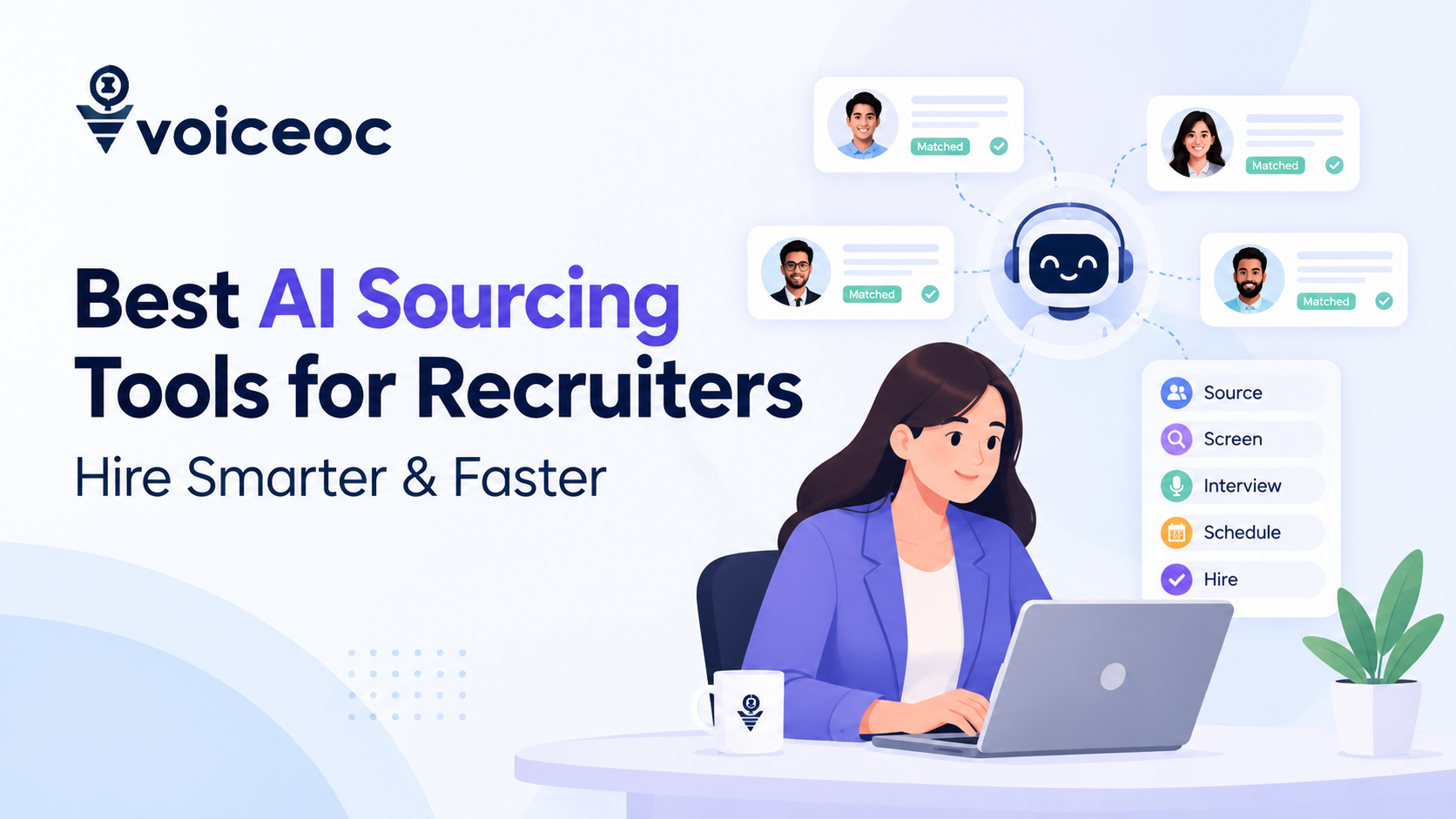
Recruitment teams today are dealing with a difficult problem: too many applications, too little time.
A single job opening can attract hundreds or even thousands of applications. Recruiters then have to review resumes, identify relevant candidates, check qualifications, conduct initial screening calls, answer candidate questions, schedule interviews, and keep applicants engaged.
This is where AI sourcing tools for recruiters can make a difference.
AI can help recruitment teams discover relevant candidates, analyze profiles, identify potential matches, and reduce the amount of manual work involved in building a candidate pipeline.
But sourcing is only the beginning.
Finding a candidate does not mean that the candidate is qualified, available, interested, or ready for an interview. Recruiters still need to screen candidates, conduct initial interviews, evaluate skills, schedule interviews, and keep candidates engaged.
This is where Voiceoc AI Recruiter takes the recruitment workflow further.
Voiceoc's AI Recruiter, Eva, is designed to handle the repetitive stages of hiring—from resume analysis and qualification screening to AI interviews, interview scheduling, candidate insights, and pre-joining engagement. Eva can help recruiters move from a large applicant pool to a focused shortlist without requiring recruiters to manually handle every early-stage interaction.
In this guide, we'll look at the best AI sourcing tools for recruiters, what they offer, and why sourcing should be connected with the rest of the recruitment workflow.
What Are AI Sourcing Tools?
AI sourcing tools are recruitment platforms that use artificial intelligence to help recruiters find and identify potential candidates.
Traditional sourcing often involves searching job boards, professional networks, talent databases, and internal candidate records manually. Recruiters may need to create Boolean searches, open multiple profiles, compare experience, and build candidate lists themselves.
AI-powered sourcing can simplify this process.
Depending on the platform, AI can help recruiters:
- Find candidates based on skills and experience
- Match candidates with job requirements
- Search talent databases
- Discover passive candidates
- Rediscover candidates already present in an ATS
- Analyze candidate profiles
- Recommend relevant candidates
- Automate parts of candidate outreach
- Build talent pipelines
The major difference is that AI sourcing can move recruitment beyond simple keyword matching.
For example, instead of searching only for the exact phrase "customer success manager," an AI system can potentially identify candidates with related experience in customer experience, account management, client relationships, or similar responsibilities.
However, sourcing should not be treated as the complete hiring solution.
A recruiter may find 500 potentially relevant candidates. The next challenge is determining which candidates actually meet the requirements.
That's where AI screening and interviewing become important.
Why Are AI Sourcing Tools Important for Recruiters?
The biggest advantage of AI sourcing is not simply finding more candidates.
It is helping recruiters spend less time on repetitive candidate-search activities and more time on decisions that require human judgment.
Faster candidate discovery
AI can help recruiters search large candidate pools and identify profiles that match specific requirements.
Less manual research
Recruiters don't have to manually open and compare every profile before building an initial candidate list.
Better candidate matching
AI can evaluate candidate information against job requirements and identify relevant experience, skills, and qualifications.
Easier passive candidate sourcing
Not every strong candidate is actively applying for jobs. AI sourcing tools can help recruiters identify people who may be suitable even when they are not actively looking.
More scalable recruitment
When hiring volumes increase, manually sourcing every candidate becomes increasingly difficult. AI can help recruiting teams handle larger talent pools without increasing manual work at the same rate.
More time for recruiters
Instead of spending most of their day searching, recruiters can spend more time interviewing candidates, working with hiring managers, and making hiring decisions.
10 Best AI Sourcing Tools for Recruiters
The best tool depends on your hiring volume, candidate database requirements, industry, geography, recruiting workflow, and budget.
Here are 10 platforms recruiters can consider when evaluating AI sourcing tools for recruiting.
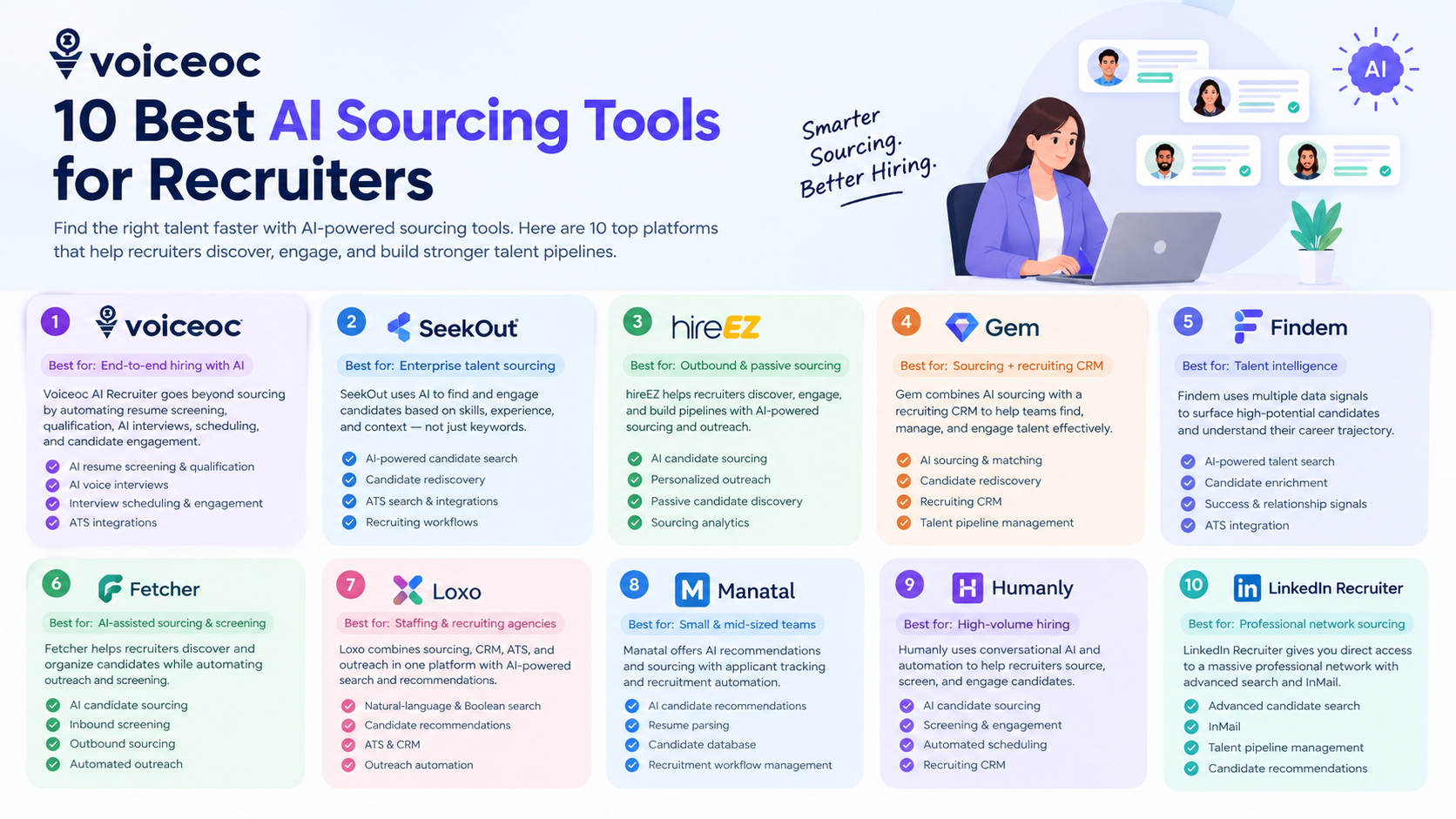
1. Voiceoc AI Recruiter
Best for: Connecting candidate sourcing with screening, AI interviews, scheduling, and candidate engagement
Voiceoc deserves a different position on this list because its focus goes beyond simply finding candidates.
Voiceoc AI Recruiter, powered by Eva, is designed to automate the early and repetitive stages of the hiring journey.
Instead of stopping after candidate discovery, Eva helps recruiters move candidates through qualification, screening, interviewing, scheduling, and engagement. Voiceoc's current platform describes Eva as an AI recruiter that screens, interviews, and schedules candidates while providing recruiters with a ranked shortlist.
What Voiceoc can do
- AI resume screening
- AI qualification screening
- Candidate sourcing
- AI voice interviews
- Candidate evaluation
- Candidate ranking
- Interview scheduling
- Candidate engagement
- Pre-joining engagement
- ATS integrations
- Phone and WhatsApp-based candidate conversations
Eva can automatically analyze resumes, screen applicants against minimum qualifications, evaluate candidates skill by skill, conduct structured AI interviews, schedule interviews, and provide recruiters with interview insights.
Fill up the form today and schedule a 30-min free consultation session with Voiceoc team experts on Eva AI Recruiter!
Why Voiceoc is different
A typical sourcing workflow looks like:
Find candidates → Contact candidates → Screen candidates → Schedule interviews
Voiceoc is built around automating much more of that journey:
Candidate → Resume Screening → Qualification → AI Interview → Evaluation → Shortlist → Scheduling → Human Decision
For example, Voiceoc illustrates a workflow in which an organization starts with 200 applicants and uses Eva to identify the candidates who should actually reach the interview stage.
The platform can also run workflows across phone calls and WhatsApp. If a candidate doesn't answer a call, the workflow can follow up through WhatsApp and retry later.
This makes Voiceoc particularly relevant for companies dealing with high-volume hiring, where sourcing is only one part of the problem.
2. SeekOut
Best for: Enterprise talent sourcing
SeekOut is an AI recruiting platform focused on candidate search, talent discovery, sourcing, and recruiting workflows.
Its platform uses AI-assisted search to help recruiters find candidates based on skills, experience, and other contextual signals rather than relying only on exact keywords.
SeekOut also provides capabilities for searching existing candidate data and supporting recruiting workflows.
Key capabilities
- AI-powered candidate search
- Talent discovery
- Candidate recommendations
- Candidate rediscovery
- ATS search
- Candidate evaluation
- Recruiting workflows
SeekOut is a strong consideration for larger organizations that need extensive talent search capabilities.
3. hireEZ
Best for: Outbound sourcing and passive candidates
hireEZ focuses heavily on proactive candidate sourcing.
Recruiters can use the platform to identify potential candidates, understand candidate fit, and support outbound engagement.
Key capabilities
- AI candidate sourcing
- Candidate recommendations
- Passive candidate discovery
- Candidate engagement
- Personalized outreach
- Recruiting analytics
hireEZ can be useful for teams that need to proactively build candidate pipelines instead of relying primarily on inbound applications.
4. Gem
Best for: Sourcing combined with recruiting CRM
Gem combines candidate sourcing with recruiting CRM and engagement capabilities.
Its platform can help recruiting teams identify candidates, rediscover existing talent, manage candidate relationships, and support recruiting outreach.
Key capabilities
- AI sourcing
- Candidate rediscovery
- Candidate matching
- Recruiting CRM
- Candidate outreach
- Talent pipeline management
- Recruiting analytics
Gem can be useful for companies that want sourcing and candidate relationship management to work together.
5. Findem
Best for: Enterprise talent intelligence
Findem approaches recruitment through talent intelligence and candidate data.
Rather than relying only on job titles and keywords, the platform uses multiple candidate signals to help recruiters identify relevant talent.
Key capabilities
- AI-powered talent search
- Candidate matching
- Talent intelligence
- Candidate enrichment
- Talent discovery
- Recruiting analytics
Findem can be particularly useful for organizations recruiting for specialized roles where traditional keyword searches may not provide enough context.
6. Fetcher
Best for: AI-assisted sourcing and candidate screening
Fetcher combines candidate sourcing with AI-assisted recruitment workflows.
The platform can help recruiters discover candidates, organize prospects, and support candidate outreach.
Key capabilities
- AI candidate sourcing
- Candidate recommendations
- Inbound candidate screening
- Outbound sourcing
- Candidate engagement
- Automated outreach
Fetcher is worth considering for teams that need to manage both inbound applicants and proactively sourced candidates.
7. Loxo
Best for: Recruiting agencies and staffing teams
Loxo combines sourcing, recruiting CRM, applicant tracking, candidate engagement, and recruiting automation.
Its sourcing capabilities include natural-language and Boolean search, allowing recruiters to find candidates using different approaches.
Key capabilities
- AI candidate sourcing
- Natural-language search
- Boolean search
- Candidate recommendations
- ATS
- Recruiting CRM
- Candidate outreach
- Workflow automation
For staffing firms and recruiting agencies, having sourcing and candidate management within the same system can reduce the need to switch between multiple tools.
8. Manatal
Best for: Small and mid-sized recruitment teams
Manatal combines applicant tracking with recruitment automation and candidate recommendations.
Its platform can help recruiters source candidates, organize applications, parse resumes, and manage recruitment workflows.
Key capabilities
- Candidate sourcing
- AI candidate recommendations
- Resume parsing
- Applicant tracking
- Candidate database
- Recruitment workflow management
Manatal can be a practical option for smaller recruiting teams that want sourcing and applicant management in one platform.
9. Humanly
Best for: High-volume recruiting and candidate engagement
Humanly focuses on conversational AI and recruitment automation.
Its platform can support candidate engagement, screening, scheduling, and other recruiting workflows.
Key capabilities
- AI candidate engagement
- Candidate screening
- Candidate sourcing
- Automated scheduling
- Recruiting CRM
- High-volume hiring support
Humanly can be useful for organizations that want to combine candidate sourcing with automated candidate conversations.
10. LinkedIn Recruiter
Best for: Professional-network-based candidate sourcing
LinkedIn Recruiter remains one of the most widely used platforms for professional candidate sourcing.
Recruiters can search candidates based on factors such as skills, experience, location, job title, and professional background.
Key capabilities
- Advanced candidate search
- Professional profiles
- Candidate recommendations
- InMail
- Talent pipeline management
- Candidate outreach
LinkedIn Recruiter can also complement specialized AI sourcing tools for recruiters, particularly when recruiters want to combine AI-assisted workflows with professional-network sourcing.
Top AI Recruiting Platforms For Startups, Staffing Firms & Enterprises
How to Choose the Right AI Sourcing Tool?
Choosing the right tool should depend on your recruitment process rather than simply choosing the platform with the most AI features.
1. Look at candidate coverage
Check whether the platform has strong coverage in the locations, industries, and roles you recruit for.
For example, sourcing tools for recruiters in India may need strong access to Indian talent pools and support for local hiring requirements.
2. Evaluate AI matching
Look for tools that understand skills, experience, qualifications, and job context instead of relying exclusively on exact keyword matches.
3. Check sourcing and outreach capabilities
Finding candidates is only useful if recruiters can effectively engage them afterward.
Consider whether the platform supports personalized outreach, follow-ups, and candidate communication.
4. Consider ATS integrations
Your sourcing platform should work with your existing recruitment technology.
Voiceoc, for example, supports integrations with ATS platforms including Workday, Greenhouse, Lever, Ashby, BambooHR, and SAP SuccessFactors. Applications, interview insights, scores, and shortlists can sync with the ATS.
5. Consider what happens after sourcing
This is one of the most important questions recruiters should ask.
If a tool only helps you find candidates, you may still need separate systems for:
- Resume screening
- Qualification calls
- AI interviews
- Scheduling
- Candidate follow-ups
- Candidate engagement
A broader AI recruitment platform can reduce this fragmentation.
6. Check scalability
If your organization expects to move from 50 hires to 500 hires, make sure the platform can support increasing candidate volume without creating additional manual work.
AI Sourcing Is Only the First Step
AI sourcing can solve the candidate discovery problem.
But recruitment has several additional bottlenecks.
Imagine receiving 10,000 applications for a high-volume hiring campaign.
The problem isn't simply finding candidates.
The recruitment team still needs to answer:
- Which candidates meet the minimum qualifications?
- Which candidates have the required skills?
- Who is actually interested in the position?
- Who is available for an interview?
- Who performs well in the initial interview?
- Who should move to the hiring manager?
- Who can be scheduled without multiple follow-ups?
This is where sourcing tools alone may not be enough.
The recruitment workflow needs to continue after candidate discovery.
How Voiceoc Goes Beyond AI Sourcing?
This is where Voiceoc takes a broader approach.
Voiceoc AI Recruiter doesn't treat sourcing as the final destination. It connects candidate discovery with the rest of the hiring workflow.
Eva is designed to help recruiters move candidates through the early stages of recruitment automatically.
Step 1: Analyze resumes
Eva reads and analyzes candidate resumes to identify relevant experience, skills, qualifications, and other role-specific information.
Step 2: Screen candidates
Candidates can be screened against predefined minimum qualifications.
Step 3: Qualify candidates
Eva can engage candidates through AI voice and WhatsApp conversations to collect additional information and verify role-specific requirements.
Step 4: Conduct AI interviews
Qualified candidates can move into structured AI voice interviews.
Eva evaluates candidates against required skills and provides recruiters with interview insights.
Step 5: Rank candidates
Instead of asking recruiters to manually review every candidate, Voiceoc provides candidate information, scores, summaries, and recommendations to help recruiters focus on stronger candidates.
Step 6: Schedule interviews
Once candidates are ready for the next stage, Eva can coordinate interview scheduling and reduce the back-and-forth between candidates and recruiters.
Step 7: Keep candidates engaged
Voiceoc also extends beyond the interview stage.
Eva can continue engaging selected candidates before joining and help identify potential joining risks.
This creates a more complete recruitment workflow:
Source → Screen → Qualify → Interview → Evaluate → Shortlist → Schedule → Engage → Hire
Instead of using one tool for sourcing, another for screening, another for interviewing, and another for scheduling, organizations can use AI to automate multiple connected stages of the recruitment journey.
Why Voiceoc Can Be a Better Fit for High-Volume Hiring?
For high-volume recruitment, the biggest challenge is often not finding candidates.
It is processing candidates efficiently.
A recruiter may receive hundreds or thousands of applications, but manually reviewing every resume and conducting every first-round call can quickly become a bottleneck.
Voiceoc is designed around this problem.
Its current platform positions Eva as an AI recruiter that can handle the first stages of hiring, including resume analysis, qualification screening, interviews, scheduling, candidate evaluation, and engagement.
Voiceoc's own hiring example illustrates the concept with 200 applicants → 5 interviews → 1 great hire, where Eva handles the repetitive screening and coordination work before recruiters focus on the strongest candidates.
The objective is not to remove recruiters from the process.
It is to change what recruiters spend their time doing.
Instead of:
Reading resumes → Calling candidates → Asking repetitive questions → Chasing availability → Sending follow-ups
Recruiters can focus more on:
Reviewing qualified candidates → Conducting meaningful interviews → Working with hiring managers → Making hiring decisions
AI Sourcing Tools vs. AI Recruitment Platforms
These terms are often used interchangeably, but there is an important difference.
AI sourcing tools
Primarily help recruiters:
- Discover candidates
- Search talent pools
- Identify potential matches
- Build candidate pipelines
- Support candidate outreach
AI recruitment platforms
Can potentially cover a broader part of the recruitment workflow:
- Candidate sourcing
- Resume screening
- Candidate qualification
- AI interviews
- Candidate evaluation
- Interview scheduling
- Candidate communication
- Candidate engagement
This distinction matters when selecting recruitment technology.
If your biggest problem is finding candidates, a dedicated sourcing tool may be enough.
If your problem is processing and hiring large numbers of candidates, a broader AI recruitment platform such as Voiceoc may provide more value because sourcing is connected to screening, interviewing, scheduling, and engagement.
FAQs
1. What are the best sourcing tools for recruiters?
Some of the leading options include Voiceoc AI Recruiter, SeekOut, hireEZ, Gem, Findem, Fetcher, Loxo, Manatal, Humanly, and LinkedIn Recruiter.
However, the best tool depends on what your recruitment team needs.
If you only need candidate discovery, a dedicated sourcing platform may be sufficient. If you want to automate the recruitment process after sourcing as well, Voiceoc AI Recruiter can help connect candidate screening, qualification, AI interviews, scheduling, and candidate engagement in one workflow.
2. What are some effective sourcing methods for recruitment?
Effective sourcing methods include:
- LinkedIn sourcing
- Boolean search
- Job boards
- Talent databases
- Employee referrals
- Professional communities
- Internal candidate databases
- Talent rediscovery
- Passive candidate sourcing
- AI-powered candidate sourcing
The right combination depends on the role, industry, location, and hiring volume.
For high-volume hiring, AI sourcing can be particularly useful because it can help recruiters identify potential candidates faster and then connect them to automated screening and qualification workflows.
Conclusion
AI is changing how recruiters approach candidate sourcing.
Instead of manually searching thousands of profiles, recruiters can use AI sourcing tools for recruiting to identify relevant candidates, discover talent faster, and build stronger pipelines.
But sourcing is only the beginning of the hiring journey.
The real opportunity is connecting sourcing with everything that happens afterward.
That's the approach Voiceoc takes with Eva, its AI Recruiter.
Eva helps organizations move beyond candidate discovery by automating resume screening, qualification, AI interviews, candidate evaluation, interview scheduling, and pre-joining engagement.
For recruiters, that means less time spent on repetitive administrative work and more time spent on the decisions that actually require human judgment.
Find the right candidates. Screen them faster. Interview at scale. Schedule automatically. Keep candidates engaged.
That's how AI can help recruitment teams hire smarter and faster with Voiceoc.