Hiring teams are under increasing pressure to screen more candidates, reduce time-to-hire, and deliver a better candidate experience without increasing recruiter workload. This is where AI interview software is becoming an important part of modern recruitment.
AI interview platforms can automate candidate screening, conduct structured interviews, generate interview questions, transcribe responses, summarize conversations, and help recruiters evaluate candidates against predefined criteria. More advanced platforms can even conduct two-way conversations with candidates using AI voice or conversational agents.
The adoption of AI interviews is growing rapidly. According to Greenhouse's 2026 Candidate AI Interview Report, 63% of job seekers have already experienced an AI interview, up 13 percentage points in six months. However, adoption also brings challenges: 38% of U.S. candidates said they had withdrawn from a hiring process because it included an AI interview.
This means choosing the right AI interview software is not simply about finding the platform with the most automation. Recruiters need to consider interview quality, candidate experience, transparency, integrations, scalability, security, and human oversight.
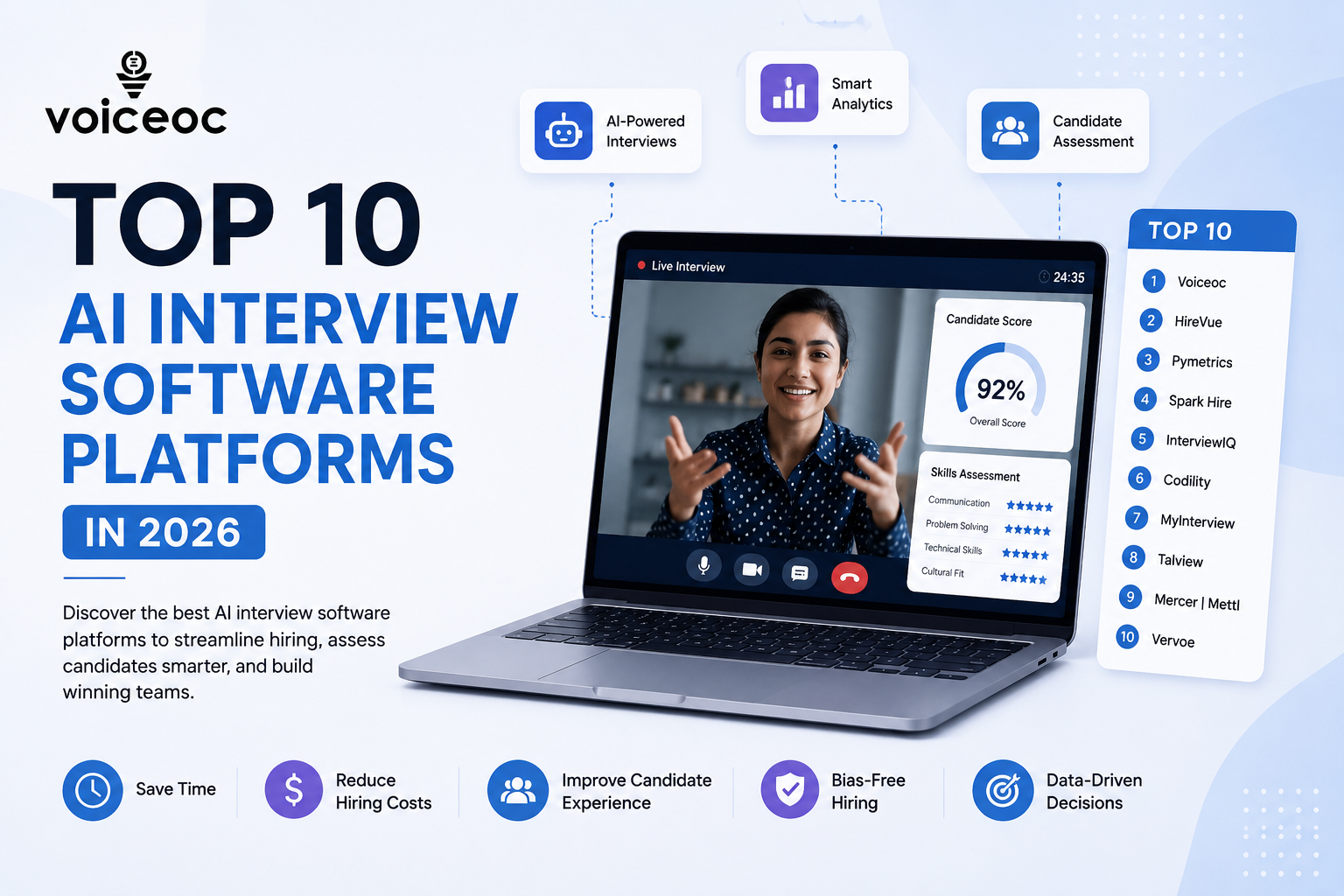
In this guide, we explore the top 10 AI interview software platforms in India in 2026, their key capabilities, ideal use cases, and what businesses should consider before choosing one.
What Is AI Interview Software?
AI interview platforms is recruitment technology in India that uses artificial intelligence to automate or assist with candidate interviews and screening.
Depending on the platform, it may support:
- Automated candidate screening
- AI-generated interview questions
- One-way video interviews
- Live video interviews
- AI voice interviews
- Conversational AI interviews
- Interview transcription
- AI-generated summaries
- Candidate scoring
- Structured interview scorecards
- Interview scheduling
- ATS and HRIS integrations
- Candidate communication
There is an important difference between traditional video interviewing and newer AI interview agents.
A traditional video interview platform may ask candidates a predefined set of questions and record their answers. An AI interviewer can go further by conducting a two-way conversation, asking follow-up questions, adapting to candidate responses, and evaluating answers against predefined criteria.
Recent research also suggests that AI voice interviewing can improve consistency when human recruiters remain involved in final decisions. A 2026 natural field experiment involving 70,000 applicants found that candidates interviewed by AI voice agents were 12% more likely to receive job offers, while human recruiters still evaluated the interviews and made hiring decisions.
How Does Voiceoc AI Recruiter Use AI Interview Software?
Voiceoc AI Recruiter takes AI interviewing beyond basic question-and-answer screening by combining AI voice agents, AI chat assistants, and recruitment workflow automation. It is designed to help recruitment teams automate repetitive early-stage hiring tasks while keeping recruiters involved in important hiring decisions.
With Voiceoc, recruiters can automate several stages of the candidate journey—from initial qualification to AI interviews and interview scheduling.
1. Resume Screening
Voiceoc AI Interview tool can help recruitment teams handle large volumes of applications by screening candidates against predefined job requirements, qualifications, skills, and experience.
Instead of manually reviewing every resume, recruiters can use AI to identify candidates who meet the initial criteria and move them forward in the recruitment process.
2. AI Candidate Qualification
After initial screening, Voiceoc can engage candidates through AI voice and chat conversations.
The AI recruiter can ask predefined qualification questions, collect candidate information, and identify whether applicants meet the requirements for the role.
This helps recruiters reduce repetitive qualification calls, particularly when hiring teams are dealing with hundreds or thousands of applications.
3. AI Voice Interviews
One of the key capabilities of Voiceoc AI Recruiter is AI-powered voice interviewing.
Candidates can interact with an AI voice agent that conducts a structured first-round interview. The conversation can be designed around the skills, experience, and requirements of the specific position.
Instead of relying only on static forms or recorded answers, candidates can participate in a conversational screening experience.
4. Structured Candidate Evaluation
Voiceoc can organize information collected during screening and interviews so recruiters can review candidates based on predefined hiring criteria.
This gives recruitment teams structured candidate information that can help them determine which applicants should move to the next stage.
5. Interview Scheduling
Once a candidate qualifies for the next stage, Voiceoc can help automate interview scheduling.
Candidates can receive interview-related communication and schedule conversations with human interviewers without requiring recruiters to manually coordinate every appointment.
6. Candidate Communication and Engagement
AI recruitment is not only about screening candidates. Keeping candidates informed throughout the process is also important.
Voiceoc can automate candidate communication for different stages of the recruitment journey, helping recruitment teams respond faster and maintain engagement.
7. Human Recruiters Stay in Control
Voiceoc is designed to automate repetitive recruitment activities rather than remove human decision-making from the hiring process.
Recruiters can use AI-generated candidate information, screening results, and interview insights to focus their time on qualified candidates, deeper interviews, relationship-building, and final hiring decisions.
Voiceoc AI Recruiter Workflow
Resume Screening → Candidate Qualification → AI Voice/Chat Screening → AI First-Round Interview → Candidate Evaluation → Human Interview Scheduling → Recruiter Review
For companies managing high-volume hiring, this workflow can help reduce repetitive screening work, accelerate early-stage candidate engagement, and allow recruitment teams to spend more time on the candidates who require human attention.
Connect for a free consultation on Voiceoc AI Indian Recruiter Platform and connect with experts today!
How Does AI Interview Software in India Work?
A typical AI interview workflow looks like this:
Job Description → Candidate Application → AI Screening → Interview Invitation → AI Interview → Transcription & Analysis → Scoring → Recruiter Review → Shortlist
The process usually includes several stages.
1. Candidate Screening
The software evaluates applications using job requirements, skills, experience, and screening questions.
2. Interview Creation
Recruiters can create structured interview questions based on the position, competencies, and hiring criteria. Some platforms can use AI to assist with question generation.
3. Automated Interview
Candidates complete a video, voice, text, or conversational interview.
4. AI Analysis
The system can transcribe responses, generate summaries, and evaluate answers against predefined criteria.
5. Recruiter Review
Recruiters receive structured candidate information instead of manually reviewing every interview from beginning to end.
6. Human Decision
The recruiter or hiring manager makes the final hiring decision.
This human-in-the-loop approach is particularly important because candidates increasingly expect transparency and accountability from AI-powered hiring processes.
Top 10 AI Interview Software in India in 2026
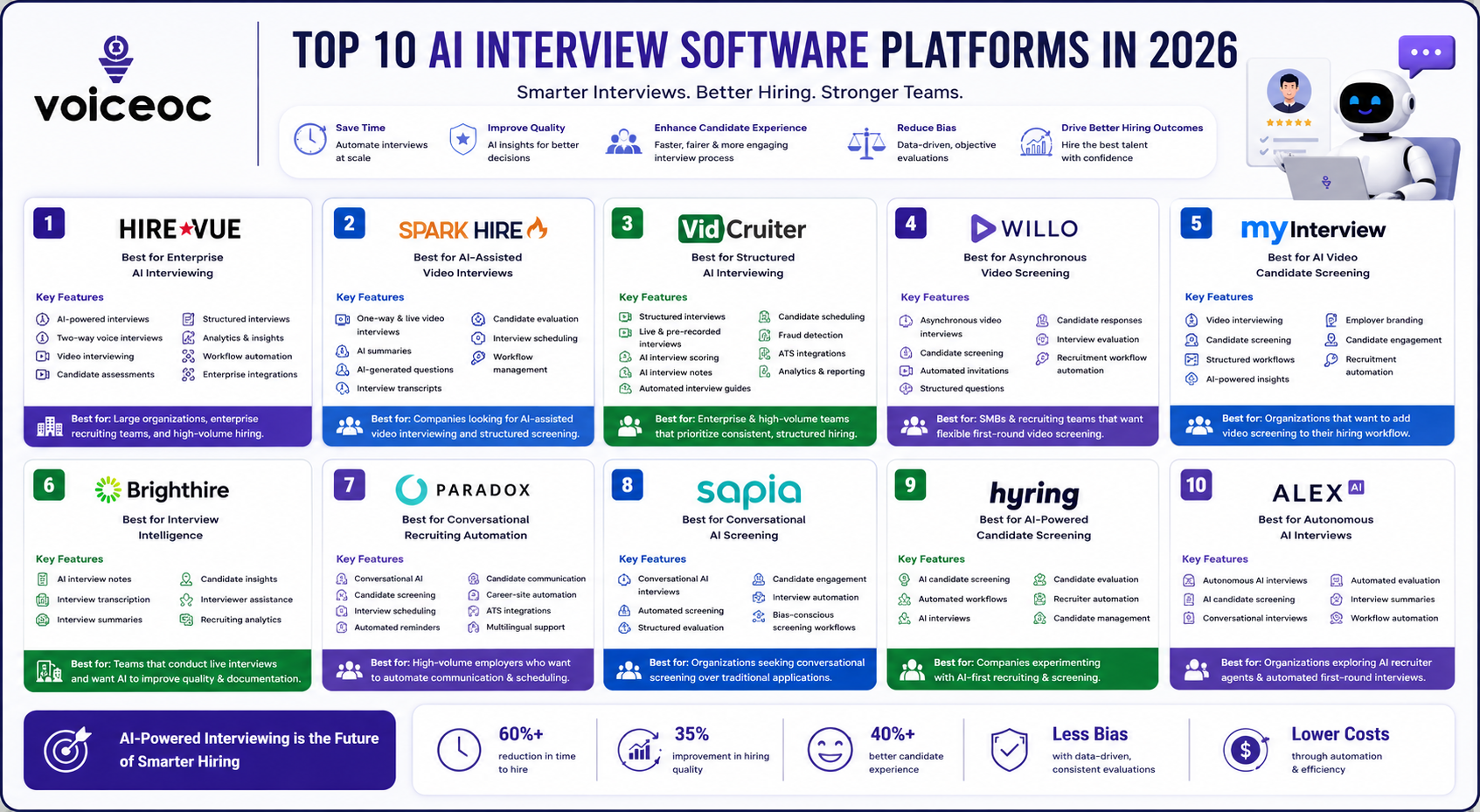
1. HireVue — Best for Enterprise AI Interviewing
HireVue is one of the established AI interview platforms in India in the video interviewing and assessment market and is particularly suited to large organizations with high-volume hiring requirements.
Its platform supports video interviewing, assessments, structured hiring workflows, and AI-powered interviewing. HireVue's AI Interviewer is designed to conduct two-way voice interviews, allowing candidates to interact with an AI interviewer rather than simply recording responses.
Key features
- AI-powered interviews
- Two-way voice interviews
- Video interviewing
- Candidate assessments
- Structured interviews
- Interview analytics
- Recruiting workflow automation
- Enterprise integrations
Best for: Large organizations, enterprise recruiting teams, and high-volume hiring.
HireVue is a strong option for organizations looking to introduce AI interviews at scale while maintaining structured recruitment processes.
2. Spark Hire — Best for AI-Assisted Video Interviews
Spark Hire is a video interviewing and recruiting platform that combines video interviews with AI-powered features.
The platform supports asynchronous video interviews, live interviews, interview scheduling, and AI-assisted recruiting workflows.
Its AI capabilities include tools such as AI resume review, interview question generation, transcripts, summaries, and candidate insights. This makes it useful for recruiters who want AI assistance without completely replacing human-led interviews.
Key features
- One-way video interviews
- Live interviews
- AI summaries
- AI-generated interview questions
- Interview transcripts
- Candidate evaluation
- Interview scheduling
- Recruiting workflow management
Best for: Companies looking for AI-assisted video interviewing and structured candidate screening.
3. VidCruiter — Best for Structured AI Interviewing
VidCruiter, another AI Interview Platforms focuses heavily on structured interviewing, interview management, automation, and ethical AI.
Its platform supports live interviews, pre-recorded video interviews, automated scheduling, AI interview notes, AI scoring, fraud detection, and automated interview guides.
One useful capability is its AI interview scoring system, which evaluates recorded responses against predefined scoring rubrics. Hiring teams can review and approve the rubrics before candidates are assessed.
Key features
- Structured interviews
- Live video interviews
- Pre-recorded interviews
- AI interview scoring
- AI interview notes
- Automated interview guides
- Candidate scheduling
- Fraud detection
- ATS integrations
Best for: Enterprise and high-volume recruitment teams that prioritize structured, consistent interviewing.
4. Willo — Best for Asynchronous Video Screening
Willo AI Interview Software is designed around asynchronous video interviewing, allowing candidates to complete interviews without requiring recruiters and candidates to be available at the same time.
This approach can be particularly useful for organizations dealing with large applicant volumes.
Instead of scheduling every initial screening call, recruiters can send candidates structured interview questions and review their responses when convenient.
Key features
- Asynchronous video interviews
- Candidate screening
- Automated interview invitations
- Structured questions
- Candidate responses
- Interview evaluation
- Recruitment workflow automation
Best for: Small and mid-sized businesses and recruiting teams that want flexible first-round video screening.
5. myInterview — Best for AI Video Candidate Screening
myInterview is another top AI interview platform focused on video-based candidate screening and recruitment automation.
The concept is straightforward: recruiters can use structured video interviews to collect more information about candidates before investing time in live interviews.
AI-powered candidate insights can help recruiters organize and review responses more efficiently.
Key features
- Video interviewing
- Candidate screening
- Structured interview workflows
- AI-powered candidate insights
- Employer branding
- Candidate engagement
- Recruitment automation
Best for: Organizations that want to add video screening to their existing recruitment workflow.
6. BrightHire — Best for Interview Intelligence
BrightHire takes a different approach from fully autonomous AI interviewer platforms. Its focus is primarily on interview intelligence—helping recruiters and interviewers get more value from human-led interviews.
AI can assist with interview transcription, notes, summaries, and insights, reducing the amount of manual documentation required from recruiters.
Key features
- AI interview notes
- Interview transcription
- Interview summaries
- Interview intelligence
- Candidate insights
- Interviewer assistance
- Recruiting analytics
Best for: Recruiting teams that already conduct live interviews but want AI to improve documentation and interview quality.
7. Paradox — Best for Conversational Recruiting Automation
Paradox uses conversational AI to automate several stages of the recruiting process, particularly candidate engagement, screening, and interview scheduling.
Its conversational scheduling technology allows candidates to schedule or reschedule interviews through automated interactions rather than lengthy email exchanges. Paradox supports calendar integrations, automated reminders, multiple interview formats, and multilingual experiences.
Its customer examples demonstrate the potential impact of this type of automation. For example, Paradox reports that Shiseido reduced interview scheduling time to five minutes and saved 1,600 hours annually.
Key features
- Conversational AI
- Candidate screening
- Interview scheduling
- Automated reminders
- Candidate communication
- Career-site automation
- ATS integrations
- Multilingual support
Best for: High-volume employers that want to automate candidate communication and scheduling alongside recruitment workflows.
8. Sapia — Best for Conversational AI Interview Screening
Sapia AI Interview Platform focuses on conversational AI for candidate screening.
Instead of relying only on resumes or traditional application forms, conversational screening can allow candidates to answer questions through a more interactive experience.
This can help recruiters collect structured candidate information before moving applicants to later stages of the hiring process.
Key features
- Conversational AI interviews
- Automated candidate screening
- Structured candidate evaluation
- Candidate engagement
- Interview automation
- Bias-conscious screening workflows
Best for: Organizations looking for conversational candidate screening rather than traditional application-first workflows.
9. Hyring — Best for AI-Powered Candidate Screening
Hyring represents the newer generation of AI recruitment platforms focused on automating candidate screening and recruitment workflows.
AI-powered screening can help recruiters identify candidates who meet role requirements before recruiters spend time on deeper interviews.
Key features
- AI candidate screening
- Automated recruitment workflows
- AI interviews
- Candidate evaluation
- Recruiter automation
- Candidate management
Best for: Companies experimenting with AI-first recruiting and automated candidate screening.
10. Alex AI — Best for Autonomous AI Interviews
Alex AI is positioned around autonomous AI-powered interviewing and candidate screening.
The key difference between an autonomous AI interviewer and a traditional video interview tool is the conversational experience. Rather than simply asking candidates to record answers to a fixed list of questions, an AI interviewer can conduct a more interactive screening conversation.
Key features
- Autonomous AI interviews
- AI candidate screening
- Conversational interviews
- Automated candidate evaluation
- Interview summaries
- Recruiter workflow automation
Best for: Organizations exploring AI recruiter agents and automated first-round interviews at scale.
What Should You Look for in Right AI Interview Software?
Choosing the right AI interview platform requires looking beyond the feature list.
1. Interview Type
Determine whether you need:
- Video interviews
- Voice interviews
- Text interviews
- Asynchronous interviews
- Live interviews
- Autonomous AI interviews
2. Candidate Screening
The platform should allow recruiters to evaluate candidates based on job-related skills, experience, competencies, and predefined requirements.
3. AI Scoring and Summaries
Look for transparent scoring, interview transcripts, structured summaries, and configurable evaluation criteria.
4. ATS and HRIS Integrations
Integration with systems such as Workday, Greenhouse, SAP SuccessFactors, iCIMS, Oracle, UKG, or other recruiting systems can prevent recruiters from having to move candidates between multiple platforms.
5. Candidate Experience
AI should make recruiting easier—not more frustrating.
Consider mobile accessibility, interview length, communication, scheduling flexibility, AI disclosure, and whether candidates can access human support when necessary.
6. Security and Compliance
For enterprise hiring, evaluate data security, privacy controls, access management, auditability, data retention, and relevant regulatory requirements.
Benefits of AI Interview Software in India
AI interview software can provide several benefits when implemented correctly.
Faster Screening
AI can conduct initial interviews without requiring recruiters to schedule individual calls with every candidate.
Reduced Recruiter Workload
Automation reduces repetitive tasks such as scheduling, note-taking, transcription, and basic screening.
Consistent Interviews
Structured AI interviews can ensure candidates are evaluated against similar questions and predefined criteria.
24/7 Candidate Engagement
AI interview agents can communicate with candidates outside normal business hours.
Faster Time-to-Hire
By automating early-stage screening, organizations can potentially move qualified candidates through the recruitment funnel faster.
Better Interview Data
Transcripts, summaries, scorecards, and structured evaluations provide recruiters with more consistent information for decision-making.
Challenges of AI Interview Software
AI interviewing also has important risks.
The biggest issue in 2026 is not simply whether candidates accept AI. It is how companies use it.
Greenhouse found that 70% of surveyed candidates were not clearly told upfront that AI would evaluate them, while only 18% said employers had clear AI policies.
Candidates also reported abandoning processes because of AI-led interviews, particularly when interviews were pre-recorded and AI-scored without human involvement.
Therefore, organizations should prioritize:
- Clear AI disclosure
- Human oversight
- Job-related evaluation criteria
- Bias testing
- Transparent scoring
- Candidate privacy
- Accessible interview experiences
- Human review before important hiring decisions
The goal should not be to remove humans from recruitment. It should be to remove unnecessary manual work while allowing recruiters to focus on judgment, relationships, and final decisions.
Future of AI Interviewing in 2026 and Beyond
AI interviews are likely to become more conversational, personalized, and integrated into complete recruiting workflows.
SHRM's 2026 research found that 87% of recruiting executives expect greater use of AI and automation in recruiting, while 85% anticipate increased use of chatbots and automated resume screening.
The next phase of AI recruiting is likely to include:
- Autonomous AI interview agents
- Real-time conversational interviews
- AI-powered follow-up questions
- Multilingual interviews
- Automated candidate summaries
- Skills-based candidate evaluation
- AI fraud and deepfake detection
- Deeper ATS integrations
- Explainable AI scoring
- Human-in-the-loop decision-making
SHRM also found that 72% of recruiting executives expect greater use of AI tools that provide real-time feedback during applications or interviews.
This suggests that AI interviewing is moving beyond simple automation toward a broader AI-powered recruitment workflow.
Final Verdict: Which AI Interview Software Is Best?
There is no single best AI interview platform for every company.
Voiceoc is a strong choice for enterprise-scale AI interviewing. Spark Hire is suitable for AI-assisted video interviewing, while VidCruiter stands out for structured interviewing and AI-assisted evaluation. Willo and myInterview are useful for asynchronous video screening, while BrightHire focuses on interview intelligence.
For conversational recruiting automation, Paradox is a notable option, while Sapia focuses on conversational screening. Hyring and Alex AI represent newer AI-first approaches to candidate screening and autonomous interviewing.
The right choice ultimately depends on your hiring volume, recruitment workflow, ATS ecosystem, budget, compliance requirements, and desired level of automation.
Most importantly, AI interview software should support recruiters rather than blindly replace them. The strongest recruitment strategies in 2026 will combine AI's speed and scalability with human judgment, transparency, and a candidate-first experience.
Frequently Asked Questions
What is the best AI interview software in 2026?
The best platform depends on your requirements. Enterprise organizations may prefer HireVue, while teams focused on structured interviewing may consider VidCruiter. Companies looking for conversational recruiting automation may consider Paradox, while businesses exploring autonomous AI interviews can evaluate emerging AI interviewer platforms.
Can AI conduct an interview without a recruiter?
Yes. Some modern AI interview agents can conduct two-way voice or conversational interviews, ask follow-up questions, and generate structured summaries. However, human oversight should remain part of important hiring decisions.
Is AI interview software accurate?
AI interview software can improve consistency and reduce manual work, but accuracy depends on interview design, data quality, evaluation criteria, and the underlying AI system. Recruiters should validate AI outputs instead of treating automated scores as unquestionable decisions.
How much does AI interview software cost?
Pricing varies by platform. Vendors may charge per candidate, per interview, per recruiter seat, monthly, annually, or through custom enterprise contracts. Companies should evaluate total cost based on candidate volume, integrations, implementation, and required features.
Is AI interviewing the future of recruitment?
AI interviewing is becoming an increasingly important part of recruitment. SHRM's 2026 research shows strong expectations for greater AI and automation adoption in recruiting. The future is likely to involve a combination of AI-powered screening and interviewing with human recruiters making final hiring decisions.