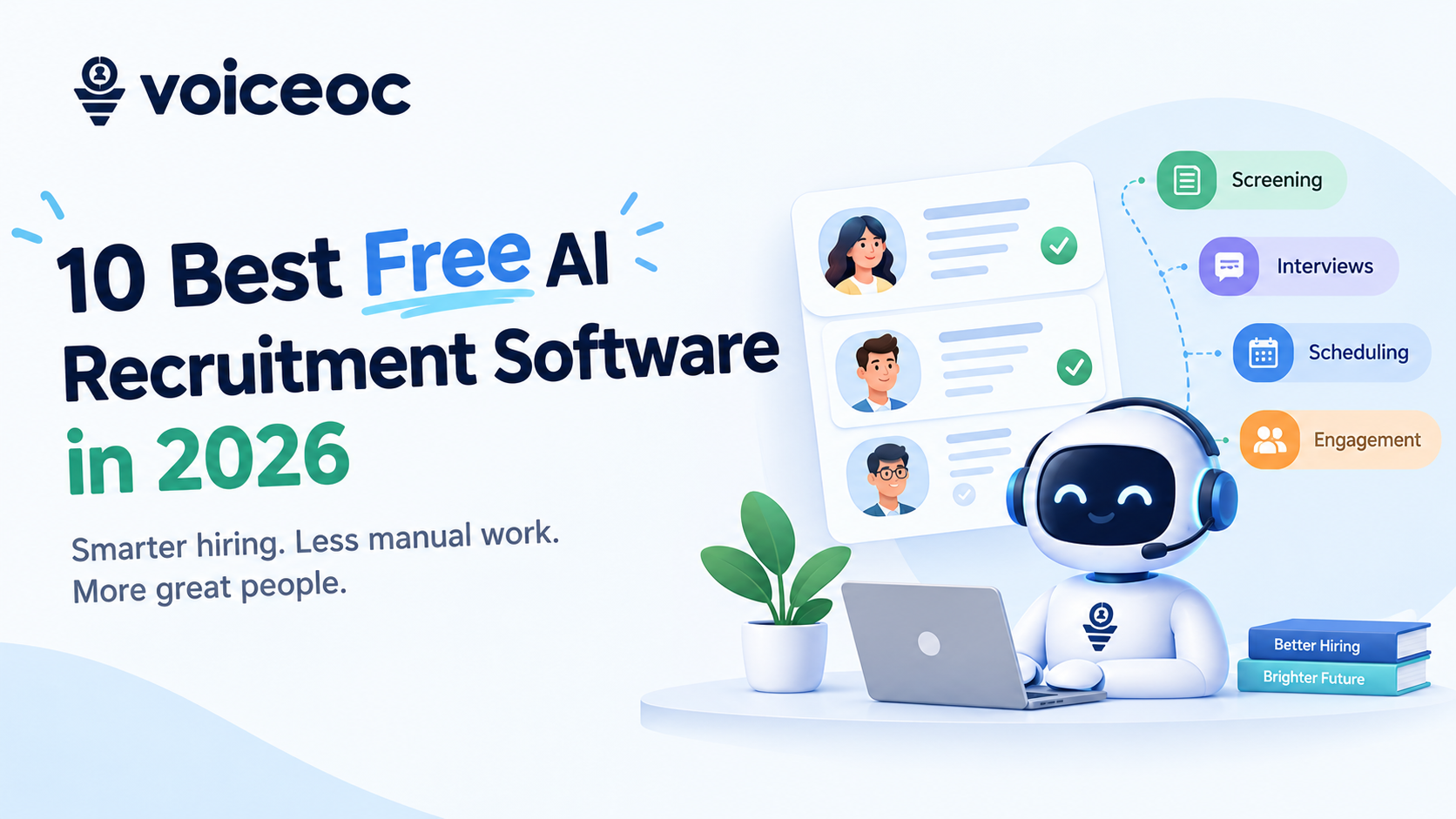
Recruitment teams are using artificial intelligence to reduce repetitive work and move candidates through the hiring process faster. Tasks such as reviewing resumes, qualifying applicants, answering candidate questions, conducting initial interviews, and scheduling meetings can take a significant amount of recruiter time when handled manually.
Free AI recruitment software gives companies an opportunity to explore these capabilities without immediately committing to a large software investment. However, not every AI recruiting tool works in the same way. Some focus on resume screening, while others specialize in interviews, sourcing, candidate engagement, or recruitment automation.
In this guide, we review 10 free or freemium AI recruitment software options in 2026, looking at what each tool does, where it fits into the hiring process, and the type of recruitment team it may suit.
What Is AI Recruitment Software?
AI recruitment software uses artificial intelligence to support different stages of the hiring process. Depending on the platform, it can analyze resumes, match candidates to job requirements, automate candidate conversations, conduct initial interviews, schedule interviews, and support recruiters with hiring workflows.
The biggest difference between traditional recruiting software and AI-powered platforms is the level of automation. Traditional tools generally help recruiters organize information, while AI tools can analyze information, interact with candidates, and automate repetitive steps.
For recruitment teams, the goal is not necessarily to replace recruiters. Instead, AI can take care of repetitive tasks so recruiters can spend more time on candidate evaluation, relationship building, and final hiring decisions.
10 Best Free AI Recruitment Software in 2026
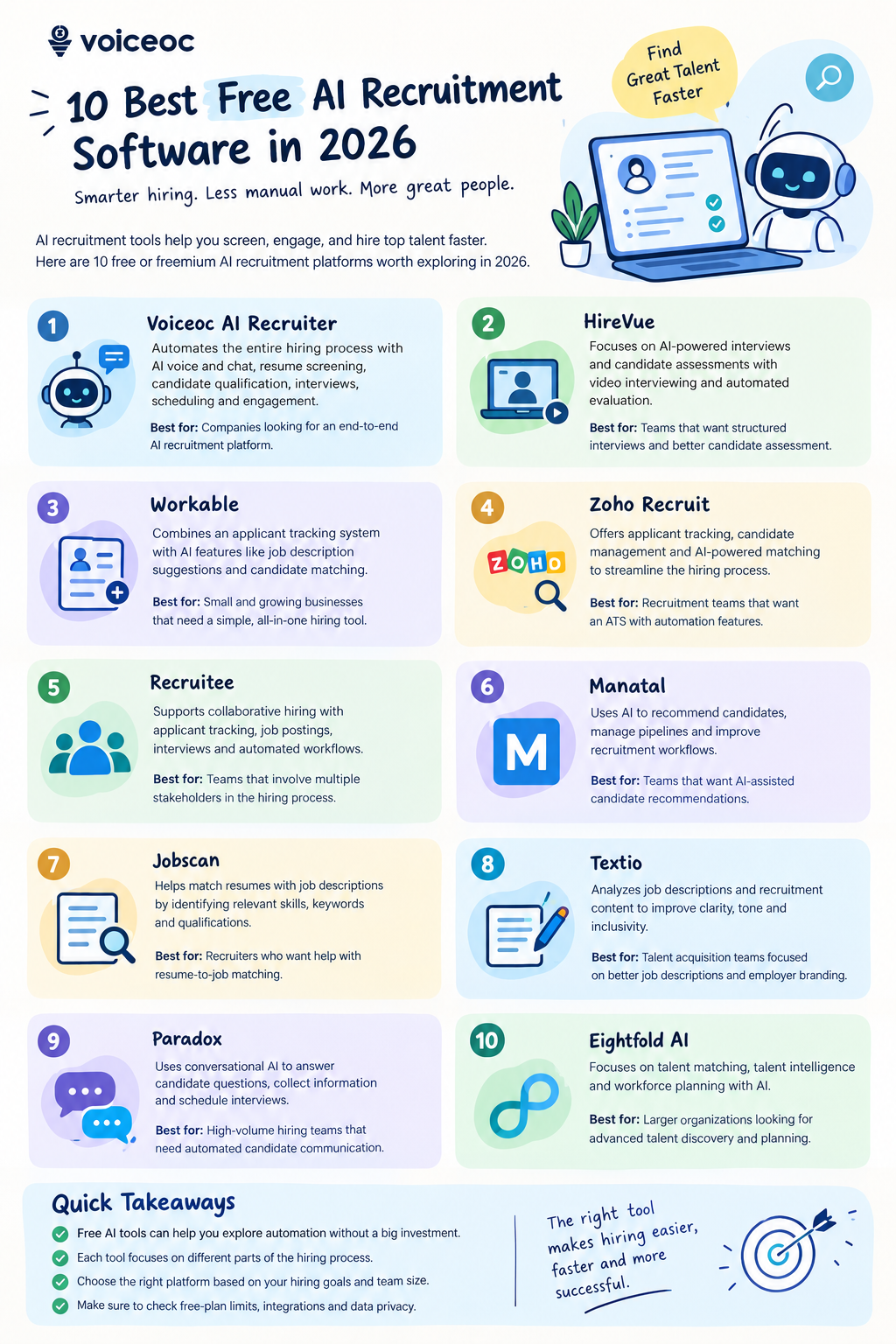
1. Voiceoc AI Recruiter
Best for: AI-powered candidate screening and recruitment automation
Voiceoc AI Recruiter helps recruitment teams automate several stages of the hiring process. Instead of focusing on a single recruitment task, it combines AI-powered candidate screening and qualification with voice and chat conversations, interviews, scheduling, and candidate engagement.
Recruiters can use Voiceoc to screen resumes, qualify candidates through AI conversations, conduct structured first-round AI voice interviews, and help schedule interviews with human recruiters. The platform can also support candidate communication throughout the hiring process.
This makes it particularly relevant for companies handling high-volume recruitment, where recruiters may spend significant time on repetitive screening and initial conversations.
Ideal for: Medium-sized businesses and enterprises looking to automate multiple recruitment workflows.
2. HireVue
Best for: AI-assisted interviews and candidate assessment
HireVue is a recruitment platform known for digital interviewing and candidate assessment. It helps organizations conduct structured interviews and evaluate candidates during early stages of recruitment.
Its tools can help recruiters manage video interviews, assessments, and candidate workflows. This can be useful for organizations that need to evaluate a large number of applicants while maintaining a consistent interview process.
Recruiters should review the current availability and limitations of its free or trial options before selecting it, as access to advanced features can vary by plan.
Ideal for: Organizations that want structured digital interviews and candidate assessments.
3. Workable
Best for: Recruitment management and AI-assisted hiring
Workable combines applicant tracking with recruitment features designed to help teams manage job postings, applicants, interviews, and hiring workflows.
Workable AI capabilities can support tasks such as job description creation and candidate-related workflows, while the broader platform helps recruiters keep the hiring process organized in one place.
For smaller teams, a free trial or limited access can be useful for understanding how the platform fits into an existing recruitment process.
Ideal for: Small and growing businesses looking for recruitment management with AI-assisted features.
4. Zoho Recruit
Best for: Applicant tracking and recruitment automation
Zoho Recruit combines applicant tracking, candidate management, job posting, and recruitment automation. It can help recruiters organize applicants and manage different stages of the hiring pipeline.
AI-powered features can support activities such as candidate matching and recruitment-related automation, depending on the selected plan.
Its broader recruitment management capabilities make it useful for teams that want more than a standalone AI screening tool.
Ideal for: Recruitment teams looking for an ATS combined with automation features.
5. Recruitee
Best for: Collaborative recruitment
Recruitee is designed around collaborative hiring and applicant tracking. It provides tools for managing candidates, recruitment pipelines, job postings, interviews, and communication.
Its automation capabilities can help reduce some repetitive recruitment tasks, while its collaborative features allow hiring teams to work together throughout the hiring process.
Teams considering the platform should check its current trial or pricing structure to determine which features are available without a paid subscription.
Ideal for: Small and mid-sized teams that involve multiple stakeholders in recruitment.
6. Manatal
Best for: AI-assisted candidate management
Manatal is an applicant tracking and recruitment platform that uses AI to support candidate recommendations and recruitment workflows.
Recruiters can organize candidate profiles, manage recruitment pipelines, and use AI-supported features to identify candidates that may match specific job requirements.
The platform can be useful when a recruitment team wants to combine candidate management with AI-assisted recommendations rather than using a standalone resume screening tool.
Ideal for: Recruiting teams that want an ATS with AI-supported candidate recommendations.
7. Jobscan
Best for: Resume and job-description matching
Jobscan focuses on helping job seekers and recruiters understand how closely resumes align with job descriptions.
Its matching approach can help identify relevant keywords, skills, and qualifications that may be important for a particular role.
While it is more focused on resume optimization and matching than end-to-end recruitment automation, it can be useful as part of an early-stage candidate evaluation process.
Ideal for: Recruiters and hiring teams that want assistance with resume-to-job-description matching.
8. Textio
Best for: Inclusive job descriptions and recruitment content
Textio uses AI to help organizations improve recruiting language and job descriptions. It can analyze recruitment content and provide suggestions around wording, clarity, and inclusive language.
For recruitment teams, this can be useful before applications even arrive because a well-written job description can make roles clearer to potential candidates.
Textio is therefore different from platforms focused primarily on candidate screening or interviews. Its value is concentrated on the content side of recruitment.
Ideal for: Talent acquisition teams focused on improving job descriptions and candidate-facing recruitment content.
9. Paradox
Best for: Candidate conversations and scheduling
Paradox uses conversational AI to help organizations interact with candidates during the recruitment process.
Its conversational assistant can support tasks such as answering candidate questions, collecting information, and helping with interview scheduling. This can reduce the amount of repetitive communication recruiters need to handle manually.
It can be especially useful for organizations where recruiters receive large numbers of candidate questions or scheduling requests.
Ideal for: High-volume recruiting teams that want to automate candidate communication and scheduling.
10. Eightfold AI
Best for: Talent matching and talent intelligence
Eightfold AI focuses on using AI and talent intelligence to help organizations identify and match candidates with opportunities.
Its technology can support areas such as talent discovery, candidate matching, internal mobility, and workforce planning. This makes it broader than a simple resume screening tool.
Because it is designed primarily for enterprise-level talent management and recruiting, users should evaluate its pricing and available plans carefully when looking specifically for a free solution.
Ideal for: Larger organizations interested in AI-powered talent matching and workforce intelligence.
What Can Free AI Recruitment Tools Actually Do?
The capabilities of free AI recruitment tools; vary considerably, but several common use cases are becoming increasingly important.
Resume screening: AI can analyze resumes and identify skills, experience, education, and other qualifications relevant to a role.
Candidate qualification: AI can ask predefined questions and collect information before a recruiter spends time speaking with a candidate.
AI interviews: Some platforms can conduct structured first-round interviews and capture candidate responses.
Interview scheduling: Recruitment software can reduce back-and-forth communication by allowing candidates to schedule interviews based on available times.
Candidate engagement: Conversational AI can answer common questions and provide information to candidates.
Recruitment automation: More advanced platforms can connect several of these activities into a single workflow.
The important difference is that some tools automate one part of recruitment, while others can support several stages from application to interview.
How to Choose the Right AI Recruitment Tool?
The right AI recruitment software depends on what your recruitment team needs to automate.
For small hiring teams, a simple tool that handles resume screening, job descriptions, or candidate management may be enough.
For high-volume hiring, look for software that can handle large numbers of applications and automate candidate screening, qualification, and communication.
For teams conducting many first-round interviews, AI interview capabilities may be more valuable than basic resume matching.
If candidate communication is a major challenge, consider platforms that support conversational AI through voice, chat, WhatsApp, or other communication channels.
Finally, consider practical factors such as integrations, data privacy, ease of implementation, scalability, and the limitations of the free plan or trial.
Connect with Voiceoc Team Experts and get a 30-min free consultation on Voiceoc AI Recruiter!
Free vs. Paid AI Recruitment Software
Free AI recruiting tools can be useful for testing AI capabilities, automating small recruitment tasks, or supporting teams with limited hiring requirements.
However, free versions often have restrictions on candidate volume, AI usage, integrations, automation, or advanced features.
Paid plans typically provide greater capacity, more automation, additional integrations, analytics, customization, and enterprise capabilities.
Before choosing a tool, recruiters should look beyond the word "free" and determine whether the available features actually support their recruitment workflow.
Frequently Asked Questions
Which AI Tool is best for recruitment?
There is no single tool that is best for every recruitment team. The right option depends on the hiring process. A company primarily looking for resume matching may need a different tool from a company looking to automate screening, interviews, scheduling, and candidate engagement.
What are the best AI tools for talent acquisition?
The best AI tools for talent acquisition depend on the specific workflow. Platforms can support sourcing, resume screening, candidate matching, interviewing, scheduling, communication, and recruitment automation.
Are there free AI tools for recruitment?
Yes. Several recruitment platforms offer free plans, limited free features, or free trials. However, the amount of AI usage and available functionality varies between platforms.
Can AI recruitment software screen resumes?
Yes. AI recruitment software can analyze resumes and compare candidate information with job requirements, skills, experience, and other predefined criteria.
Can AI conduct recruitment interviews?
Some AI recruitment platforms can conduct structured first-round interviews using conversational AI. These tools can collect candidate responses and provide information that recruiters can use during later stages of the hiring process.
Conclusion
AI recruitment software is becoming a practical way for hiring teams to reduce repetitive work and manage increasingly complex recruitment processes. Free AI tools can be a useful starting point for companies that want to test AI without immediately committing to a paid platform.
The key is to choose software based on the recruitment problem you are trying to solve. Some tools are designed for resume matching or job descriptions, while others can support candidate conversations, interviews, scheduling, and broader recruitment workflows.
For organizations looking to automate multiple stages of hiring, Voiceoc AI Recruiter provides an AI-powered approach that combines candidate screening, qualification, AI voice and chat interactions, first-round interviews, scheduling, and candidate engagement in one recruitment workflow.