Artificial intelligence is changing how companies attract, screen, interview, and hire talent. What started as simple automation for resume screening and job description writing has evolved into AI-powered recruitment workflows that can support recruiters throughout the hiring process.
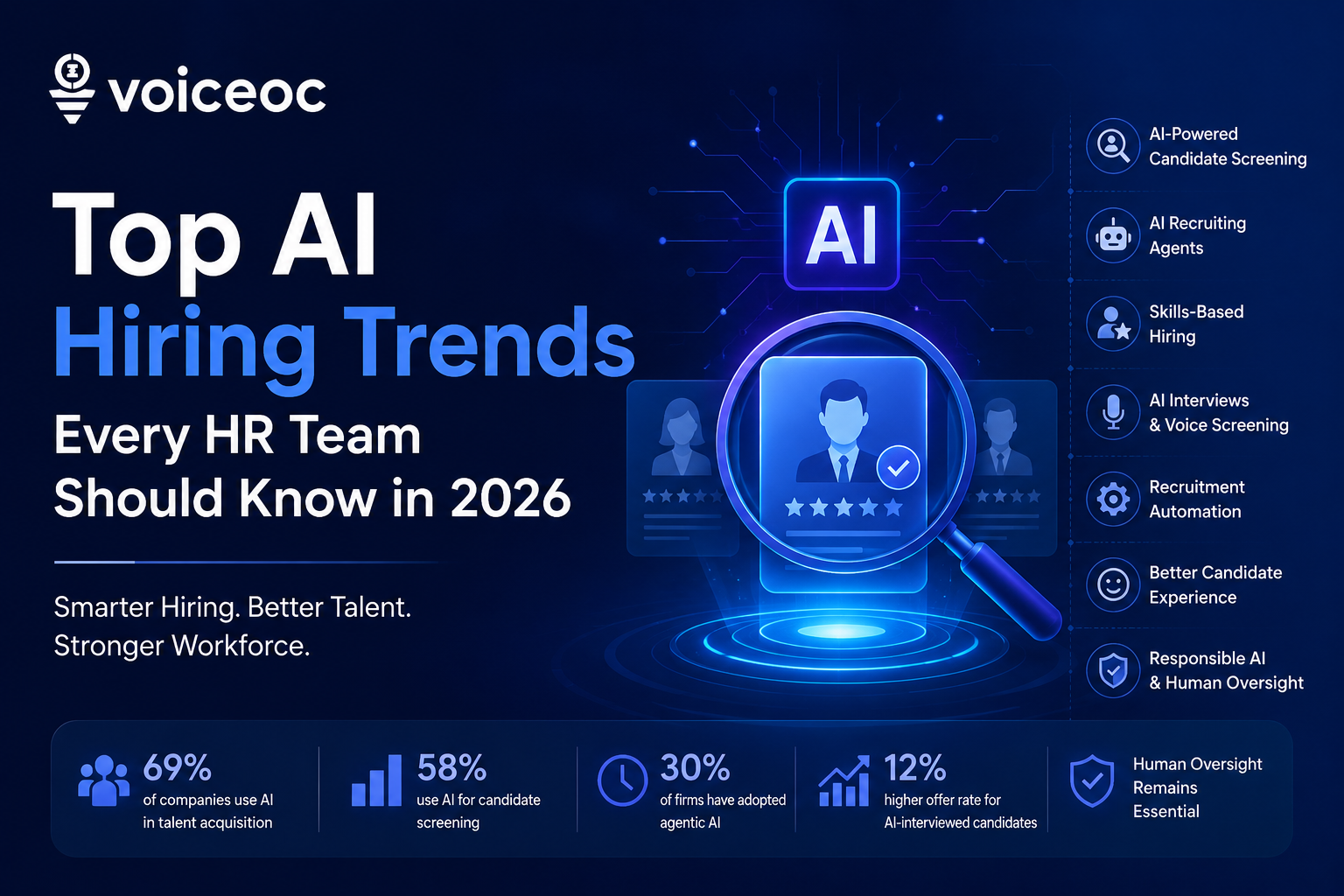
In 2026, AI is becoming less of an experimental HR technology and more of a practical part of talent acquisition. According to iCIMS and Aptitude Research, 69% of companies surveyed use AI in some capacity in talent acquisition, although only 18% have adopted it broadly across their hiring processes.
Looking for the right AI Recruitment Software platform? If yes, fill up the form today and book 30-min free consultation with Voiceoc experts.
The biggest change is that AI is moving beyond individual tasks. Recruiters are increasingly using AI for candidate screening, communication, assessments, sourcing, interviews, and workflow automation.
Let's move to the next section and know in depth about top AI Hiring Trends that every HR team must know.
For HR teams, the question is no longer whether AI will influence hiring. The more important question is where AI can create measurable value while keeping human judgment at the center of important hiring decisions.
How Is AI Changing Recruitment in 2026?
Recruitment has evolved from manual hiring to technology-assisted hiring and now toward AI-powered and agentic recruitment.
Earlier recruitment software primarily helped HR teams organize applications and track candidates. Modern AI recruitment technology can understand job requirements, identify relevant skills, screen candidates, communicate with applicants, and automate repetitive steps.
According to iCIMS, candidate screening is currently the most common AI use case in talent acquisition, followed by candidate communication, assessments, and sourcing.
This shift is creating a new recruitment model where AI handles repetitive, time-consuming tasks while recruiters spend more time on candidate relationships, hiring strategy, and final decisions.
8 AI Hiring Trends HR Teams Need to Know in 2026
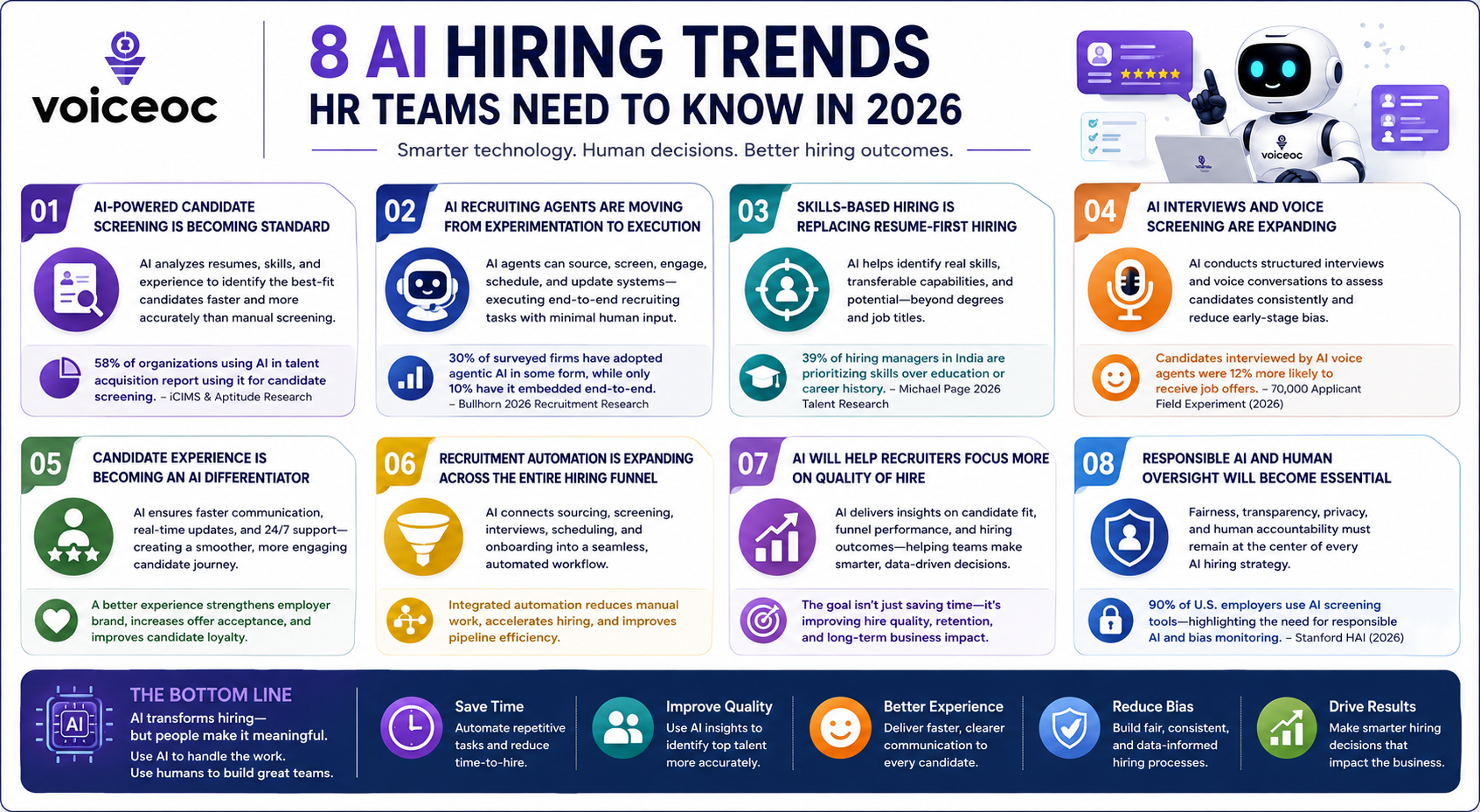
1. AI Candidate Screening Is Becoming Standard
One of the biggest AI hiring trends in 2026 is the growing use of AI for candidate screening.
Traditional screening requires recruiters to manually review hundreds of resumes and compare qualifications against job requirements. This can be particularly challenging when companies receive thousands of applications for a single position.
AI candidate screening software can help recruiters analyze resumes, identify relevant skills, compare candidate profiles with job requirements, and prioritize applicants for further review.
Modern AI screening can go beyond simple keyword matching. Instead of looking only for an exact term, AI systems can identify related skills, experience, qualifications, and transferable capabilities.
According to iCIMS and Aptitude Research, 58% of organizations using AI in talent acquisition report using it for candidate screening, making it the most common AI use case in their research.
The goal isn't to allow AI to make hiring decisions independently. Instead, AI can serve as a first-level screening assistant, helping recruiters spend less time filtering applications and more time evaluating qualified candidates.
2. AI Recruiting Agents Are Moving From Experimentation to Execution
AI recruiting agents are emerging as one of the most important developments in recruitment technology.
There is an important difference between an AI assistant and an AI recruiting agent.
An AI assistant may answer a recruiter's question or generate a job description. An AI recruiting agent can potentially perform a sequence of connected tasks based on a defined objective.
For example, an AI recruiting agent could:
- Receive hiring requirements.
- Identify potentially suitable candidates.
- Screen applicants against predefined criteria.
- Conduct an initial conversational screening.
- Schedule qualified candidates for interviews.
- Update recruitment systems.
- Escalate complex cases to a recruiter.
Bullhorn's 2026 recruitment research found that 30% of surveyed firms had moved to some level of agentic AI, although only 10% reported having AI embedded throughout their workflow.
This demonstrates an important shift: organizations are moving from asking AI to recommend the next action toward using AI to execute parts of the recruitment workflow.
For HR teams, this can create a more scalable hiring process without requiring recruiters to manually coordinate every step.
3. Skills-Based Hiring Is Replacing Resume-First Hiring
Another major AI recruitment trend is the shift toward skills-based hiring.
Traditional hiring often starts with education, job titles, certifications, and years of experience. While these factors remain relevant for many roles, they don't always provide a complete picture of a candidate's capabilities.
Skills-based hiring focuses more directly on what candidates can actually do.
AI can help recruiters identify:
- Technical skills
- Transferable skills
- Industry knowledge
- Communication skills
- Relevant experience
- Skill gaps
- Potential job fit
This is becoming particularly important as job requirements change quickly.
According to 2026 talent research reported by Michael Page, 39% of hiring managers in India are prioritizing skills over education or career history.
AI can make this approach more scalable by analyzing candidate profiles and identifying relevant skills that recruiters might otherwise miss during a manual review.
For HR teams, this means recruitment can become less focused on whether someone has followed a traditional career path and more focused on whether they have the capabilities required to succeed in a role.
4. AI Interviews and Voice Screening Are Expanding
AI interview screening software are becoming another important component of modern recruitment.
Instead of requiring a recruiter to conduct every initial screening call, companies can use conversational AI or AI voice technology to conduct structured preliminary conversations with candidates.
AI interviews can be used to ask predefined questions, collect candidate information, assess basic qualifications, and determine whether a candidate should move to the next stage.
A 2026 field experiment involving 70,000 job applicants found that applicants interviewed by AI voice agents were 12% more likely to receive job offers. Human recruiters still evaluated the interviews and made the final hiring decisions.
The result highlights an important potential advantage of AI interviews: consistency.
Every candidate can receive a structured set of questions, while recruiters can receive standardized information that makes comparisons easier.
However, HR teams should also consider candidate transparency, accessibility, privacy, and the risk of over-automating the interview experience.
AI interviews work best when they support recruiters rather than completely remove human interaction from the hiring process.
Must Read: Top AI Recruiting Tools Every Enterprise HR Teams Must Know
5. Candidate Experience Is Becoming an AI Differentiator
Recruitment isn't only about finding qualified candidates. It is also about how candidates experience the hiring process.
Slow responses, unclear communication, complicated scheduling, and long waiting periods can negatively affect candidate experience and employer brand.
AI can help address some of these challenges by providing candidates with faster and more accessible communication.
For example, conversational AI can help candidates:
- Get answers to frequently asked questions
- Check application status
- Complete initial screening
- Schedule interviews
- Receive reminders
- Understand the next step in the hiring process
This can be particularly useful for organizations hiring at scale.
However, automation should not mean removing human interaction entirely. Candidates still need access to recruiters or hiring managers when they have complex questions, require clarification, or reach important stages of the hiring process.
The strongest approach is therefore a combination of AI speed and human connection.
6. Recruitment Automation Is Expanding Across the Entire Hiring Funnel
AI hiring is no longer limited to resume screening.
Organizations are increasingly looking at how AI can connect multiple stages of the recruitment process.
A modern AI-powered hiring workflow can look like:
Job Requirement → Candidate Sourcing → Screening → AI Interview → Scheduling → Recruiter Review → Hiring → Onboarding
The advantage of this approach is that AI can reduce manual handoffs between different stages.
For example, once a candidate meets predefined screening criteria, the system can potentially move them to the next stage, initiate a screening conversation, schedule an interview, and notify the recruiter.
Phenom's 2026 research highlights the growing opportunity to connect activities such as parsing, scoring, matching, routing, screening, and scheduling into a more continuous hiring workflow.
This is where recruitment automation becomes significantly more valuable than using multiple disconnected AI tools.
Instead of simply adding AI to individual tasks, HR teams can build a connected workflow where different AI capabilities work together.
7. AI Will Help Recruiters Focus More on Quality of Hire
One of the biggest mistakes companies can make is measuring AI recruitment success only by how much time it saves.
Saving recruiter hours is useful, but the ultimate goal of recruitment is to find and retain the right people.
AI can help recruiters analyze and improve different parts of the hiring funnel, including:
- Candidate-job fit
- Screening quality
- Interview completion
- Offer acceptance
- Time-to-hire
- Cost-per-hire
- Candidate engagement
- Quality of hire
Bullhorn's 2026 recruitment research indicates that organizations using AI for screening can reduce the time recruiters spend searching for and screening candidates.
The next step is connecting these productivity gains with hiring outcomes.
For example, an HR team shouldn't only ask:
"How many hours did AI save our recruiters?"
It should also ask:
"Did AI help us identify qualified candidates faster and improve the quality of our hiring decisions?"
This shift from productivity metrics to business outcomes will become increasingly important as AI adoption grows.
8. Responsible AI and Human Oversight Will Become Essential
Recent AI hiring trends can create significant advantages in recruitment, but it also introduces risks that HR teams cannot ignore.
AI hiring systems can potentially reproduce biases present in historical hiring data. There are also concerns around candidate privacy, transparency, accessibility, explainability, and automated decision-making.
A 2026 Stanford HAI study found that 90% of U.S. employers use AI screening tools, while highlighting concerns around racial bias and systemic rejection in AI-assisted hiring.
This makes responsible AI an essential part of any modern recruitment strategy.
HR teams should establish clear guidelines around:
- What AI can and cannot do
- When human review is required
- How candidate data is stored and processed
- How AI systems are tested for bias
- How candidates are informed about AI use
- How AI decisions can be reviewed or challenged
The best AI hiring strategy is not one where humans disappear from the process.
It is one where AI handles appropriate tasks while humans remain accountable for important hiring decisions.
If you are looking for a right AI recruitment software, then Voiceoc AI Recruiter works best for you.
Schedule a 30-min free consultation session with Voiceoc team experts and get the information about all in detail.
How Can HR Teams Prepare for AI Hiring in 2026?
HR Recruitment teams don't need to automate the entire recruitment process overnight. A practical approach is to start with the areas where AI can provide the clearest value.
1. Identify Repetitive Tasks
Start by identifying activities that consume significant recruiter time, such as resume screening, scheduling, candidate communication, and interview coordination.
2. Prioritize High-Impact Use Cases
Choose AI hiring applications that directly address existing recruitment bottlenecks.
For many organizations, this could mean starting with AI candidate screening, candidate engagement, or interview scheduling.
3. Keep Humans in the Loop
AI should support recruiters rather than remove accountability from the hiring process.
Recruiters should remain involved in important candidate evaluations and final hiring decisions.
4. Integrate AI With Existing Systems
AI recruitment technology becomes more valuable when it works with the ATS, HRMS, calendars, communication platforms, and other systems already used by HR teams.
5. Establish AI Governance
Create clear policies for data privacy, transparency, bias monitoring, human oversight, and candidate communication.
6. Measure the Results
Track metrics such as:
- Time-to-hire
- Time-to-screen
- Cost-per-hire
- Candidate response time
- Qualified candidate rate
- Offer acceptance rate
- Quality of hire
- Recruiter productivity
This allows HR leaders to determine whether AI is creating measurable business value rather than simply adding another technology layer.
What Will AI Hiring Software Look Like in the Future?
The next stage of AI recruitment will likely involve more connected and autonomous AI workflows.
We can expect to see continued development in:
- Autonomous recruiting agents
- AI voice recruiters
- Continuous candidate sourcing
- Predictive talent matching
- AI-powered skills assessments
- Automated candidate engagement
- AI-powered internal mobility
- End-to-end recruitment automation
The biggest change will be the movement from individual AI tools toward connected AI hiring systems.
Instead of using separate tools for sourcing, screening, interviews, and scheduling, organizations will increasingly look for systems that can coordinate multiple stages of recruitment.
Frequently Asked Questions
What are the biggest AI hiring trends in 2026?
The biggest trends include AI candidate screening, AI recruiting agents, skills-based hiring, AI interviews, recruitment automation, AI-powered candidate engagement, and responsible AI governance.
How is AI changing the recruitment process?
AI is automating repetitive recruitment tasks such as candidate screening, sourcing, communication, scheduling, and initial interviews while giving recruiters more time for strategic and human-centered activities.
What is an AI recruiting software?
An AI recruiting agent is an AI system capable of performing multiple connected recruitment tasks, such as screening candidates, communicating with applicants, scheduling interviews, and escalating qualified candidates to recruiters.
How does AI candidate screening work?
AI candidate screening analyzes candidate information against job requirements and can identify relevant skills, experience, qualifications, and potential job fit to help recruiters prioritize applicants.
Will AI replace recruiters?
AI is more likely to change the role of recruiters than eliminate it entirely. Recruiters can use AI to automate repetitive work while focusing more on relationships, judgment, candidate experience, and strategic hiring.
Is AI hiring safe and unbiased?
AI hiring requires careful governance. Organizations should monitor systems for bias, protect candidate data, maintain human oversight, and provide transparency about how AI is used during recruitment.
Conclusion
Utilizing AI Recruitment Software for hiring in 2026 is moving beyond simple automation.
The biggest opportunity for HR teams is to use AI platform across the recruitment workflow, from candidate screening and skills matching to interviews, communication, scheduling, and recruitment analytics.
But successful AI adoption isn't about replacing recruiters or automating every decision. It is about giving recruiters better technology to reduce repetitive work, improve candidate experiences, and make more informed hiring decisions.
The organizations that gain the most from AI recruitment platform will be those that combine AI automation, human judgment, skills-based hiring, strong candidate experiences, and responsible AI governance.
For companies looking to adopt AI candidate screening, platforms such as Voiceoc can help bring conversational AI and automated screening into the recruitment workflow, allowing recruiters to spend less time on repetitive screening and more time engaging with the candidates who matter most.