Hiring has a volume problem. For every open role, recruiters can receive dozens, sometimes hundreds of applications, but only a fraction of those candidates are actually qualified. The traditional screening process- resume review, manual calls, repetitive question-asking, endless scheduling back-and-forth- wasn't built to handle this volume efficiently. That's where AI candidate screening comes in.
AI candidate screening uses conversational AI to engage every applicant, ask role-specific questions, evaluate their answers against your hiring criteria, and surface only the candidates worth a recruiter's time. Instead of spending hours on first-round conversations, recruiters receive a shortlist of qualified, interview-ready candidates, often within minutes of an application being received.
In this guide, we'll break down exactly how AI-driven screening transforms every stage of the hiring funnel, why manual screening struggles to keep up with modern hiring demands, and what recruiting teams should look for when adopting an AI Candidate screening platform like Voiceoc.
The Real Cost of Manual Screening
Before looking at how AI changes the process, it's worth understanding what manual screening actually costs a recruiting team:
- Time drain on repetitive work. Recruiters end up asking the same qualifying questions- availability, experience level, notice period, salary expectations, must-have skills- to every single applicant, call after call.
- Inconsistent evaluation. When different recruiters (or the same recruiter on a busy day versus a slow one) screen candidates manually, the bar can shift. One candidate might get a tougher line of questioning than another purely by chance.
- Slow response times. Candidates who apply and don't hear back within a few days often lose interest or accept another offer. Manual processes make fast response nearly impossible at scale.
- Qualified candidates get missed. With limited hours in the day, recruiters can only manually screen so many people, meaning strong candidates further down the resume pile may never get a call at all.
- Scheduling friction. Coordinating interview times across recruiters, hiring managers, and candidates by email can add days to a process that should take hours.
Each of these issues compounds during high-volume hiring, seasonal hiring, campus recruiting, retail or BPO staffing, or fast-scaling startups, where the sheer number of applicants makes manual screening close to unmanageable.
How AI Candidate Screening Platform Helps Recruiters Hire Faster? - 7 Steps
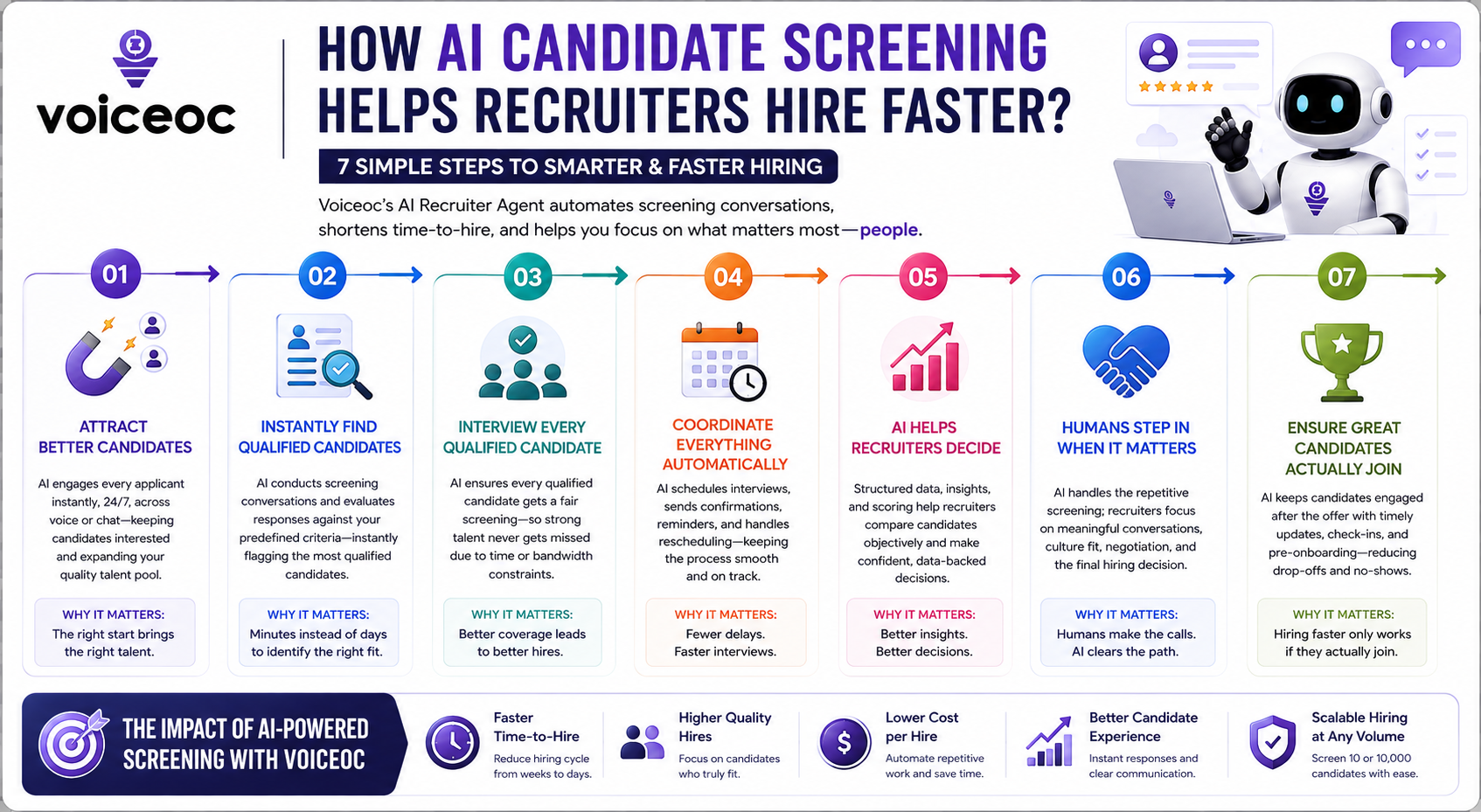
Step 1: Attract Better Candidates
Faster hiring doesn't start with screening; it starts with attracting the right people in the first place. An AI recruiter screening platform like Voiceoc engages every applicant immediately after they apply, giving even passive or hesitant candidates a reason to stay engaged instead of dropping off. Because the AI is available around the clock, candidates in different time zones or working other jobs can respond and interact on their own schedule, widening your pool of quality applicants rather than just increasing raw application volume.
This immediate engagement also shapes candidate perception of your company. A slow, silent application process signals disorganization; an instant, conversational response signals a company that values candidates' time.
Why it matters: Attracting the right candidates upfront reduces the downstream burden on recruiters and improves the quality of every later stage in the pipeline.
Step 2: Instantly Find Qualified Candidates With Screening Software
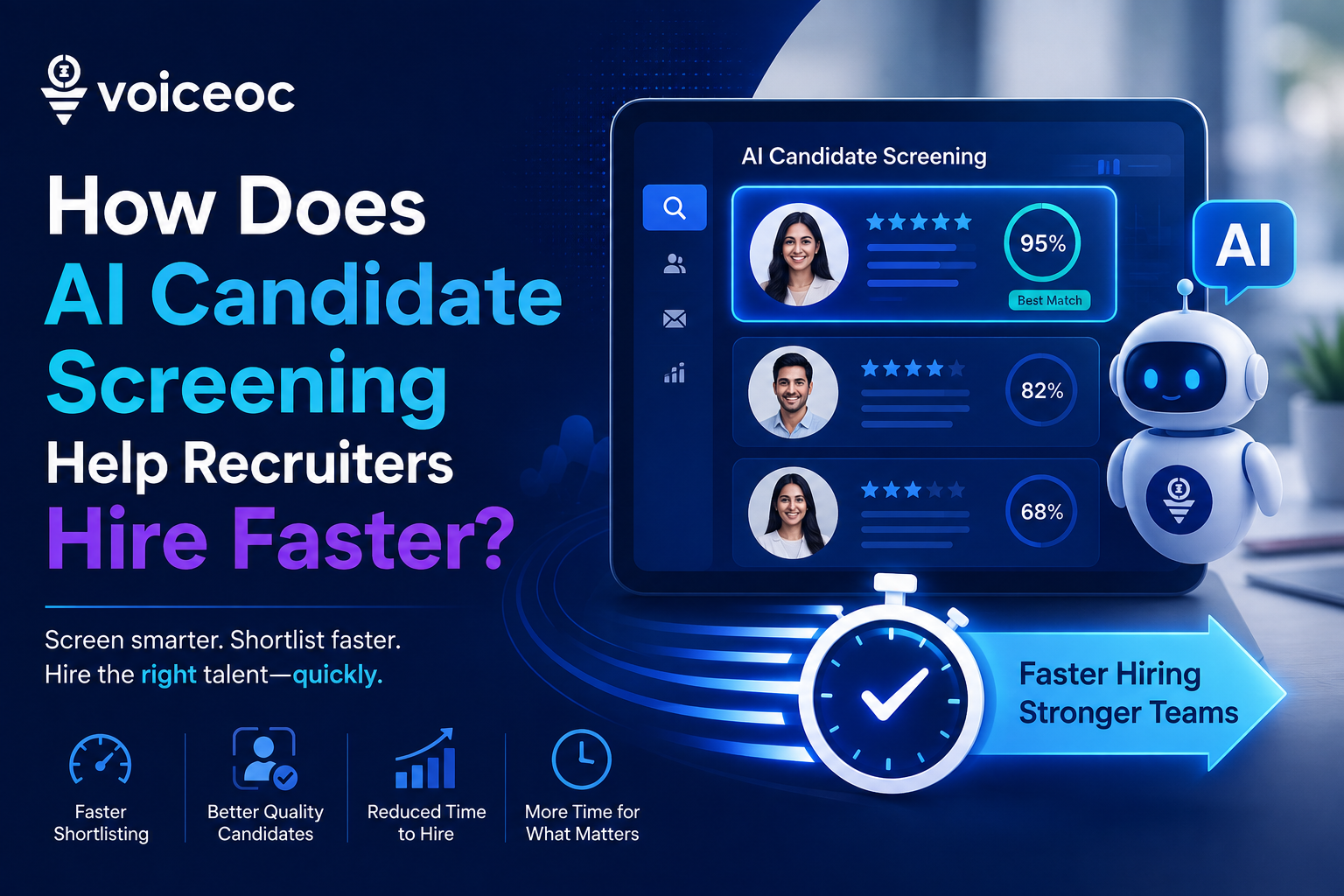
Once applications start coming in, automated candidate screening takes over. The AI conducts natural voice or text conversations with each applicant, asking role-specific screening questions covering skills, experience, availability, and other must-have criteria defined by the recruiter. Responses are evaluated instantly against these predefined requirements, so instead of a recruiter manually reading through hundreds of resumes or conducting repetitive intro calls, they receive a filtered, ranked list of candidates who actually meet the bar.
This step typically covers the same ground a recruiter's first screening call would: confirming experience level, verifying availability and location constraints, checking salary expectations, and probing role-specific competencies, but it happens in parallel across every applicant, not one at a time.
Why it matters: What used to take days of manual review now happens in minutes, without sacrificing consistency or accuracy in how candidates are evaluated.
Step 3: Interview Every Qualified Candidate
One of the highest hidden costs of manual screening is that qualified candidates get skipped simply because there wasn't enough time for recruiters to talk to everyone. With AI handling first-round conversations at scale, every candidate who meets the criteria gets evaluated, not just the first few resumes a recruiter happened to open. This means strong candidates no longer fall through the cracks because of bandwidth constraints, and hiring teams get a genuinely representative view of their qualified applicant pool.
This matters most for roles with high applicant volume, where recruiters historically had to make a judgment call about which resumes were even worth opening. AI removes that guesswork by evaluating everyone against the same standard.
Why it matters: Interviewing every qualified candidate, not a rushed sample, leads to better hires and fewer missed opportunities.
Step 4: Coordinate Everything Automatically
Scheduling is one of the most time-consuming, low-value parts of recruiting. AI interview scheduling removes the back-and-forth emails and calendar juggling by coordinating interview times directly with candidates based on recruiter and panel availability. Confirmations, reminders, and rescheduling are handled automatically, keeping the process moving without recruiter intervention at every step.
This also reduces no-shows: automated reminders sent close to the interview time keep the appointment top of mind for candidates, especially those juggling a current job or multiple interview processes.
Why it matters: Automated coordination shortens time-to-interview and reduces candidate drop-off caused by scheduling delays.
Read More: Best AI Recruiting Software in 2026 - Top Platforms for Startups, Staffing Firms, & Enterprises
Step 5: AI Helps Recruiters Decide
AI candidate screening platform isn't just about filtering people out; it's about giving recruiters better information to make decisions. Every conversation produces structured data: how a candidate answered key questions, how their experience maps to role requirements, and where they stand relative to other applicants. Recruiters get clear, organized screening insights instead of raw transcripts or gut impressions, making it easier to compare candidates objectively and move forward with confidence.
This structured approach also helps with reporting; hiring managers and leadership can see, at a glance, how many candidates were screened, how many qualified, and where the pipeline is converting or stalling.
Why it matters: Data-backed screening insights lead to more consistent, defensible hiring decisions across the team.
Step 6: Humans Step In When It Matters
AI handles the repetitive, high-volume work, but the final hiring decision stays with people. Voiceoc is designed to support recruiters, not replace their judgment. Once candidates are screened, qualified, and organized, recruiters step in for the parts of hiring that genuinely require human judgment: deeper interviews, culture fit conversations, negotiation, and the final call on who gets an offer.
This division of labor is central to how AI recruiting tools should work: automation handles volume and repetition, humans handle nuance and relationship-building.
Why it matters: This balance lets recruiters spend their time where it counts, building relationships and making decisions, instead of on repetitive administrative screening.
Step 7: Ensure Great Candidates Actually Join
Hiring doesn't end when an offer is extended. Candidates can go cold, receive competing offers, or lose engagement during the gap between offer and start date. Consistent, timely communication throughout this window, something AI candidate screening can help maintain through regular check-ins, reminders, and pre-onboarding updates, keeps candidates engaged and reduces the risk of offer drop-off or no-shows on day one.
Why it matters: A faster hiring process only pays off if candidates actually join, making post-offer engagement a critical final step.
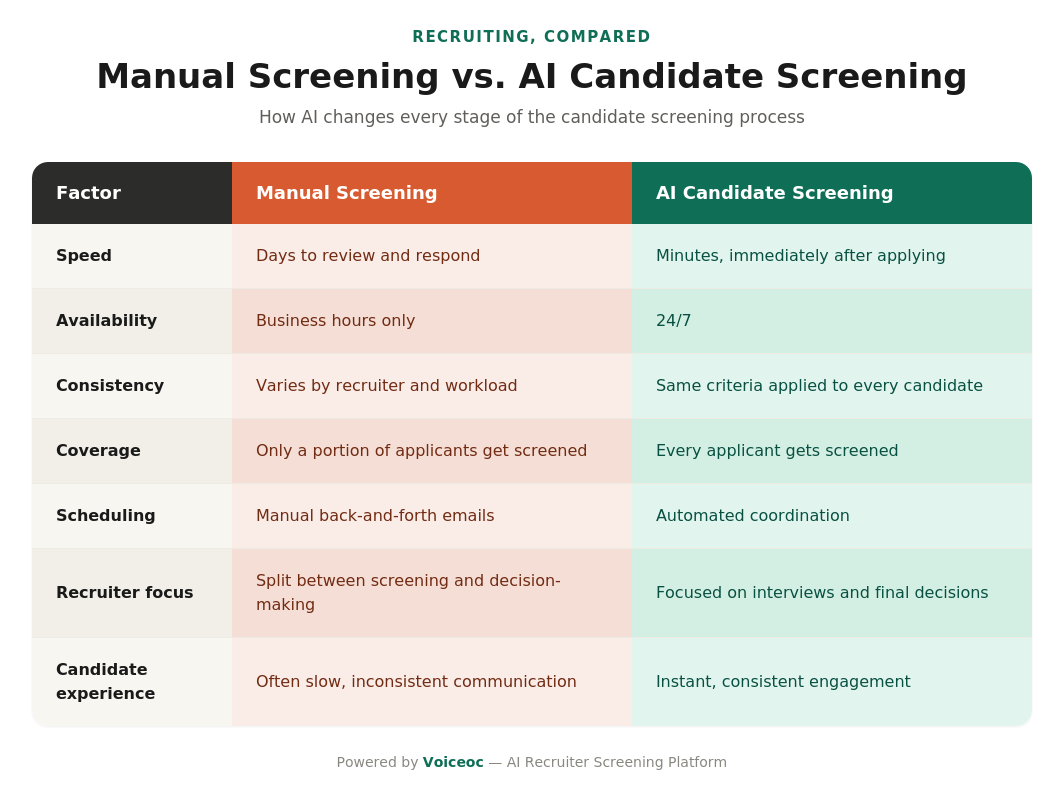
Manual Screening vs. AI Candidate Screening Platform
Who Benefits Most from AI Candidate Screening?
While any recruiting team can benefit from removing repetitive work, AI screening tends to deliver the biggest impact for:
- High-volume hiring — retail, BPO/call centers, delivery and logistics, hospitality, and other roles with large applicant pools
- Seasonal and bulk hiring — festive season, campus placements, or rapid team scaling
- Distributed and remote hiring — engaging candidates across time zones without limiting screening to business hours
- Lean recruiting teams — smaller HR teams that need to do more with the same headcount
- Roles with well-defined qualification criteria — where must-have skills, experience, and availability can be clearly screened for upfront
Key Metrics AI Interview Software for Screening Improves
Recruiting teams adopting AI screening typically track improvements across:
- Time-to-screen — how long it takes from application to a qualification decision
- Time-to-interview — how quickly a qualified candidate gets on a recruiter's calendar
- Recruiter hours spent on first-round screening
- Candidate response and completion rates for screening conversations
- Offer-to-join ratio, reflecting how well candidates stay engaged after an offer
Why AI Candidate Screening Is Becoming Essential for Recruiters?
Put together, these seven steps show why more recruitment teams are adopting AI screening software: it doesn't just speed up one part of hiring; it removes friction and manual effort from the entire funnel, from first contact to first day. The result is a hiring process that is:
- Faster — candidates are screened in minutes, not days
- More consistent — every applicant is evaluated against the same criteria
- More scalable — high application volumes no longer overwhelm recruiting teams
- More candidate-friendly — instant, 24/7 engagement instead of long silences
- More human where it counts — recruiters focus on judgment-driven work, not repetitive screening
How Voiceoc AI Candidate Screening Software Fits In?
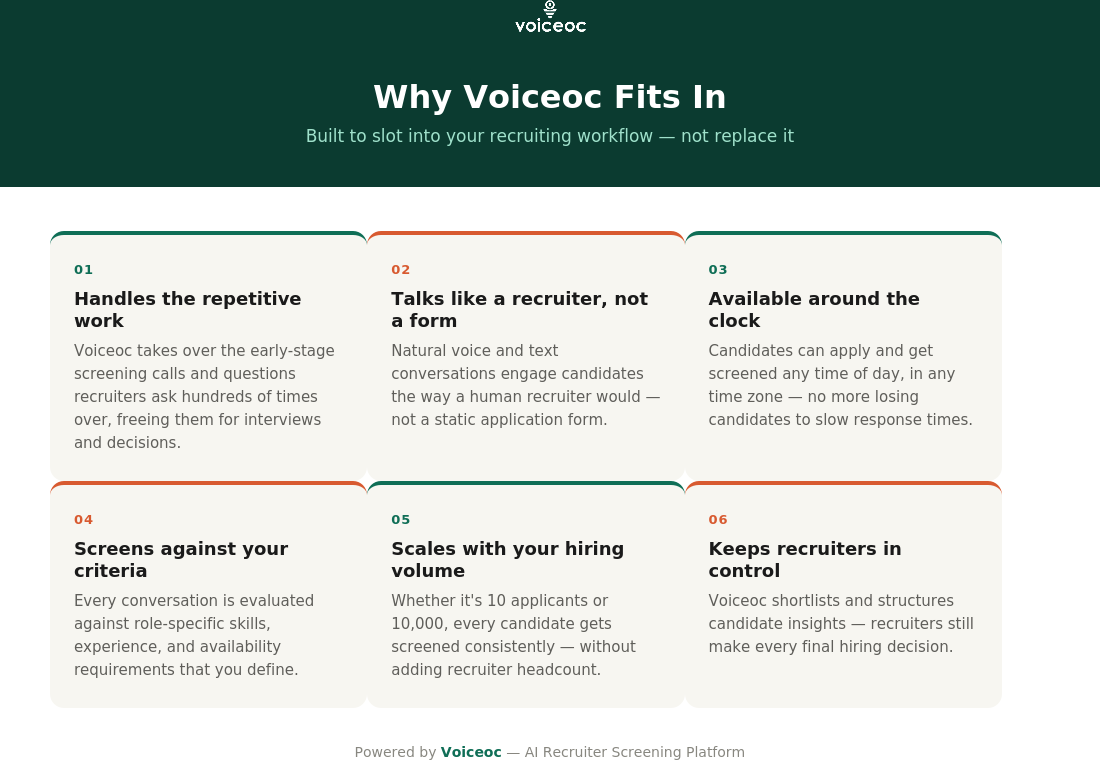
Voiceoc is an AI candidate screening platform built around exactly this workflow. It engages candidates through natural voice and text conversations, screens them against job-specific criteria, shortlists qualified applicants, automates interview coordination, and gives recruiters structured insights to make faster, better-informed hiring decisions, all while keeping humans in control of the final call.
Recruiting teams using Voiceoc can move from "application received" to "qualified, interview-ready candidate" without a recruiter having to conduct a single manual first-round call, freeing that time for the interviews and decisions that actually need a human.
Book a 30-min free consultation on AI Candidate Screening Software with Voiceoc Experts!
Frequently Asked Questions
- What is AI candidate screening?
AI candidate screening is the use of conversational AI to engage job applicants, ask role-specific screening questions, and evaluate their responses against predefined hiring criteria, automating the first stage of the recruitment process.
- Does AI candidate screening replace recruiters?
No. AI handles repetitive, high-volume early-stage screening, while recruiters retain control over final decisions, deeper interviews, and candidate relationships.
- How does AI screening help recruiters hire faster?
By instantly screening every applicant, interviewing all qualified candidates rather than a small sample, automating scheduling, and providing structured insights, AI screening removes the biggest time bottlenecks in the hiring funnel.
- Is AI candidate screening only useful for high-volume hiring?
It's most impactful at scale, but any recruiting team dealing with repetitive screening questions and scheduling coordination can benefit from automating those steps.
- Does AI screening improve candidate experience?
Yes. Candidates get faster responses, can engage on their own schedule through voice or text, and aren't left waiting days to hear back, which tends to improve how candidates perceive the hiring company.
- What happens after AI screens a candidate?
Qualified candidates are shortlisted and handed off to recruiters with structured screening insights, ready for interview scheduling and further evaluation by the hiring team.
- Can AI screening be customized for different roles?
Yes, screening questions and qualification criteria are typically set per role, so the AI candidate interview software evaluates candidates against the specific skills, experience, and requirements relevant to that job.