

Healthcare systems around the world are under constant pressure. Primary care clinics are facing increasing patient loads, limited staff, and rising expectations for faster, more personalised care. This is where AI virtual health assistants in primary care are emerging as a practical and scalable solution.
Fill up the form and connect for a 30-min free consultation on an AI primary care assistant!
From appointment scheduling to patient follow-ups, AI is no longer a futuristic concept; it is already reshaping how primary care clinics operate and serve patients.
What Is an AI-Powered Virtual Health Assistant in Primary Care?
An AI medical assistant for primary care is a software-based system that uses artificial intelligence to automate routine clinical and administrative tasks. These assistants interact with patients through chat, voice, or messaging platforms and support healthcare providers by reducing manual workload.
Unlike traditional software, AI assistants can understand patient queries, provide context-aware responses, and continuously improve through data and usage patterns.
Why Primary Care Needs AI Assistants Today?
Primary care is often the first point of contact for patients, which makes efficiency and accessibility critical. However, clinics frequently struggle with:
- High call volumes for appointment booking
- Staff burnout due to repetitive administrative work
- Missed follow-ups and delayed responses
- Limited time for doctors to focus on patient care
A primary care AI assistant addresses these challenges by acting as a digital support system that works 24/7 without fatigue.
Key Roles of an AI Medical Assistant for Primary Care
1. Virtual Receptionist for Clinics
An AI primary care virtual receptionist handles front-desk tasks such as:
- Appointment scheduling and rescheduling
- Answering common patient questions
- Sharing clinic timings, location, and services
- Managing cancellations and reminders
This reduces dependency on human reception staff while ensuring patients get instant responses.
2. Patient Intake and Symptom Collection
AI assistants can guide patients through structured symptom questionnaires before a visit. This helps doctors:
- Understand patient concerns in advance
- Reduce consultation time
- Improve diagnostic accuracy
Patients also feel more comfortable sharing information digitally, especially for sensitive issues.
3. Appointment Reminders and Follow-Ups
Missed appointments are costly for clinics. AI assistants automatically:
- Send reminders via SMS or WhatsApp
- Share post-visit care instructions
- Follow up on medication adherence
This improves patient engagement and continuity of care.
4. Administrative Task Automation
AI medical assistants for primary care can integrate with clinic systems to:
- Update patient records
- Handle basic billing queries
- Route complex issues to human staff
By automating these tasks, clinics save time and reduce healthcare operational costs.
Benefits of AI-Powered Virtual Health Assistants in Primary Care
1. Improved Patient Experience
Patients get instant responses without waiting for calls. This creates a smoother, more professional experience and increases trust in the clinic.
2. Reduced Staff Workload
Receptionists and nurses can focus on high-value tasks instead of repetitive queries, leading to better staff satisfaction.
3. Higher Clinic Efficiency
AI assistants operate continuously, ensuring no patient query goes unanswered—even outside working hours.
4. Scalable Growth for Clinics
Whether a clinic serves 50 or 500 patients a day, AI systems scale without the need for additional staff.
Modern AI assistants used in primary care are designed with strict data protection measures. They follow healthcare compliance standards and ensure patient information is encrypted and securely stored. Clinics can also control what data the AI can access or share.
The Future of AI in Primary Care
AI-powered virtual health assistants are not replacing doctors. Instead, they are becoming reliable support tools that enhance human decision-making.
In the near future, we can expect:
- Smarter symptom analysis
- Personalised health reminders
- Better integration with electronic health records
- Predictive insights for preventive care
As technology advances, AI will continue to strengthen the foundation of primary care delivery.
Choose Voiceoc AI Primary Care Virtual Receptionist
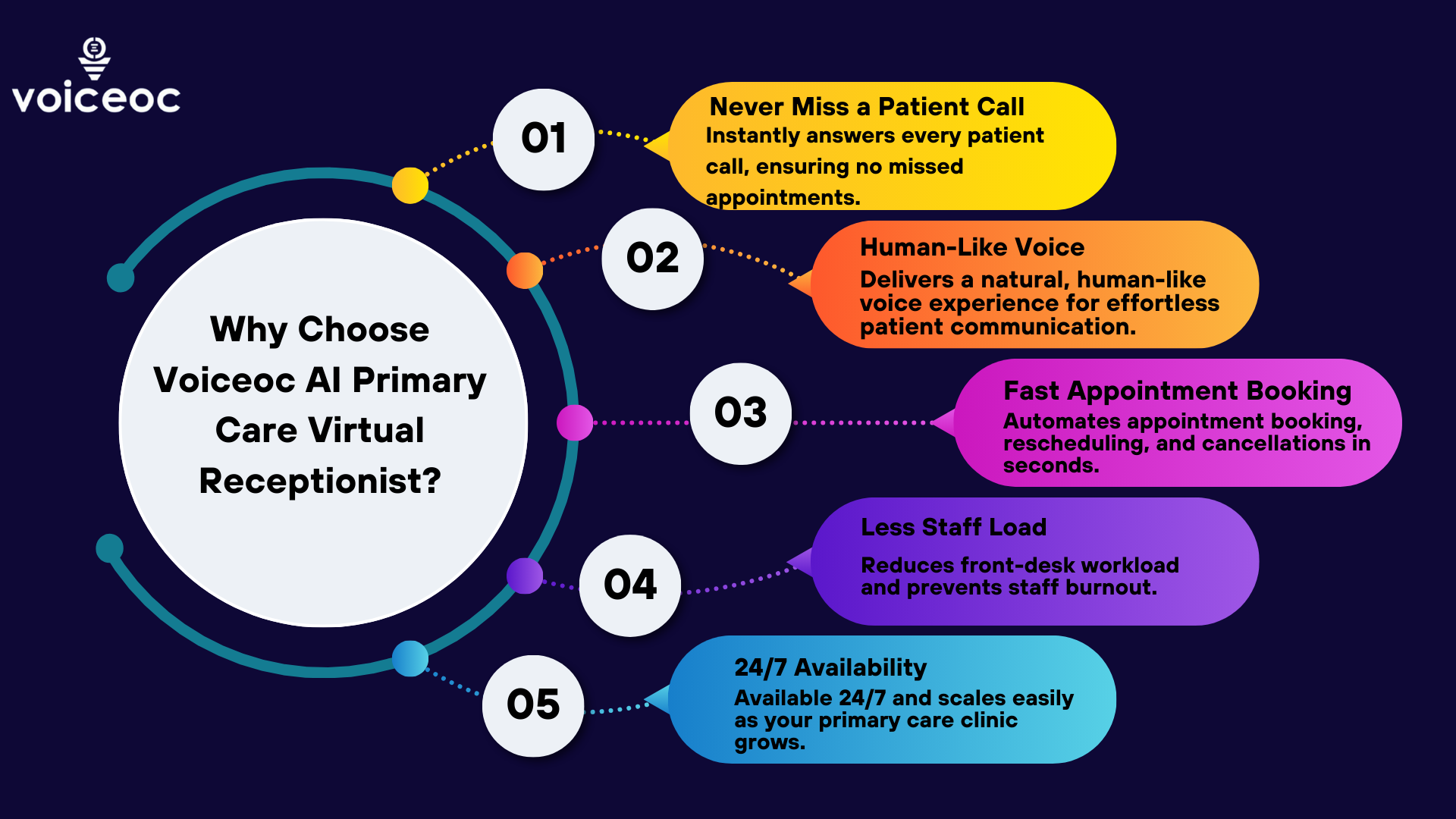
Voiceoc is an AI health bot company that focuses on voice-based automation for healthcare workflows. In primary care settings, a Voiceoc AI primary care receptionist acts as a smart, voice-enabled front desk assistant that manages patient communication without replacing human staff.
Unlike text-only systems, Voiceoc’s voice-driven AI allows clinics to handle patient calls more naturally, making it especially useful for practices that receive a high volume of phone inquiries.
Schedule a 30-min free demo session to know more about Voiceoc AI Primary Care Assistant!
How Voiceoc Supports Primary Care Clinics?
A Voiceoc AI primary care virtual receptionist is designed to handle common but time-consuming tasks such as:
- Answering incoming patient calls automatically
- Booking, rescheduling, or canceling appointments
- Sharing clinic hours, location, and service information
- Routing urgent or complex calls to human staff
- Reducing call wait times and missed calls
Healthcare Meets Tech: Know How Voice AI is Transforming Patient Care?
This ensures that patients receive immediate assistance while clinic teams stay focused on in-clinic care.
Conclusion
The adoption of AI-powered virtual health assistants in primary care is no longer optional; it is a strategic advantage. Clinics that implement a primary care AI assistant can deliver faster care, reduce operational stress, and improve patient satisfaction.
By combining human expertise with intelligent automation, primary care providers can focus on what truly matters, building meaningful doctor-patient relationships and delivering quality healthcare.

.webp)






.svg)
.svg)