
Orthopedic practices are evolving rapidly. With rising patient volumes, complex imaging data, value-based care models, and increasing administrative pressure, traditional Electronic Medical Records (EMRs) are no longer enough. In 2025, AI-powered orthopedic EMRs are becoming a critical foundation for efficient, scalable, and patient-centric orthopedic care.
Artificial intelligence is transforming how orthopedic clinics document encounters, analyse imaging, predict outcomes, automate workflows, and engage patients. From AI-assisted charting to predictive analytics for post-surgical recovery, modern EMRs are no longer passive record-keeping systems; they are intelligent clinical partners.
Fill up the form and know about the best Orthopedic Clinic EMR medical assistant!
In this blog, we explore the top 10 AI orthopedic clinic EMRs medical assistants for 2026, know their key features to evaluate, emerging trends, and how platforms like Voiceoc enhance EMR value by improving patient communication and front-desk automation.
What Is an AI-Powered Orthopedic EMR?
An AI-powered orthopedic EMR is a specialised electronic medical record system enhanced with artificial intelligence and machine learning capabilities, designed specifically for musculoskeletal and orthopedic workflows.
Unlike traditional EMRs, AI-driven systems can:
- Automatically generate clinical notes using voice or ambient listening
- Analyze historical patient data to support clinical decision-making
- Improve imaging interpretation workflows
- Predict outcomes such as recovery timelines or readmission risk
- Automate scheduling, follow-ups, and documentation tasks
For orthopedic clinics, where care is data-heavy and workflow-intensive, AI EMRs significantly reduce administrative burden while improving clinical accuracy.
Must Learn: Healthcare Meets Tech: How Voice AI is Transforming Patient Care?
Why Orthopedic Clinics Need AI-Powered EMRs in 2026?
Orthopedics is one of the most demanding specialties in healthcare, both clinically and operationally. In 2025, clinics face several challenges that make AI adoption essential:
1. Increasing Patient Demand
An aging population and rising sports-related injuries have led to higher orthopedic patient volumes, putting pressure on clinicians and staff.
2. Complex Documentation
Orthopedic notes often include detailed physical exams, imaging references, surgical planning, and post-op care documentation, ideal use cases for AI-assisted charting.
3. Imaging-Heavy Workflows
Orthopedic care relies heavily on X-rays, MRIs, and CT scans. AI can help organize, analyze, and contextualize imaging data more efficiently.
4. Staffing Shortages
Front-desk staff, scribes, and billing teams are stretched thin. AI-powered EMRs reduce dependency on manual processes.
5. Patient Experience Expectations
Patients now expect fast scheduling, digital communication, and proactive follow-ups, capabilities that AI-enabled systems deliver seamlessly.
Key Criteria for Evaluating AI-Powered Orthopedic EMRs
Before reviewing the top platforms, it’s essential to understand what makes an orthopedic EMR truly AI-powered and future-ready, thereby enhancing the patient care experience.
Core Evaluation Factors:
- AI Documentation Tools (voice-to-text, ambient listening)
- Orthopedic-Specific Templates
- Predictive Analytics & Reporting
- Imaging & PACS Integration
- Automated Coding & Billing Support
- Interoperability with Other Systems
- Security, Compliance, and Scalability
- Patient Engagement Capabilities
Top 10 AI-Powered Orthopedic EMRs to Watch in 2025
Below are leading EMR platforms leveraging AI to transform orthopedic workflows.
1. Epic Orthopedics (with AI Enhancements)
Epic continues to dominate large health systems and enterprise orthopedic practices.
AI Strengths:
- AI-driven clinical decision support
- Predictive analytics for outcomes and readmissions
- Voice-assisted documentation
Best For: Large orthopedic hospitals and multi-specialty networks
Limitations: High cost and complex implementation
2. ModMed (Modernising Medicine – Orthopedics)
ModMed offers a specialty-focused EMR with strong AI-backed workflows.
AI Strengths:
- Structured orthopedic templates
- Automated documentation and coding
- Data-driven clinical insights
Best For: Mid-sized orthopedic practices
Why It Stands Out: Designed specifically for specialty care
3. AdvancedMD Orthopedic EMR
AdvancedMD integrates AI across clinical, billing, and patient engagement workflows.
AI Strengths:
- Intelligent scheduling and reminders
- Predictive revenue cycle analytics
- Customizable orthopedic workflows
Best For: Growing orthopedic clinics seeking scalability
4. athenaOne (athenahealth)
Athenahealth’s AI focuses heavily on automation and network intelligence.
AI Strengths:
- Claims automation and denial prevention
- Smart documentation suggestions
- Population health analytics
Best For: Orthopedic practices focused on revenue optimization
5. DrChrono Orthopedic EMR
DrChrono offers AI-assisted clinical workflows with a user-friendly interface.
AI Strengths:
- Voice-enabled charting
- Custom orthopedic macros
- Automated patient communication
Best For: Small to mid-sized orthopedic practices
6. NextGen Healthcare Orthopedics
NextGen combines AI, analytics, and interoperability.
AI Strengths:
- Predictive reporting tools
- AI-enhanced clinical alerts
- Integrated population health management
Best For: Practices transitioning to value-based care
7. Kareo (Now Tebra)
Kareo leverages AI primarily for administrative efficiency.
AI Strengths:
- Smart billing and coding tools
- Automated appointment workflows
- Performance analytics
Best For: Independent orthopedic clinics
8. Practice Fusion (Orthopedic Customization)
While traditionally primary-care focused, Practice Fusion now supports AI-driven custom workflows.
AI Strengths:
- Clinical decision prompts
- Documentation assistance
- Reporting automation
Best For: Smaller orthopedic practices with limited budgets
9. Cerner Orthopedic Solutions (Oracle Health)
Cerner offers enterprise-grade AI capabilities.
AI Strengths:
- Advanced data analytics
- AI-powered clinical intelligence
- Imaging and diagnostics integration
Best For: Large hospital-based orthopedic departments
10. Greenway Health Orthopedic EMR
Greenway emphasizes AI-driven reporting and workflow efficiency.
AI Strengths:
- Automated charting assistance
- Data insights for performance improvement
- Interoperability support
Best For: Mid-sized practices looking for flexibility
How AI-Powered Orthopedic EMRs Improve Patient Experience?
AI isn’t just about operational efficiency; it directly impacts patient satisfaction.
1. Faster Access to Care
AI automates patient appointment scheduling, waitlist management, and reminders, reducing delays.
2. More Personalized Treatment Plans
Predictive analytics help tailor post-op care and rehabilitation plans based on patient data.
3. Improved Communication
AI-enabled messaging and reminders keep patients informed throughout their care journey.
4. Reduced Errors
Automated documentation and coding reduce inaccuracies that can affect care and billing.
Challenges to Consider Before an Orthopedic Clinic Medical Assistant Adoption
While AI-powered EMRs offer immense value, orthopedic practices should be aware of potential challenges:
- Implementation Time: Data migration and staff training require planning
- Upfront Costs: AI-driven platforms may have higher initial investment
- Workflow Adaptation: Clinics must align processes with new technology
- Data Privacy: AI systems must meet strict healthcare compliance standards
Choosing the right vendor and implementation partner is critical to success.
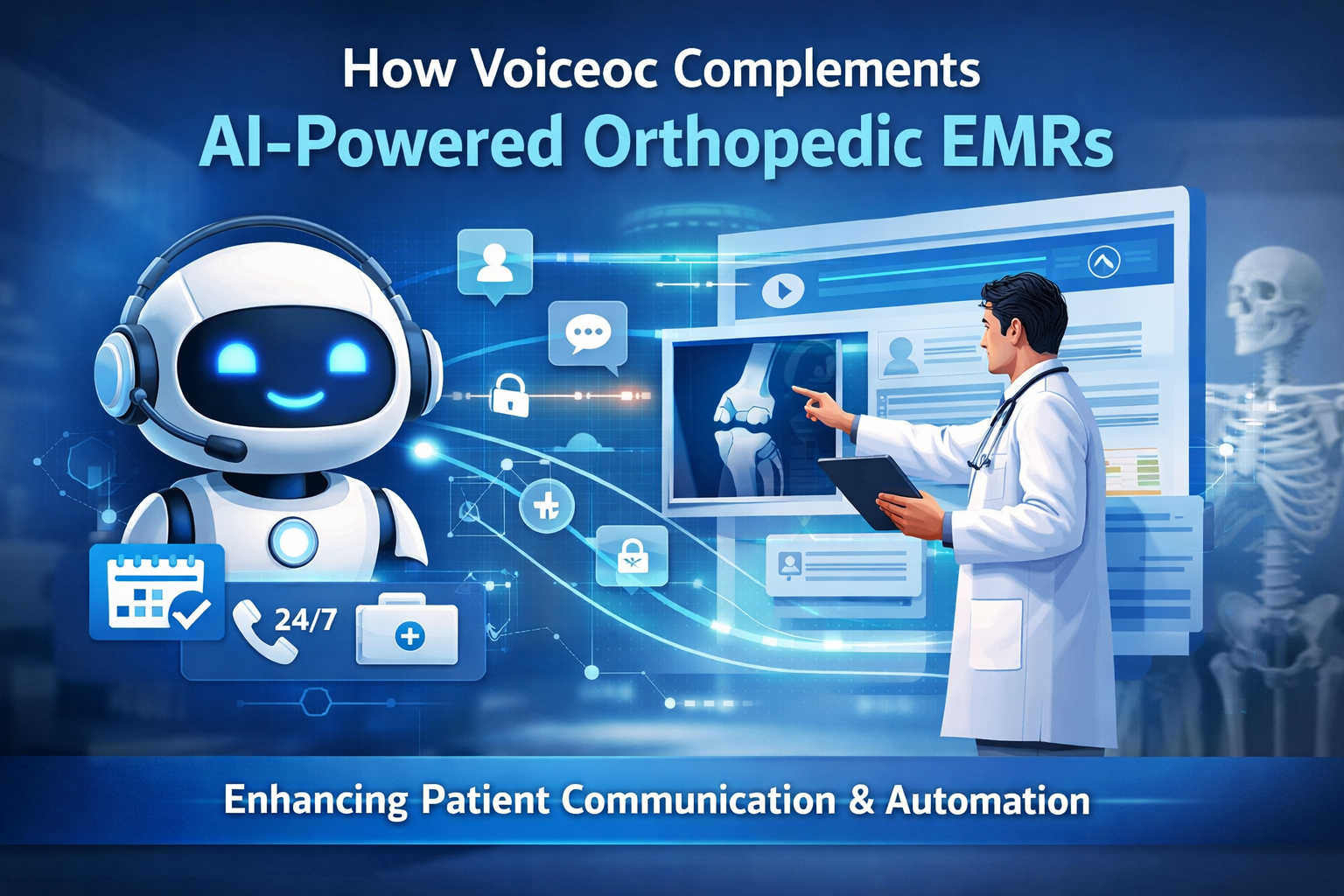
How Voiceoc Complements AI-Powered Orthopedic EMRs as Best AI Medical Receptionist?
Voiceoc plays a critical role in completing the entire AI ecosystem of modern Orthopedic practices by strengthening the right patient communication layer.
When we talk about AI orthopedic EMRs, they are best at optimizing the clinical documentation, imaging workflows, billing, and admin processes, and are not designed to manage continuous patient interactions.
This is where Voiceoc fulfills the gap between healthcare professionals and the orthopedics front desk receptionist. Designed by professionals, the Voiceoc orthopedic clinic medical assistant works as a virtual front desk, answering patient calls 24/7, reducing missed calls, and ensuring that not a single appointment opportunity will be lost, even during peak hours or after clinic hours.
Voiceoc + Orthopedic EMRs = Complete Automation
By working with orthopedic EMRs, Voiceoc focuses on scheduling, rescheduling, and cancelling of patient appointments without human intervention. It captures patient intent, whether they want to visit, ask a query, need a prescription refill, or inquire about services, and routes this information directly into the EMR.
This integration directly reduces the workload on front-desk teams, allowing them to focus more on in-clinic patient care rather than repetitive phone tasks. As a reliable orthopedic clinic medical assistant, Voiceoc not only improves operational efficiency but also enhances patient satisfaction through faster responses, eliminating wait time, and consistent communication.
Hence, the result is a fully automated, patient-first orthopedic practice where EMRs manage clinical intelligence, and Voiceoc ensures instant patient engagement.
Recommendations for Orthopedic Practices
If you’re evaluating AI-powered orthopedic EMRs in 2025:
- Identify workflow bottlenecks first
- Choose EMRs with orthopedic-specific AI features
- Prioritize interoperability and scalability
- Train staff effectively
- Complement your EMR with AI communication tools like Voiceoc
Conclusion
AI-powered orthopedic EMRs are reshaping the future of musculoskeletal care. In 2025, practices that adopt intelligent, data-driven systems will gain a competitive advantage through improved efficiency, better outcomes, and superior patient experiences.
By pairing a robust AI-powered orthopedic EMR with Voiceoc’s AI virtual assistant, clinics can unlock end-to-end automation, from the first patient call to post-treatment follow-ups.
The future of orthopedics is intelligent, connected, and patient-first, and the time to adopt AI is now.


.webp)


