

The front desk is the backbone of any healthcare facility. It is the first place patients interact with a hospital, clinic, or medical practice, often shaping their overall experience even before they meet a doctor. From answering calls and scheduling appointments to handling patient queries and follow-ups, front desk teams carry a heavy operational load.
As patient expectations rise and healthcare systems face increasing pressure due to staff shortages and high call volumes, Artificial Intelligence (AI) is emerging as a powerful ally. The future of AI in front desk healthcare operations is not about replacing people; it’s about enabling smoother workflows, better patient experiences, and more efficient healthcare delivery.
The Challenges of Traditional Front Desk Work in a Hospital
Front desk work in a hospital or clinic is demanding and often underestimated. A typical front desk team handles:
- Continuous front desk calls in healthcare
- Appointment booking, rescheduling, and cancellations
- Patient inquiries about doctors, timings, and services
- Insurance verification and basic administrative tasks
- Managing frustrated or anxious patients
Despite their importance, front desks frequently struggle with:
- Missed calls during peak hours
- Long waiting times for patients
- Overworked staff and burnout
- Inconsistent information delivery
- Limited availability outside working hours
These challenges directly affect patient satisfaction and can even lead to revenue loss when calls go unanswered.
What Is an AI Receptionist for a Medical Office?
An AI receptionist for a medical office is a voice- or chat-based system designed to handle routine front desk interactions automatically. Unlike traditional IVR systems that rely on rigid menus, AI receptionists understand natural language and respond in a more human-like way.
A modern front desk receptionist AI can:
- Answer incoming patient calls instantly
- Schedule, reschedule, or cancel appointments
- Provide information about doctors, services, and clinic hours
- Send reminders and follow-ups
- Escalate complex cases to human staff
The goal is simple: reduce the workload on front desk teams while ensuring patients are never left waiting.
How AI Is Transforming Front Desk Call Handling in Healthcare?
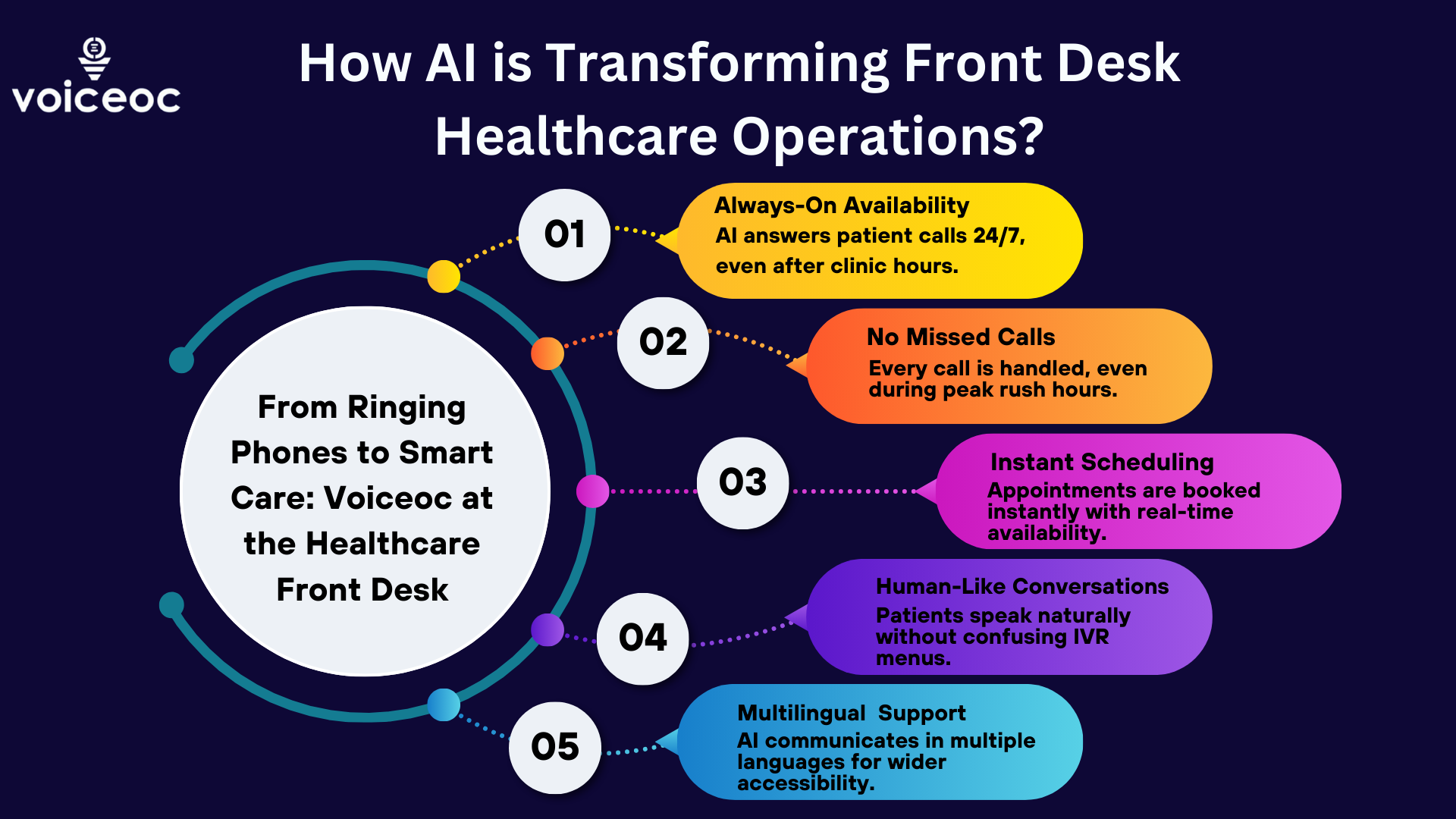
1. Always-On Call Availability
AI-powered receptionists can handle calls 24/7. Even after clinic hours, patients can book appointments or get basic information without waiting for the next business day.
2. Reduced Missed Calls
Missed calls are one of the biggest problems in healthcare front desks. AI ensures that every call is answered, even during high-traffic periods.
3. Faster Appointment Scheduling
AI can instantly check availability and book appointments, reducing wait times and manual errors.
4. Natural, Human-Like Conversations
With advancements in conversational AI, patients can speak naturally instead of navigating confusing menus. This is especially helpful for elderly or non-technical patients.
5. Multilingual Communication
AI receptionists can support multiple languages, making healthcare services more inclusive and accessible.
The Long-Term Impact of AI on Front Desk Healthcare Operations
Looking ahead, the role of AI at the front desk will continue to evolve. Future developments may include:
- Predictive scheduling to reduce no-shows
- Personalized patient interactions based on history
- Seamless integration across voice, SMS, and messaging apps
- Real-time analytics for call trends and patient needs
- Smarter routing of calls to the right departments
Healthcare providers that adopt AI early will gain a significant advantage in efficiency, patient satisfaction, and operational scalability.
Addressing Concerns Around AI in Healthcare Front Desks
- Is patient data safe with AI?
Yes. Modern AI solutions are built with strict security standards and healthcare compliance in mind.
- Will AI reduce the human touch?
No. AI enhances the human touch by freeing staff from repetitive tasks, allowing for more meaningful patient interactions.
- Can patients trust AI receptionists?
Patients already interact with AI daily through voice assistants. In healthcare, AI is designed to be calm, accurate, and supportive.
How Voiceoc Supports the Future of AI in Healthcare Front Desks?
At Voiceoc, the focus is on creating AI voice solutions that truly understand healthcare workflows.
What Voiceoc Offers:
- AI-powered voice agents for handling healthcare calls
- Automated appointment booking and reminders
- Reduced wait times and missed calls
- Human-like conversations tailored for medical use cases
- Seamless integration with existing hospital systems
Voiceoc helps healthcare providers modernize their front desk operations without disrupting existing teams or processes.
Final Thoughts
The future of AI in front-desk healthcare operations is already unfolding. As patient volumes grow and expectations rise, relying solely on traditional front desk setups is no longer sustainable.
By combining AI receptionists for medical offices with skilled human staff, healthcare providers can deliver faster responses, improved patient experiences, and more efficient operations.
AI is not here to replace the front desk; it is here to empower it. And for healthcare organizations willing to embrace this change, the result is a smoother, smarter, and more patient-friendly front desk experience from the very first call.


.webp)






.svg)
.svg)