Finance Tickets Automation: How to Solve Finance Tickets Faster with AI and Workflow Automation?
June 26, 2026
Finance departments are the backbone of every organization. From processing invoices and handling reimbursements to resolving vendor payment inquiries and payroll concerns, finance teams manage hundreds or even thousands of requests every month.
As businesses grow, managing finance tickets manually becomes increasingly challenging. Delayed responses, repetitive tasks, data entry errors, and compliance risks can significantly impact productivity and employee satisfaction.
This is where Finance Tickets Automation comes into play.
By leveraging AI-powered ticketing systems, workflow automation, and intelligent finance support solutions, organizations can streamline financial operations, improve response times, reduce operational costs, and enhance employee experiences.
In this guide, we'll explore what finance ticket automation is, how finance tickets are solved, key workflows, benefits, industry statistics, and how AI-powered platforms like Voiceoc are transforming finance operations.
What Are Finance Tickets?
Finance tickets are requests, inquiries, issues, or tasks submitted to the finance department by employees, vendors, customers, or stakeholders.
Common Types of Finance Tickets
Invoice processing requests
Accounts payable inquiries
Vendor payment status checks
Expense reimbursement requests
Payroll-related issues
Purchase order approvals
Tax documentation requests
Budget approval requests
Financial reporting inquiries
Travel expense disputes
Procurement-related questions
Compliance and audit requests
Without automation, these tickets are often managed through emails, spreadsheets, or shared inboxes, creating inefficiencies and delays.
The Growing Challenge of Finance Ticket Management
Modern finance teams are experiencing a surge in support requests due to:
Remote and hybrid work environments
Increasing transaction volumes
Growing vendor ecosystems
Regulatory compliance requirements
Complex procurement processes
Key Industry Statistics
According to Deloitte, finance teams spend nearly 40% of their time on repetitive manual tasks.
Gartner reports that organizations implementing automation can reduce finance process costs by up to 30%.
Research from McKinsey suggests that automation technologies can automate up to 42% of finance activities.
Companies using AI-driven service management solutions often see ticket resolution times reduced by 50-70%.
These numbers demonstrate why finance automation has become a strategic priority.
What Is Finance Ticket Automation?
Finance Ticket Automation refers to the use of:
Artificial Intelligence (AI)
Workflow Automation
Conversational AI
Intelligent Routing
Robotic Process Automation (RPA)
Machine Learning
to automatically manage, classify, route, prioritize, and resolve finance-related requests.
Instead of manually reviewing every request, AI systems understand the issue, determine the correct action, and either resolve it automatically or route it to the right finance specialist.
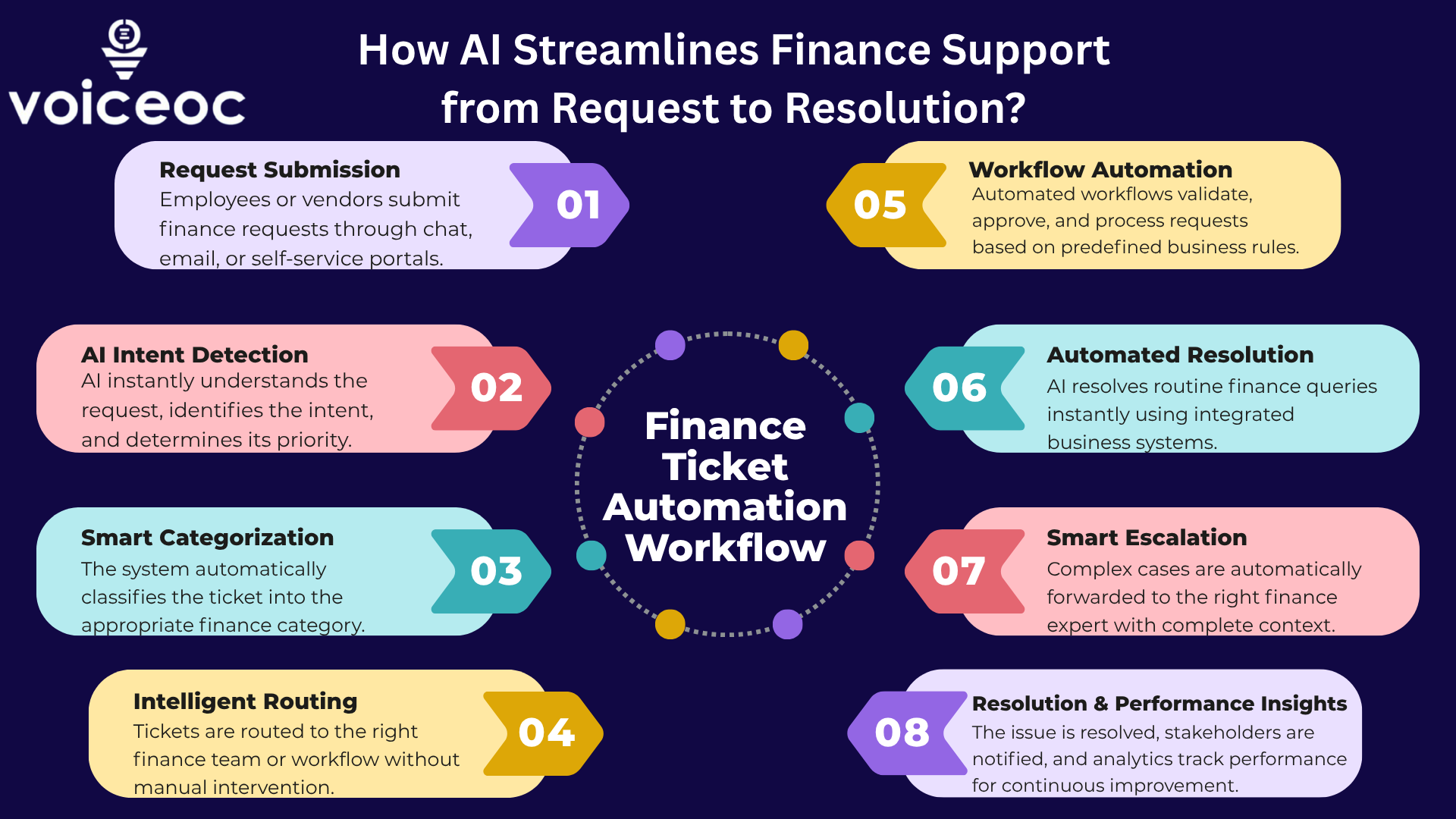
How Finance Tickets Are Solved Through Automation?
Step 1: Ticket Submission
Employees, vendors, or customers submit requests through:
Chatbots
Self-service portals
Microsoft Teams
Slack
Email
Mobile apps
Example
Employee asks:
"When will my travel reimbursement be processed?"
The request automatically becomes a finance ticket.
Step 2: AI Understands the Request
Natural Language Processing (NLP) analyzes the message.
The system identifies:
User intent
Ticket category
Urgency level
Relevant department
Example
Request:
"I haven't received my reimbursement payment."
AI identifies:
Category: Expense Reimbursement
Priority: Medium
Department: Accounts Payable
Step 3: Automatic Ticket Categorization
The ticket is automatically assigned to categories such as:
Invoice Issue - Accounts Payable
Missing Payment - Vendor management
Salary Query - Payroll
Budget Request - Financial Planning
Tax Forms - Compliance
This eliminates manual sorting.
Step 4: Intelligent Routing
The ticket is sent directly to the right team or workflow.
Examples
Payroll issues → Payroll Team
Vendor invoices → Accounts Payable
Tax inquiries → Compliance Team
Budget approvals → Finance Manager
Automated routing prevents delays caused by ticket transfers.
Step 5: Automated Resolution
Many finance requests can be resolved instantly without human intervention.
Examples
Vendor Payment Status
Vendor asks:
"Has Invoice #45678 been paid?"
AI checks ERP data and instantly provides the status.
Expense Reimbursement
Employee asks:
"What's the status of my reimbursement?"
The system retrieves approval status and payment details automatically.
Payroll Questions
Employee asks:
"When is the next payroll run?"
AI responds immediately using payroll system data.
This automated workflow ensures every ticket follows a consistent process.
Key Use Cases of Finance Ticket Automation
1. Accounts Payable Automation
AI can:
Capture invoice data
Validate invoices
Match purchase orders
Detect duplicates
Route approvals
Benefits
Faster invoice processing
Reduced errors
Improved vendor relationships
2. Expense Reimbursement Management
Automation can:
Verify receipts
Check policy compliance
Approve routine expenses
Trigger payments
Benefits
Faster reimbursements
Improved employee satisfaction
Reduced manual reviews
3. Payroll Support Automation
Employees frequently ask:
Paycheck questions
Tax deductions
Benefits information
Payroll schedules
AI agents provide instant responses.
Benefits
Reduced payroll workload
Better employee experience
4. Vendor Inquiry Management
Common vendor requests include:
Payment status
Invoice tracking
Tax forms
Contract questions
Automation resolves many inquiries without finance involvement.
5. Budget Approval Requests
AI-driven workflows automatically:
Validate requests
Route approvals
Notify stakeholders
Track status
This accelerates decision-making.
Benefits of Finance Ticket Automation
Faster Resolution Times
Automated systems provide instant responses to common questions.
Organizations often achieve:
50–70% faster ticket resolution
Reduced response delays
Improved service levels
Lower Operational Costs
Automation reduces manual effort and staffing burdens.
Benefits include:
Fewer repetitive tasks
Better resource allocation
Lower support costs
Improved Accuracy
AI minimizes:
Data entry errors
Routing mistakes
Duplicate processing
Resulting in more reliable financial operations.
Better Compliance
Automated workflows create:
Audit trails
Approval records
Policy enforcement
Supporting regulatory compliance requirements.
Enhanced Employee Experience
Employees receive:
Instant responses
Real-time status updates
Self-service options
Leading to higher satisfaction.
Increased Finance Team Productivity
Finance professionals can focus on:
Strategic planning
Financial analysis
Risk management
Business growth initiatives
Instead of repetitive administrative tasks.
Essential Features of a Finance Ticket Automation System
When selecting a solution, look for:
AI-Powered Ticket Classification
Automatically identifies request types.
Conversational AI Support
Provides natural language interactions.
ERP Integration
Connects with:
SAP
Oracle
NetSuite
Microsoft Dynamics
Workflow Automation
Automates approvals and escalations.
Analytics Dashboard
Tracks:
Resolution times
Ticket volumes
SLA performance
Productivity metrics
Multi-Channel Support
Supports:
Email
Chat
Mobile
Teams
Slack
Future Trends in Finance Ticket Automation
Agentic AI
Autonomous AI agents will manage end-to-end finance workflows with minimal human intervention.
Predictive Ticket Resolution
AI will anticipate issues before tickets are submitted.
Hyperautomation
Organizations will combine:
AI
RPA
Workflow Automation
Process Mining
to create fully automated finance operations.
Voice-Based Finance Support
Employees and vendors will interact with finance systems using voice assistants and conversational AI.
Real-Time Financial Intelligence
Future systems will deliver instant insights into:
Payment bottlenecks
Cash flow risks
Vendor performance
Expense trends
Why Finance Teams Need Automation Now?
Finance departments are under pressure to do more with fewer resources while maintaining accuracy, compliance, and exceptional service.
Manual ticket handling simply cannot keep pace with today's transaction volumes and employee expectations.
By implementing finance ticket automation, organizations can:
Reduce operational costs
Improve service delivery
Accelerate issue resolution
Increase the finance team's productivity
Enhance compliance and governance
Automation is no longer a luxury; it's becoming a necessity for modern finance operations.
How Voiceoc Helps Automate Finance Tickets?
As organizations seek smarter ways to manage finance operations, Voiceoc provides an AI-powered solution that automates finance ticket management from submission to resolution.
Whether handling payroll inquiries, reimbursement requests, accounts payable questions, or vendor support tickets, Voiceoc enables finance teams to operate more efficiently while maintaining accuracy and compliance.
By combining AI, workflow automation, and intelligent support capabilities, Voiceoc helps organizations transform finance service delivery and scale operations without increasing workload.
Connect with Voiceoc today!
Thank you! Your submission has been received!
Oops! Something went wrong while submitting the form.
Topics:
Read More
July 29, 2026
How Does Voiceoc Handle High-Volume Finance Support Requests Using AI?