How Does AI Help HR Teams Focus on Strategic Initiatives Instead of Administrative Tasks?
July 28, 2026
Human Resources has evolved far beyond hiring and payroll. Today, HR leaders are expected to shape workplace culture, improve employee engagement, develop future leaders, and align workforce strategies with business goals. However, despite these growing responsibilities, many HR teams continue to spend a significant portion of their day on repetitive administrative tasks.
Answering employee questions, managing leave requests, processing onboarding documents, handling HR tickets, and responding to policy inquiries consume valuable time that could otherwise be invested in strategic initiatives. As organizations grow, these routine tasks become even more difficult to manage efficiently.
This is where Artificial Intelligence (AI) is making a meaningful difference.
Looking for the right AI HR Automation platform? Fill out the form today and our Voiceoc team will connect with you shortly!
Rather than replacing HR professionals, AI helps them work smarter by automating repetitive processes, streamlining employee support, and delivering actionable insights. By reducing administrative burdens, AI empowers HR teams to focus on high-impact initiatives that improve employee experiences and drive business growth.
According to Gartner, more than 60% of HR leaders are actively exploring or implementing Generative AI to improve HR operations. Similarly, research from SHRM shows that a large majority of HR professionals report improved efficiency after adopting AI-powered tools. These trends demonstrate that AI is no longer an emerging technology—it is becoming an essential part of modern HR.
Let's explore how AI enables HR professionals to shift from administrative work to strategic leadership.
Why Do Administrative Tasks Hold HR Teams Back?
Every organization depends on HR to support employees throughout their journey, from recruitment and onboarding to career development and retention. However, much of HR's daily workload revolves around repetitive activities that require significant time and manual effort.
Some of the most common administrative responsibilities include:
Responding to leave balance and attendance inquiries
Explaining company policies and benefits
Managing onboarding documentation
Processing employee requests
Handling payroll-related questions
Updating employee records
Coordinating approvals
Managing HR service tickets
Preparing recurring reports
While each of these tasks is important, they often prevent HR professionals from concentrating on strategic initiatives such as workforce planning, leadership development, and employee engagement.
As organizations expand, employee requests increase, making it difficult for HR teams to maintain fast response times while balancing broader organizational objectives.
What Are Strategic HR Initiatives?
Strategic HR focuses on activities that directly contribute to long-term organizational success rather than routine administrative operations.
These initiatives include:
Workforce Planning
Understanding future hiring needs, identifying skill gaps, and ensuring the organization has the right talent to achieve business objectives.
Employee Engagement
Designing programs that improve job satisfaction, productivity, and workplace culture while reducing employee turnover.
Leadership Development
Preparing future managers and leaders through mentoring, coaching, and professional development initiatives.
Learning and Development
Creating personalized learning opportunities that help employees build new skills and stay competitive.
Talent Retention
Developing strategies that improve employee satisfaction, reduce attrition, and encourage long-term career growth.
Organizational Culture
Building an inclusive, collaborative, and high-performing work environment that supports innovation and employee well-being.
These initiatives have a direct impact on business performance, but they require time, planning, and meaningful interactions with employees, resources that are often limited when HR teams are overwhelmed with administrative work.
How AI Helps HR Teams Focus on Strategic Initiatives?
AI HR Automation transforms how organizations manage employee support by taking over repetitive processes while allowing HR professionals to focus on higher-value work.
1. Automating Routine Employee Queries
One of the biggest challenges HR teams face is responding to the same questions repeatedly.
Employees frequently ask about:
Leave balances
Holiday calendars
Payroll schedules
Company policies
Insurance benefits
Reimbursement processes
Work-from-home guidelines
Instead of manually answering every request, AI-powered employee assistants provide instant, accurate responses around the clock.
Employees receive the information they need within seconds, while HR professionals spend less time handling repetitive inquiries. This not only improves employee satisfaction but also allows HR teams to dedicate more time to strategic planning and employee development.
2. Streamlining HR Ticket Management
As organizations grow, HR service requests become increasingly complex. Manually reviewing, categorizing, and assigning each request can create delays and inconsistencies.
AI simplifies HR ticket management by automatically:
Categorizing employee requests
Assigning priority levels
Routing tickets to the appropriate HR specialist
Suggesting responses for common issues
Tracking service-level agreements (SLAs)
Escalating complex cases when human intervention is required
This intelligent workflow significantly reduces response times while improving operational efficiency.
Employees receive faster support, and HR teams can manage a higher volume of requests without increasing headcount.
The onboarding experience plays a crucial role in employee satisfaction and long-term retention. However, traditional onboarding often involves numerous manual tasks, including document collection, policy distribution, training coordination, and answering frequently asked questions.
AI streamlines the entire onboarding journey by:
Sharing personalized welcome messages
Collecting required documents digitally
Providing instant answers to onboarding questions
Sending automated reminders
Guiding employees through required training
Helping new hires complete tasks independently
This creates a smoother onboarding experience while reducing administrative workload for HR teams.
4. Improving Employee Self-Service
Modern employees expect quick access to information without waiting for HR responses.
AI-powered self-service portals allow employees to access:
Company policies
HR documents
Leave information
Payroll details
Benefits information
Training resources
Frequently asked questions
By empowering employees to find answers independently, organizations reduce the number of repetitive requests reaching HR teams.
This improves both efficiency and the overall employee experience.
5. Automating HR Reporting and Analytics
Preparing reports is another time-consuming responsibility for HR departments.
Collecting workforce data manually often requires multiple spreadsheets, systems, and hours of analysis.
AI automates this process by generating real-time dashboards and reports on key HR metrics such as:
Employee engagement
Workforce trends
HR ticket resolution
Recruitment performance
Attrition rates
Employee satisfaction
Training completion
Service response times
With instant access to accurate insights, HR leaders can make faster, data-driven decisions that support organizational growth.
6. Delivering Predictive Workforce Insights
Beyond automation, AI helps HR teams anticipate future challenges.
By analyzing workforce data, AI can identify patterns related to:
Employee turnover risks
Skills shortages
Hiring trends
Engagement levels
Performance indicators
These predictive insights enable HR professionals to proactively address issues before they impact the organization.
Instead of reacting to problems, HR teams can develop long-term workforce strategies that support sustainable growth.
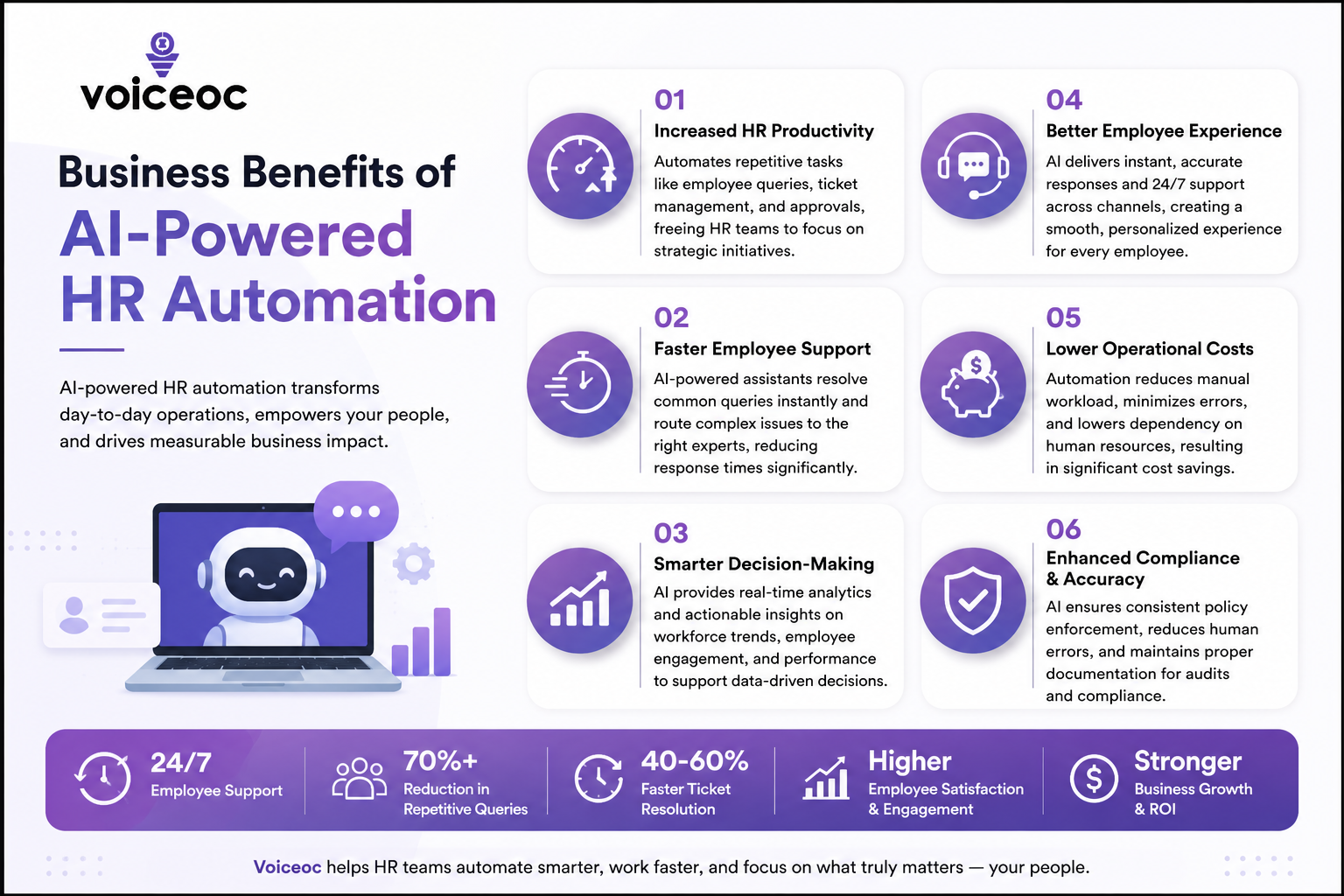
Business Benefits of AI-Powered HR Automation
Organizations that adopt AI in HR experience benefits that extend far beyond operational efficiency.
Increased Productivity
HR professionals spend less time on repetitive administrative work and more time supporting employees, improving workplace culture, and developing talent strategies.
Faster Employee Support
AI provides instant responses to common employee questions, reducing waiting times and improving satisfaction.
Better Employee Experience
Employees receive consistent, personalized, and accessible support whenever they need assistance, regardless of business hours.
Lower Operational Costs
Automating repetitive processes reduces manual effort and allows HR teams to manage growing workloads without significantly increasing staffing costs.
Improved Decision-Making
Real-time analytics provide HR leaders with actionable insights that support workforce planning and strategic business decisions.
Enhanced Compliance
AI helps standardize HR processes, ensuring policies are applied consistently while reducing the risk of manual errors.
Together, these benefits position HR as a strategic business partner rather than an administrative function.
How Does Voiceoc Help HR Teams Become More Strategic?
At Voiceoc, we believe AI should empower HR professionals rather than replace them.
Voiceoc's AI-powered HR automation platform is designed to eliminate repetitive administrative work while delivering exceptional employee experiences through intelligent automation.
Automate employee support using AI-powered chat and voice assistants
Resolve HR tickets faster through intelligent routing and workflow automation
Enable employee self-service for common HR requests
Provide 24/7 support across multiple communication channels
Automate onboarding workflows and document management
Deliver real-time HR analytics and performance insights
Integrate seamlessly with existing enterprise systems
Improve response times while reducing HR workload
Instead of spending hours answering repetitive questions, HR professionals can focus on initiatives that create lasting value for employees and the business.
Whether it's improving engagement, developing leaders, planning future workforce needs, or building a stronger organizational culture, Voiceoc helps HR teams dedicate more time to what truly matters.
The Future of HR Is Strategic, Not Administrative
The role of HR is changing rapidly. As businesses become more digital, HR professionals are expected to contribute to organizational growth, workforce innovation, and employee success.
However, achieving these goals is difficult when valuable time is consumed by repetitive administrative tasks.
Artificial Intelligence is helping organizations solve this challenge by automating routine work, improving employee support, and delivering meaningful workforce insights. Instead of replacing HR professionals, AI enables them to focus on the human side of human resources, building relationships, developing talent, fostering engagement, and driving strategic initiatives.
Organizations that embrace AI-powered HR automation today will be better equipped to attract top talent, retain employees, improve operational efficiency, and create exceptional workplace experiences.
By combining intelligent automation with human expertise, platforms like Voiceoc empower HR teams to move beyond administration and become true strategic partners in business success.
Connect with Voiceoc today!
Thank you! Your submission has been received!
Oops! Something went wrong while submitting the form.
Topics:
Read More
July 28, 2026
How Does AI Help HR Teams Focus on Strategic Initiatives Instead of Administrative Tasks?









.svg)
.svg)