

Finance teams have evolved far beyond managing budgets and closing the books. Today, they serve as a critical support function for every department in an organization. From processing expense reimbursements and approving purchase orders to responding to payroll questions and vendor payment inquiries, finance professionals handle hundreds. Sometimes thousands, of employee requests every month.
As organizations grow, so does the volume of these requests. Employees expect quick answers, while finance teams are expected to maintain accuracy, ensure compliance, and meet strict service-level agreements (SLAs). Unfortunately, many finance departments still rely on shared inboxes, spreadsheets, and manual workflows to manage support requests. This often leads to delayed responses, repetitive work, and frustrated employees.
Looking for the right Finance Support Automation platform? Then, fill out the form today, and our Voiceoc team experts will connect with you shortly.
Artificial intelligence (AI) is changing this landscape. Modern AI-powered finance support platforms can automate routine inquiries, intelligently route complex requests, and provide employees with instant, self-service assistance around the clock. Instead of spending hours answering the same questions, finance teams can focus on strategic initiatives such as financial planning, forecasting, and business growth.
This is where Voiceoc helps. By combining conversational AI, workflow automation, and intelligent ticket management, Voiceoc enables finance teams to handle high volumes of support requests faster, more accurately, and with significantly less manual effort.
In this guide, we'll explore the challenges finance teams face, how AI is transforming internal finance support, and how Voiceoc helps organizations deliver a faster and more efficient employee experience.
Why Do Finance Teams Struggle with High-Volume Support Requests?
Finance departments are responsible for much more than accounting and reporting. They also act as an internal service desk, supporting employees, managers, vendors, and procurement teams with a wide range of operational requests.
Some of the most common finance support requests include:
- Payroll and salary-related questions
- Expense reimbursement status updates
- Invoice processing and payment inquiries
- Purchase order approvals
- Vendor onboarding requests
- Budget approval requests
- Tax document requests
- Corporate credit card issues
- Finance policy clarifications
While each request may seem simple on its own, the cumulative volume can quickly become overwhelming, especially in medium and large enterprises.
Repetitive Requests Consume Valuable Time
A significant portion of finance support requests are repetitive. Employees often ask the same questions repeatedly, such as:
- Has my expense claim been approved?
- When will my reimbursement be processed?
- Can you share my latest payslip?
- Has the vendor invoice been paid?
- How do I submit a purchase request?
Answering these questions manually requires finance teams to search through systems, verify information, and respond individually. Over time, these repetitive tasks consume hours that could otherwise be spent on higher-value financial activities.
Growing Ticket Volumes Lead to Delays
As businesses expand, finance support requests naturally increase. New employees, multiple business units, remote work environments, and global operations all contribute to higher ticket volumes.
Without an efficient support system, finance teams often face:
- Large ticket backlogs
- Longer response times
- Missed SLAs
- Duplicate requests
- Inconsistent communication
Employees waiting days for answers about reimbursements or payroll can quickly lose confidence in internal support processes.
Manual Processes Increase the Risk of Errors
Many finance departments still rely on shared email inboxes or spreadsheets to track incoming requests. While these methods may work for smaller organizations, they become difficult to manage at scale.
Manual processes often result in:
- Lost or overlooked requests
- Duplicate responses
- Incorrect ticket assignments
- Limited visibility into request status
- Difficulty tracking performance metrics
Since finance operations involve sensitive financial data, even small mistakes can lead to payment delays, compliance issues, or poor employee experiences.
Limited Visibility Makes Improvement Difficult
Another common challenge is the lack of meaningful reporting.
Finance leaders need answers to questions like:
- Which requests are most common?
- How long does it take to resolve different ticket types?
- Which teams receive the highest volume of requests?
- Where are operational bottlenecks occurring?
Without centralized analytics, identifying improvement opportunities becomes difficult. As a result, organizations continue investing time and resources into inefficient processes without understanding where automation could make the greatest impact.
How AI Is Transforming Finance Support?
Artificial intelligence is reshaping how finance departments manage internal support. Rather than replacing finance professionals, AI acts as an intelligent assistant that handles repetitive work, accelerates response times, and improves the overall employee experience.
Instead of waiting for someone to manually review every request, AI can instantly understand employee questions, retrieve relevant information, and either resolve the request automatically or route it to the appropriate finance specialist.
Instant Responses to Routine Questions
Employees no longer need to wait hours—or even days—for answers to simple finance-related questions.
AI-powered assistants can instantly respond to requests such as:
- Checking reimbursement status
- Locating invoices
- Explaining finance policies
- Sharing payroll schedules
- Providing tax documentation guidance
- Tracking payment status
This self-service approach reduces dependence on finance teams while giving employees immediate access to the information they need.
Intelligent Ticket Classification
One of AI's biggest strengths is its ability to understand intent.
Instead of asking employees to select the correct department manually, AI analyzes the request and automatically categorizes it.
For example:
- "Where is my reimbursement?" → Expense Management
- "My vendor hasn't received payment." → Accounts Payable
- "I need my payslip." → Payroll
- "How do I create a purchase order?" → Procurement
Accurate classification ensures that requests are routed correctly from the beginning, reducing delays and unnecessary handoffs.
Automated Workflow Management
AI also streamlines finance workflows by automating repetitive tasks that previously required manual intervention.
For example, AI can:
- Trigger approval workflows
- Send status updates automatically
- Notify employees when requests are completed
- Escalate overdue tickets
- Assign requests based on priority or expertise
These automated workflows help finance teams maintain consistency while reducing administrative effort.
A Better Employee Experience
Employees increasingly expect workplace support to match the speed and convenience of the digital services they use every day. Waiting several days for answers to routine finance questions creates unnecessary friction and affects productivity.
By providing fast, accurate, and always-available support, AI enables finance teams to deliver a smoother employee experience while allowing specialists to focus on strategic initiatives instead of repetitive administrative work.
How Voiceoc Handle High-Volume Finance Support Requests Using AI?
Managing finance support isn't just about answering questions quickly, it's about delivering accurate information, maintaining compliance, and ensuring every request reaches the right person at the right time. As request volumes increase, finance teams need a solution that can automate routine work while keeping employees informed throughout the process.
Voiceoc combines conversational AI, workflow automation, and intelligent ticket management to help finance departments respond faster without increasing headcount. Instead of replacing finance professionals, Voiceoc acts as an AI-powered assistant that handles repetitive requests, routes complex issues, and gives finance teams complete visibility into their support operations.
Here's how it works.
Step 1: Employees Submit Finance Requests Through Their Preferred Channel
Employees shouldn't have to search for the right email address or portal whenever they need finance support. Voiceoc allows them to submit requests through the communication channels they already use.
Employees can raise finance requests via:
- Microsoft Teams
- Slack
- Web portal
- Mobile application
- Company intranet
- AI chat assistant
Whether an employee wants to check a reimbursement, request a copy of a tax document, or ask about a vendor payment, they can simply type their question in natural language.
For example:
- "When will my travel reimbursement be processed?"
- "Has Invoice #45821 been approved?"
- "I need my latest payslip."
- "How do I submit a purchase request?"
- "Can you share our expense reimbursement policy?"
The experience feels like chatting with a knowledgeable finance representative rather than navigating multiple systems or waiting for an email response.
Step 2: Voiceoc AI Understands the Employee's Intent
Every finance request is different, but employees don't always use the same wording. One employee may ask about an "expense claim," while another refers to it as a "travel reimbursement."
Voiceoc's conversational AI uses Natural Language Processing (NLP) to understand the intent behind each request instead of relying on predefined keywords.
For instance:
Employee Request
AI Understanding
"Where is my reimbursement?"
Expense reimbursement status
"Has my invoice been paid?"
Invoice payment inquiry
"I need my Form 16."
Tax document request
"My vendor hasn't received payment."
Accounts Payable issue
"How do I raise a purchase request?"
Procurement guidance
By accurately identifying the request type, Voiceoc eliminates the need for employees to manually choose categories or departments, making the support process faster and more user-friendly.
Step 3: Routine Finance Requests Are Resolved Instantly
One of the biggest advantages of AI is its ability to handle repetitive questions automatically.
Many finance teams spend a significant portion of their day answering the same queries repeatedly. Instead of requiring manual intervention for every request, Voiceoc provides instant responses by accessing approved knowledge bases, finance policies, and integrated business systems.
Common requests that can be automated include:
- Expense reimbursement status
- Payroll schedules
- Invoice tracking
- Payment confirmation
- Finance policy FAQs
- Tax document availability
- Purchase order guidelines
- Vendor onboarding information
Imagine an employee asking:
"Has my reimbursement been approved?"
Instead of waiting for someone from the finance team to check the system and reply, Voiceoc can retrieve the latest status and provide an immediate response. If the reimbursement is still pending approval, the AI can also inform the employee of the current stage and expected next steps.
This level of automation significantly reduces repetitive workloads while ensuring employees receive timely and consistent information.
Step 4: Complex Requests Are Automatically Routed to the Right Finance Expert
Not every finance request can, or should, be automated. Some cases require human judgment, policy interpretation, or approval from finance specialists.
Voiceoc recognizes when a request needs human intervention and automatically routes it to the appropriate team based on predefined workflows.
Examples include:
- High-value payment approvals
- Vendor disputes
- Budget exception requests
- Procurement escalations
- Compliance-related issues
- Complex payroll discrepancies
Instead of forwarding emails between departments or manually assigning tickets, Voiceoc automatically:
- Identifies the correct finance team
- Assigns the request based on expertise or workload
- Sets the appropriate priority level
- Applies SLA timelines
- Sends notifications to both employees and finance staff
This intelligent routing reduces delays, prevents tickets from being overlooked, and ensures every request is handled by the right person from the start.
Step 5: Employees Stay Updated Without Chasing the Finance Team
One of the most common frustrations employees face is not knowing the status of their requests. When updates are unavailable, they often send follow-up emails or messages, creating even more work for finance teams.
Voiceoc keeps employees informed through automated notifications at every stage of the request lifecycle.
Employees can receive updates such as:
- Request received
- Under review
- Awaiting approval
- Approved
- Payment processed
- Request completed
This transparency reduces unnecessary follow-ups and gives employees confidence that their requests are progressing as expected.
For finance teams, fewer status inquiries mean more time to focus on strategic work rather than responding to repetitive "Any update?" emails.
Real-World Finance Support Use Cases
Voiceoc supports a wide range of finance operations, making it valuable for organizations across industries.
Expense Reimbursements
Employees can instantly check reimbursement status, upload supporting documents, and receive automated updates throughout the approval process.
Accounts Payable
The AI assists employees and vendors by providing invoice status, payment timelines, and relevant finance policies while routing exceptions to the appropriate team.
Payroll Support
Employees can ask questions about salary processing, payslips, deductions, tax documents, and payroll schedules without waiting for manual responses.
Procurement Support
Voiceoc guides employees through purchase request procedures, approval workflows, and procurement policies, reducing confusion and minimizing incomplete requests.
Vendor Management
Finance teams can automate responses related to vendor onboarding, payment status, required documentation, and compliance requirements, improving communication with both internal teams and external partners.
By combining conversational AI, intelligent routing, workflow automation, and real-time employee updates, Voiceoc helps finance departments manage growing support volumes without sacrificing accuracy or service quality. Instead of spending valuable time on repetitive administrative tasks, finance professionals can focus on financial analysis, planning, compliance, and strategic decision-making, areas where their expertise creates the greatest business value.
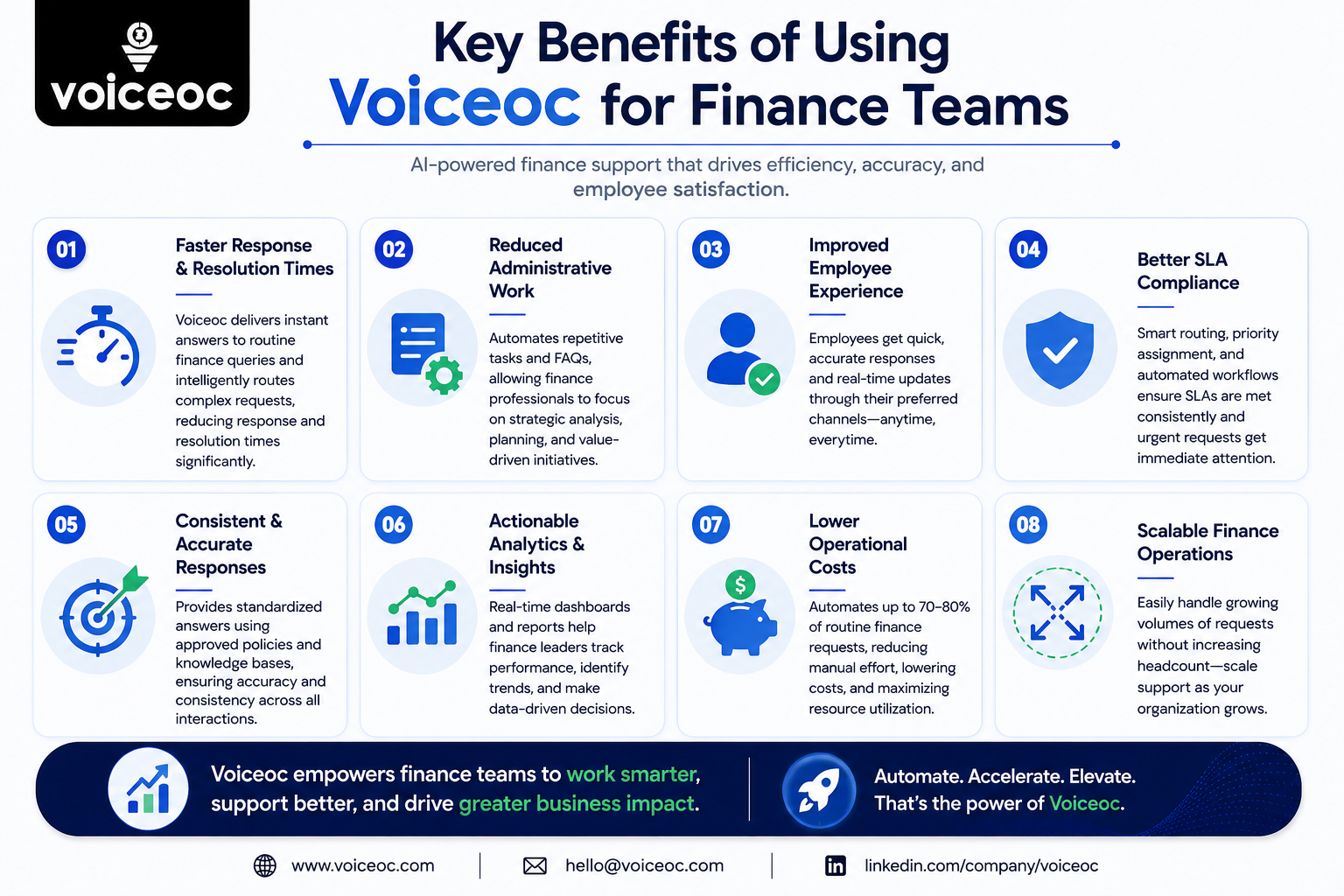
Key Benefits of Using Voiceoc for Finance Teams
Implementing AI in finance support isn't just about responding to tickets faster; it's about creating a more efficient, scalable, and employee-friendly support experience. By automating repetitive requests and streamlining workflows, Voiceoc enables finance teams to focus on work that drives greater business value.
Faster Response and Resolution Times
Employees no longer have to wait hours, or even days, for answers to routine finance questions. Voiceoc provides instant responses to common requests and intelligently routes more complex issues to the appropriate finance specialist. This reduces first response times and accelerates overall ticket resolution.
Reduced Administrative Work
Finance professionals often spend a significant portion of their day answering repetitive questions related to reimbursements, payroll, invoices, or finance policies. Voiceoc automates these routine interactions, allowing finance teams to dedicate more time to budgeting, forecasting, financial analysis, and compliance initiatives.
Improved Employee Experience
Quick and transparent support has a direct impact on employee satisfaction. Instead of following up multiple times for updates, employees receive real-time responses and automated status notifications throughout the request lifecycle. This creates a smoother, more reliable support experience.
Better SLA Compliance
Meeting internal service-level agreements (SLAs) becomes easier when requests are automatically categorized, prioritized, and routed to the right finance team. Voiceoc helps reduce delays and ensures urgent requests receive immediate attention.
Consistent and Accurate Responses
When employees rely on multiple sources for finance information, inconsistent answers can create confusion. Voiceoc delivers standardized responses using approved finance policies and knowledge bases, ensuring employees receive accurate and up-to-date information every time.
Actionable Analytics for Continuous Improvement
Voiceoc provides finance leaders with real-time dashboards that offer insights into:
- Total finance support requests
- Most common request categories
- Average response and resolution times
- Automation rates
- SLA performance
- Employee satisfaction trends
These insights help organizations identify recurring issues, optimize workflows, and continuously improve finance support operations.
Best Practices for Implementing AI in Finance Support
Successfully implementing AI goes beyond deploying new technology. Organizations should take a structured approach to maximize adoption and long-term value.
Start with High-Volume, Repetitive Requests
Identify the finance requests that consume the most time, such as expense reimbursements, payroll questions, invoice status checks, and finance policy inquiries. These are ideal candidates for automation because they are repetitive and follow standardized workflows.
Build a Centralized Knowledge Base
AI performs best when it has access to accurate and up-to-date information. Maintaining a centralized repository of finance policies, approval processes, reimbursement guidelines, and frequently asked questions ensures employees receive reliable responses.
Integrate with Existing Finance Systems
To provide real-time updates, AI should integrate with ERP platforms, accounting software, payroll systems, procurement tools, and ticketing solutions. This allows employees to receive accurate information without switching between multiple applications.
Continuously Monitor Performance
Track key performance indicators such as:
- Average response time
- Resolution time
- Automation rate
- Employee satisfaction score
- Ticket backlog
- Frequently raised finance requests
Reviewing these metrics regularly helps identify opportunities to refine workflows and expand automation.
Keep Human Expertise at the Center
While AI can automate many routine interactions, finance professionals remain essential for handling exceptions, compliance matters, strategic planning, and complex financial decisions. The most effective approach combines AI-driven efficiency with human expertise.
Conclusion
Finance support has become an essential part of the employee experience. As organizations grow, finance teams must manage increasing volumes of requests while maintaining speed, accuracy, and compliance. Relying on manual processes and shared inboxes is no longer enough to meet these expectations.
AI is transforming finance support by automating repetitive tasks, providing instant answers, intelligently routing complex requests, and delivering real-time insights into support performance. Rather than replacing finance professionals, AI enables them to spend less time on administrative work and more time on strategic financial initiatives.
Voiceoc brings these capabilities together in a single AI-powered platform. From handling routine payroll and reimbursement inquiries to automating finance workflows and providing actionable analytics, Voiceoc helps organizations build a faster, more scalable, and employee-centric finance support function.
As businesses continue to embrace digital transformation, adopting AI for finance support is no longer just an operational improvement; it's a strategic investment in productivity, employee satisfaction, and long-term business growth.
If your organization is looking to modernize finance operations and deliver faster, smarter support, Voiceoc can help you automate high-volume finance requests while empowering your finance team to focus on what matters most.
Frequently Asked Questions (FAQs)
1. What are finance support requests?
Finance support requests are internal inquiries submitted by employees, vendors, or departments related to financial operations. Common examples include payroll questions, expense reimbursement status, invoice tracking, purchase order approvals, vendor payments, tax documents, and finance policy clarification.
2. How does AI improve finance support?
AI improves finance support by automating repetitive requests, understanding employee intent through conversational AI, providing instant responses, routing complex issues to the appropriate finance team, and delivering real-time updates. This reduces manual work, improves response times, and enhances the overall employee experience.
3. What types of finance requests can Voiceoc automate?
Voiceoc can automate a wide range of routine finance requests, including:
- Expense reimbursement status
- Payroll and payslip inquiries
- Invoice and payment tracking
- Finance policy questions
- Purchase order guidance
- Vendor onboarding information
- Tax document requests
- Approval status updates
Complex requests that require human review are automatically routed to the appropriate finance specialist.
4. Can Voiceoc integrate with existing finance systems?
Yes. Voiceoc is designed to integrate with enterprise finance and business applications such as ERP, accounting, payroll, procurement, and ticketing systems. These integrations enable employees to receive accurate, real-time information while helping finance teams manage requests from a centralized platform.
5. Why should organizations use AI for finance support?
AI helps organizations reduce repetitive workloads, improve response times, maintain consistent communication, enhance employee satisfaction, and scale finance operations without significantly increasing administrative effort. It also provides valuable analytics that help finance leaders optimize support processes and make data-driven decisions.








.svg)
.svg)