
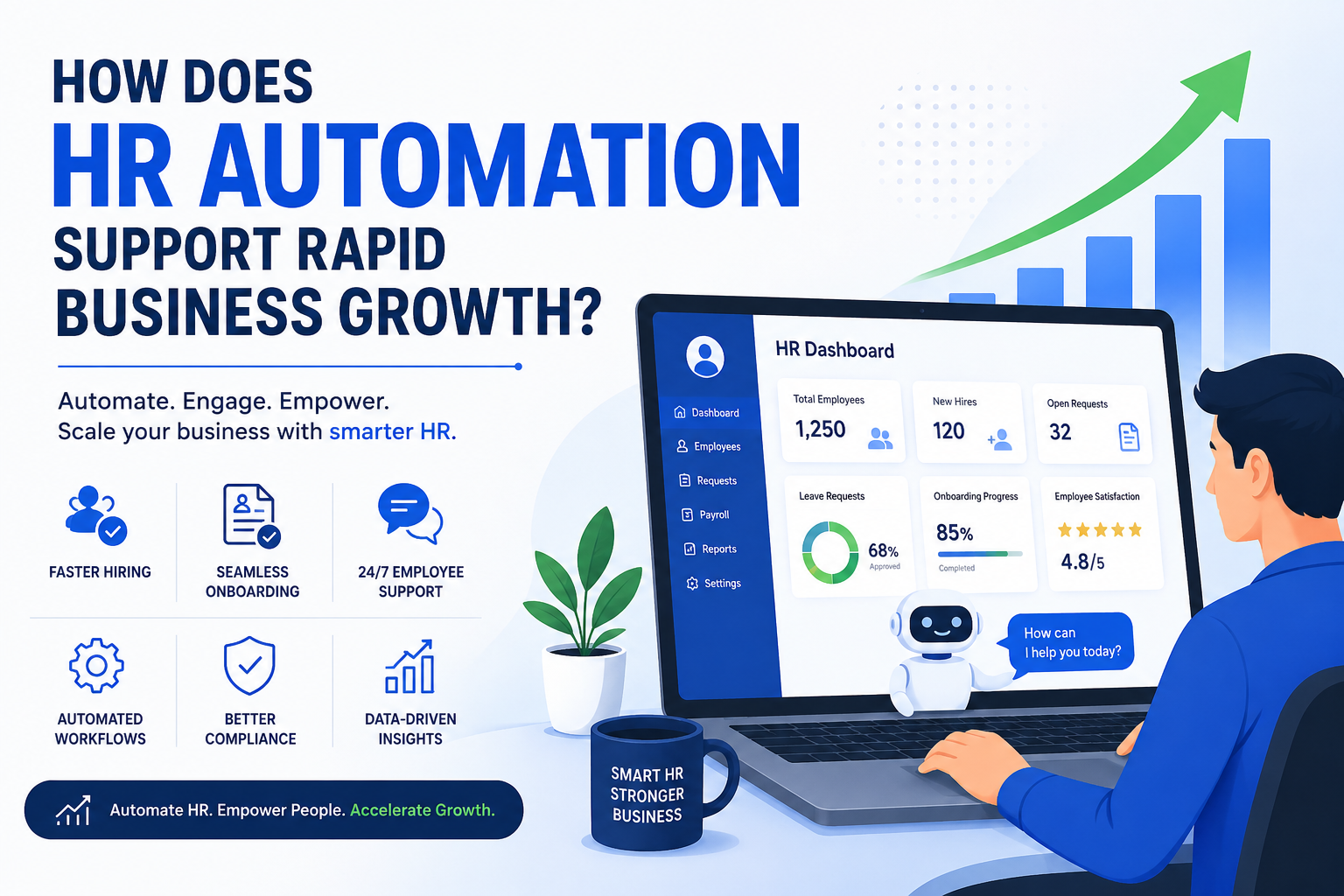
Business growth is an exciting milestone, but it also introduces new operational challenges. As organizations hire more employees, expand into new markets, and manage larger teams, Human Resources (HR) often becomes one of the busiest departments. Processes that once worked for a small workforce, such as manual onboarding, leave management, payroll support, and employee query handling, can quickly become inefficient and time-consuming.
This is where HR automation becomes a game-changer. By automating repetitive HR tasks and leveraging artificial intelligence (AI), businesses can streamline operations, improve employee experiences, and support sustainable growth without overburdening HR teams.
Fill out the form today to learn more about AI HR Automation, and our team will connect with you shortly!
According to multiple industry studies, HR professionals spend a significant portion of their time on administrative tasks rather than strategic initiatives. By adopting HR automation software, organizations can reduce manual workloads, improve operational efficiency, and allow HR teams to focus on talent development, employee engagement, and business strategy.
In this blog, we'll explore how HR automation, AI HR automation, and HR process automation help organizations scale faster, improve workforce productivity, and build a better employee experience.
What Is HR Automation?
HR automation is the use of technology to automate repetitive Human Resources tasks, workflows, and employee interactions. Instead of relying on spreadsheets, emails, or manual paperwork, organizations use HR automation software to manage HR operations more efficiently and accurately.
Modern human resource automation goes beyond simple workflow automation. AI-powered platforms can now answer employee questions, automate approvals, route HR requests, schedule onboarding activities, generate reports, and even provide personalized support through conversational AI.
Some of the most common HR processes that organizations automate include:
- Employee onboarding and offboarding
- Leave and attendance management
- Payroll inquiries
- Benefits administration
- Employee document management
- Performance review workflows
- HR ticket management
- Employee support requests
- Policy and compliance communication
Unlike traditional systems that require manual intervention at every step, AI HR automation enables organizations to create intelligent workflows that operate around the clock. Employees can receive instant answers to common HR questions, managers can approve requests more efficiently, and HR teams can spend less time on administrative work.
As businesses continue to grow, investing in HR process automation is no longer just about improving efficiency; it has become an essential strategy for scaling operations while maintaining a positive employee experience.
Why Rapid Business Growth Puts Pressure on HR Teams?
Growth brings new opportunities, but it also increases the complexity of HR operations. Every new hire, policy update, and employee request adds to the workload. Without the right systems in place, HR teams can quickly become overwhelmed, leading to slower response times, inconsistent processes, and reduced employee satisfaction.
Let's look at some of the biggest HR challenges growing businesses face.
High-Volume Hiring
When companies experience rapid growth, recruitment often becomes a top priority. HR teams may need to fill dozens, or even hundreds, of positions within a short period.
Managing resumes, scheduling interviews, communicating with candidates, and coordinating hiring managers manually can consume countless hours. Delays in recruitment may result in losing top talent to competitors.
With HR automation software, repetitive recruitment tasks can be streamlined, allowing HR professionals to focus on selecting the best candidates rather than managing administrative work.
Employee Onboarding Becomes More Complex
Hiring new employees is only the first step. Every new hire needs contracts, training materials, IT access, policy documents, and introductions to company processes.
When onboarding is handled manually, important steps can easily be missed, creating confusion and delaying employee productivity.
Employee onboarding automation ensures that every new hire follows a consistent onboarding journey. Automated workflows can assign tasks, send welcome emails, collect documents, schedule training sessions, and notify relevant departments without requiring constant HR involvement.
As a result, new employees can become productive faster while enjoying a smoother onboarding experience.
Growing Employee Support Requests
As organizations expand, HR teams receive an increasing number of employee questions every day.
Common requests include:
- Leave balance inquiries
- Payroll questions
- Benefits information
- Company policies
- Expense reimbursement
- Remote work guidelines
- Employment verification letters
Answering these repetitive questions manually can take hours each day.
An employee self-service portal powered by AI enables employees to find information independently or receive instant responses through chat or voice assistants. This significantly reduces the burden on HR teams while improving response times.
Also Read: Role of AI in Employee Retention Strategies
Compliance and Documentation Challenges
Business growth often means operating across multiple locations, hiring internationally, or complying with new labor regulations.
Managing contracts, employee records, policy acknowledgments, and compliance documents manually increases the risk of human error.
Missed deadlines or inconsistent documentation can expose organizations to legal and financial risks.
With HR support automation, compliance workflows become standardized. Automated reminders, digital records, approval tracking, and audit trails help organizations stay compliant while reducing administrative effort.
Limited Time for Strategic HR Initiatives
Perhaps the biggest challenge of rapid growth is that HR teams become trapped in repetitive administrative work.
Instead of focusing on initiatives such as:
- Leadership development
- Employee engagement
- Workforce planning
- Talent retention
- Learning and development
HR professionals spend much of their day processing requests and updating records.
This limits HR's ability to contribute strategically to business growth.
By implementing enterprise HR automation, organizations can reduce manual workloads and empower HR professionals to focus on activities that drive long-term business success.
Know: How AI Agents Reduce HR Resolution Time?
How Does HR Automation Support Rapid Business Growth?
Scaling a business isn't just about hiring more people, it's about ensuring your internal operations can keep pace with growth. As employee numbers increase, so do HR responsibilities. Without efficient systems, delays in approvals, onboarding, employee support, and compliance can slow business momentum.
This is where HR automation creates a measurable impact. By combining intelligent workflows, AI-powered assistance, and automated employee support, organizations can eliminate repetitive tasks and build a scalable HR function that grows alongside the business.
Here are the key ways HR automation software supports rapid business growth.
Accelerates Recruitment and Hiring
Recruitment is one of the first HR functions affected during business expansion. As hiring demand increases, manually reviewing resumes, scheduling interviews, and communicating with candidates becomes increasingly difficult.
With AI HR automation, many of these repetitive tasks can be automated.
For example, automation can:
- Screen resumes based on predefined criteria.
- Schedule interviews automatically by syncing calendars.
- Send interview reminders and follow-up emails.
- Keep candidates informed throughout the hiring process.
- Route applications to the right hiring managers.
By reducing administrative work, recruiters can focus on evaluating talent and building stronger relationships with candidates.
A faster hiring process also improves the candidate experience, helping organizations secure top talent before competitors do.
Simplifies Employee Onboarding
An effective onboarding process plays a major role in employee productivity and retention. However, manual onboarding often involves countless emails, paperwork, approvals, and coordination between HR, IT, and department managers.
Employee onboarding automation streamlines every step of the process.
Instead of manually assigning tasks, automated workflows can:
- Send offer letters and onboarding documents.
- Collect digital signatures.
- Create employee profiles.
- Assign mandatory training modules.
- Notify IT to prepare devices and software access.
- Schedule orientation sessions.
- Share company policies and employee handbooks.
Every department receives the right tasks at the right time, ensuring nothing is overlooked.
A structured onboarding experience helps new employees feel welcomed and allows them to become productive much faster.
Reduces Administrative Work for HR Teams
Administrative tasks consume a significant portion of an HR professional's day. Responding to routine employee requests, updating records, processing leave applications, and managing documentation can leave little time for strategic initiatives.
With HR process automation, these repetitive tasks can run automatically.
Organizations can automate processes such as:
- Leave requests and approvals
- Attendance tracking
- Payroll-related inquiries
- Document generation
- Employment verification letters
- Policy acknowledgments
- Expense approval workflows
Automation minimizes manual data entry, reduces errors, and ensures consistent execution across departments.
As a result, HR professionals can shift their focus from administrative work to employee engagement, workforce planning, and organizational development.
Delivers 24/7 Employee Support
One of the biggest advantages of modern HR automation software is its ability to provide employees with instant support.
Employees frequently ask questions about:
- Leave balances
- Payroll dates
- Insurance benefits
- Company policies
- Holiday calendars
- Expense reimbursement
- Internal procedures
Instead of waiting hours, or even days, for an HR representative to respond, employees can receive immediate assistance through an AI HR assistant.
Powered by conversational AI, these virtual assistants understand employee questions and provide accurate, personalized answers around the clock.
Whether an employee is working remotely, in another time zone, or outside business hours, they can still access the information they need.
This type of AI employee support improves responsiveness while significantly reducing the volume of repetitive HR tickets.
Improves Employee Experience
Employee experience has become a critical factor in attracting and retaining top talent.
Long response times, complicated HR processes, and inconsistent communication can frustrate employees and reduce engagement.
HR automation helps create a smoother and more employee-centric workplace by making HR services faster, easier, and more accessible.
Employees benefit from:
- Instant answers to common questions
- Self-service access to HR information
- Faster approvals
- Simplified leave applications
- Digital document access
- Personalized communication
When employees spend less time waiting for support, they can focus more on their work.
A positive employee experience not only boosts productivity but also strengthens retention and workplace satisfaction.
Streamlines HR Workflows Across Departments
HR doesn't operate in isolation. Many HR processes require collaboration with IT, finance, legal, and department managers.
Without automation, these cross-functional workflows often rely on lengthy email chains and manual follow-ups.
HR workflow automation connects these departments through intelligent approval processes.
For example, when a new employee joins:
- HR completes onboarding documentation.
- IT receives an automatic request to create accounts and provision equipment.
- Finance is notified to process payroll setup.
- Managers receive onboarding checklists.
- Security teams receive access requests.
Instead of coordinating these activities manually, automated workflows ensure every task is completed in the correct sequence.
This reduces delays and creates a seamless employee experience.
Strengthens Compliance and Reduces Human Error
As organizations grow, compliance becomes increasingly complex.
Businesses must manage employee records, labor regulations, tax documentation, policy acknowledgments, and audit requirements.
Manual processes increase the likelihood of:
- Missing documents
- Data entry errors
- Expired certifications
- Missed compliance deadlines
- Inconsistent recordkeeping
Human resource automation helps standardize HR operations by ensuring every workflow follows predefined rules.
Automated systems maintain digital records, track approvals, generate audit trails, and send reminders for important compliance activities.
This not only reduces legal risks but also gives HR leaders greater confidence that policies are being followed consistently across the organization.
Provides Data-Driven HR Insights
Modern HR automation software doesn't just automate tasks; it also generates valuable workforce insights.
Every employee interaction, workflow, and HR request creates data that can help organizations make better decisions.
Advanced analytics can provide visibility into:
- Hiring performance
- Time-to-hire
- Employee onboarding completion
- HR ticket resolution time
- Employee satisfaction
- Leave trends
- Workforce productivity
- Attrition patterns
Instead of relying on assumptions, HR leaders can use real-time dashboards to identify bottlenecks and improve decision-making.
For example, if analytics reveal that onboarding takes longer than expected, HR teams can optimize workflows to reduce delays. If employee support requests spike around payroll, organizations can proactively improve communication or automate responses.
These insights help businesses continuously refine HR operations while supporting long-term growth.
Enables HR Teams to Focus on Strategic Initiatives
Perhaps the greatest advantage of enterprise HR automation is that it allows HR professionals to move beyond administrative responsibilities.
When repetitive work is automated, HR teams gain more time to focus on initiatives that directly contribute to business growth, such as:
- Building a strong employer brand
- Improving employee engagement
- Developing leadership programs
- Workforce planning
- Learning and development
- Diversity and inclusion initiatives
- Talent retention strategies
Instead of acting as process managers, HR professionals become strategic business partners who help shape the organization's future.
As businesses continue to grow, this shift becomes essential for maintaining a competitive advantage.
Key Benefits of HR Automation for Growing Businesses
Implementing HR automation is about more than replacing manual tasks with digital workflows. It enables organizations to build an HR function that can scale efficiently while delivering a better experience for employees and managers alike.
Here are some of the biggest benefits businesses can expect from HR automation software.
Increased Productivity
HR professionals spend a considerable amount of time handling repetitive administrative work. By automating routine processes, they can focus on strategic initiatives such as talent acquisition, employee development, and organizational planning.
At the same time, employees no longer have to wait for simple requests like leave approvals or policy information, allowing them to stay focused on their core responsibilities.
Reduced Operational Costs
Hiring additional HR staff to manage a growing workforce can be expensive. HR process automation helps organizations handle increased workloads without significantly increasing operational costs.
By reducing manual effort, paperwork, and processing time, businesses can improve efficiency while keeping HR expenses under control.
Faster Decision-Making
Modern AI HR automation platforms provide real-time dashboards and workforce insights that help HR leaders make informed decisions.
Instead of manually collecting data from multiple systems, HR teams can monitor hiring performance, employee engagement, ticket resolution times, and workforce trends from a single platform.
This enables quicker responses to business needs and supports long-term growth planning.
Improved Employee Satisfaction
Employees expect fast, personalized, and accessible HR support. Long wait times for answers or approvals can lead to frustration and lower engagement.
With employee self-service capabilities and AI-powered support, employees can access information, submit requests, and resolve common HR issues whenever they need assistance.
A responsive HR experience contributes to higher employee satisfaction and stronger workplace morale.
Better Scalability
As organizations grow, manual HR processes become increasingly difficult to manage.
Enterprise HR automation provides standardized workflows that can support hundreds or even thousands of employees without compromising efficiency or consistency.
This allows businesses to expand confidently while maintaining high-quality HR services.
Best Practices for Successfully Implementing HR Automation
Introducing automation requires thoughtful planning to ensure long-term success. Following these best practices can help organizations maximize the value of their investment.
Start with Repetitive Processes
Identify HR activities that consume the most time, such as onboarding, leave management, employee support, or document approvals. Automating these processes first often delivers the quickest return on investment.
Set Clear Objectives
Before implementing HR automation software, define measurable goals such as reducing HR response times, improving onboarding completion rates, increasing employee satisfaction, or lowering administrative costs.
Clear objectives make it easier to evaluate success.
Integrate Existing HR Systems
Automation works best when connected with existing HRIS, payroll, collaboration, and communication platforms.
Integrated systems eliminate duplicate data entry and ensure information flows seamlessly across departments.
Encourage Employee Adoption
Even the best technology requires user adoption. Provide training sessions, onboarding resources, and clear communication so employees understand how to use new automation tools effectively.
Continuously Monitor and Improve
Business needs evolve, and HR workflows should evolve with them.
Regularly review automation performance, gather employee feedback, and optimize workflows to improve efficiency and employee experience.
Why Is AI Shaping the Future of HR Automation?
The next generation of HR automation is powered by artificial intelligence.
Unlike traditional automation, which follows predefined rules, AI for HR can understand employee intent, provide contextual responses, and continuously improve based on interactions.
Some of the most significant AI-driven innovations include:
- Conversational AI that answers employee questions naturally through chat or voice.
- AI-powered HR assistants that resolve common HR requests instantly.
- Intelligent ticket routing that automatically directs employee issues to the appropriate department.
- Predictive analytics that identify workforce trends and potential retention risks.
- Personalized employee support based on individual roles, policies, and previous interactions.
- Automated knowledge management that delivers accurate answers from HR documentation.
As AI technology continues to advance, organizations will increasingly rely on intelligent automation to create more responsive, efficient, and employee-centric HR operations.
Businesses that embrace AI today will be better positioned to adapt to future workforce demands and maintain a competitive advantage.
How Does Voiceoc Help Businesses Scale HR Operations?
As organizations grow, managing employee support manually becomes increasingly challenging. Voiceoc provides an AI-powered HR automation platform that helps businesses simplify HR operations, automate employee interactions, and deliver exceptional employee experiences at scale.
With Voiceoc, organizations can:
- Automate repetitive HR tasks and employee support requests.
- Provide 24/7 assistance through AI-powered chat and voice agents.
- Enable employee self-service for HR policies, leave management, payroll inquiries, and frequently asked questions.
- Streamline HR ticket automation with intelligent routing and faster resolution.
- Automate onboarding workflows to ensure every new employee has a consistent experience.
- Integrate with enterprise HR systems to create seamless workflows across departments.
- Monitor HR performance through analytics and reporting dashboards.
By combining conversational AI with intelligent workflow automation, Voiceoc empowers HR teams to spend less time on repetitive administrative work and more time building a productive, engaged, and future-ready workforce.
Whether you're a fast-growing startup or a large enterprise, Voiceoc helps you scale HR operations without compromising employee experience or operational efficiency.
Frequently Asked Questions
- What is HR automation?
HR automation is the use of software and AI to automate repetitive Human Resources tasks such as onboarding, leave management, employee support, document processing, approvals, and workflow management. It improves efficiency while reducing manual work.
- How does HR automation support rapid business growth?
HR automation enables organizations to handle increasing employee workloads without expanding HR teams at the same pace. It accelerates hiring, improves onboarding, streamlines workflows, enhances employee support, and provides valuable workforce insights that help businesses scale efficiently.
- What HR processes can be automated?
Organizations can automate recruitment, onboarding, leave management, attendance tracking, payroll inquiries, document approvals, employee helpdesk requests, compliance workflows, performance management, and offboarding processes.
- Is HR automation suitable for small and medium-sized businesses?
Yes. While large enterprises often benefit from advanced automation capabilities, small and medium-sized businesses can also use HR automation to reduce administrative work, improve employee experiences, and prepare for future growth.
- How does AI improve HR automation?
AI enhances HR automation by enabling conversational employee support, intelligent ticket routing, predictive workforce analytics, personalized assistance, and faster issue resolution. These capabilities help HR teams deliver more efficient and responsive services.
Conclusion
Rapid business growth brings exciting opportunities, but it also increases the complexity of managing people, processes, and employee expectations. Relying on manual HR operations can create bottlenecks that slow hiring, delay onboarding, overwhelm HR teams, and impact the overall employee experience.
By adopting HR automation, organizations can streamline routine tasks, improve operational efficiency, enhance compliance, and provide employees with faster, more personalized support. From HR process automation and employee onboarding automation to AI-powered employee assistance and intelligent workflow management, automation enables HR teams to focus on strategic initiatives that drive long-term business success.
As artificial intelligence continues to transform the workplace, investing in AI HR automation is no longer just an option, it's a competitive advantage. Businesses that embrace intelligent HR solutions today will be better equipped to scale, adapt, and meet the evolving needs of their workforce.
If your organization is looking to simplify HR operations and deliver exceptional employee experiences, Voiceoc offers an intelligent, AI-powered HR automation platform that helps growing businesses automate employee support, optimize workflows, and scale with confidence.







.svg)
.svg)