The Best HR Software Solutions For Enterprises in 2026
May 6, 2026
Managing a growing team in India comes with a different set of challenges, whether it’s navigating the complexities of multiple payroll systems and statutory compliance or building a positive work culture.
For enterprises, whether small, medium, or large-scale, manual HR processes become inefficient, error-prone, and time-consuming. And this increases the need for a dedicated HR Automation software, especially for small businesses, and it works as a strategic necessity.
This showcases a simple understanding of why enterprises need to rely on HR software solutions, highlighting the need for specialized financial management for better organizational health & growth. In this guide, we are going to talk about some comprehensive enterprise HR platforms with their core features, pricing structures, use cases, and limitations.
Fill up the form today and know more about HR Automation, IT, and Finance Tickets Automation Solution!
Before that, let’s understand:
Why You Must Choose Enterprise HR Software for HR Teams in 2026?
The HR team works as the backbone of every organization in order to manage the recruitment, payroll, onboarding, performance management, compliance, and analytics.
And in case founders or upper management do it manually, then it honestly takes too much time and increases risk.
When combined with other core HRIS and payroll systems, HR leaders work on reducing the cycle times, improving data quality, and increasing employee experience with consistent workflows.
The right direction upgrades the enterprise HR management system from reactive administration to focus on a strategic function with measurable impact on hiring, velocity, retention, and workforce planning across different locations.
Why Should You Look For HR Enterprise Software in 2026?
HR software is a professional solution, works in depth, and no matter where you actually pay off. The core HRIS system works on providing reliable data, time, and pay; your recruiting stack should maximize sourcing efficiency and candidate quality.
When considering the right AI HR software solution, it focuses on prioritizing interoperability, transparent pricing, strong compliance posture, and bringing measurable outcomes like time to hire or payroll accuracy.
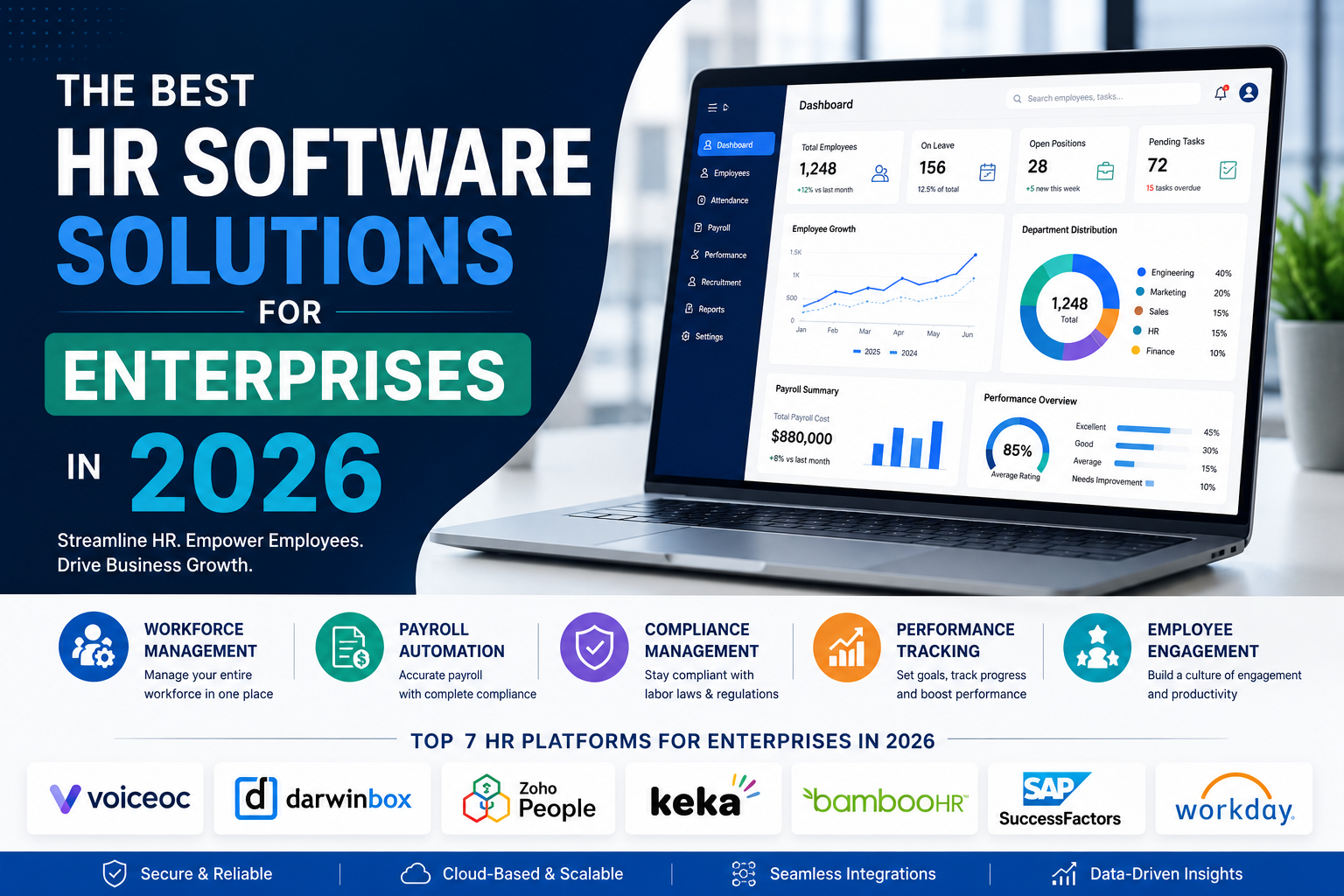
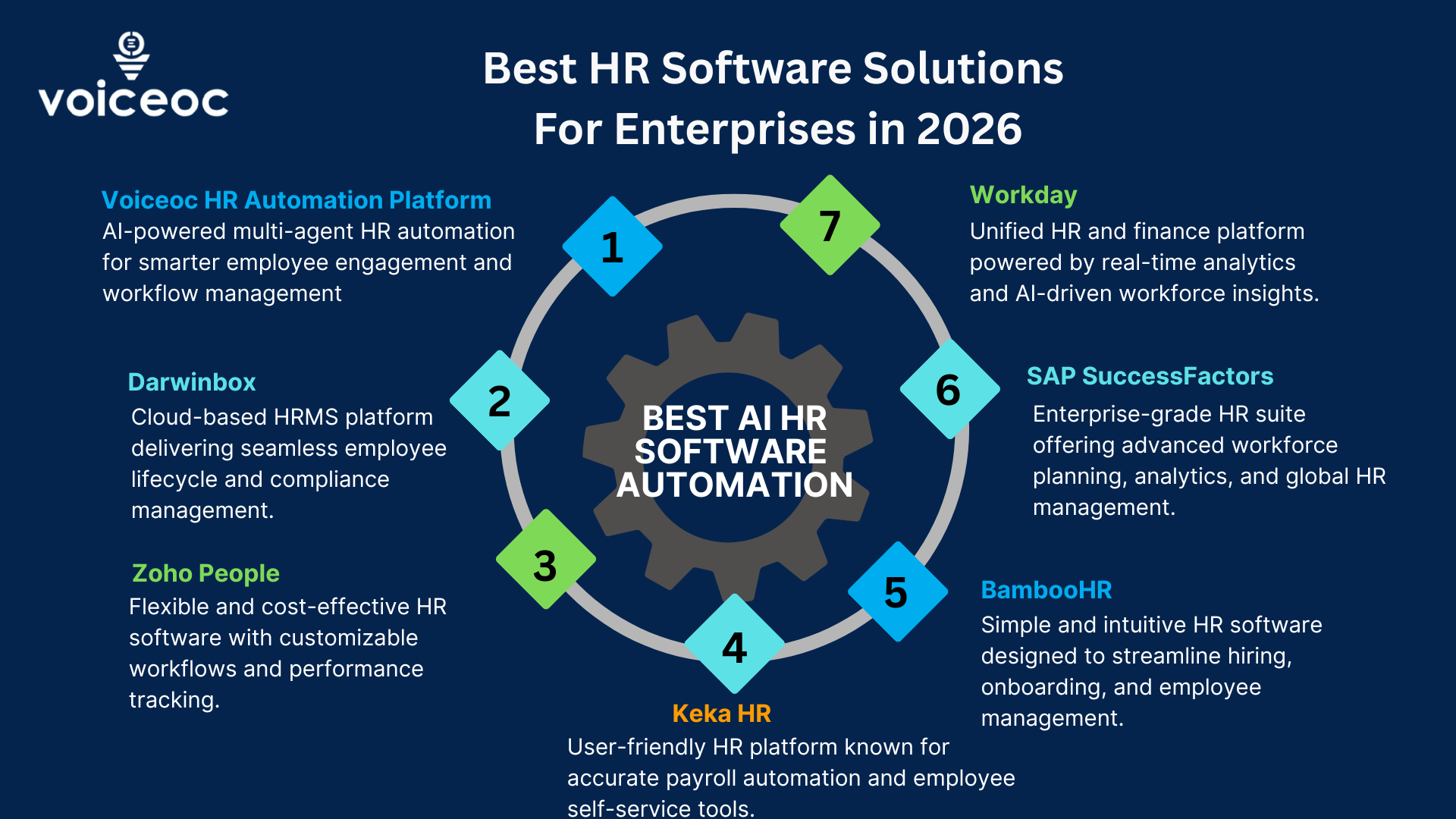
Best HR Software for Enterprises in 2026
1. Voiceoc HR Automation Platform
Voiceoc is designed with a strong focus on AI HR Enterprise Automation and employee experience. Unlike traditional HR systems that primarily digitize processes, Voiceoc takes it a step further by introducing multi-agent automation, where different AI agents handle tasks like onboarding, employee queries, scheduling, and internal communication.
Core Capabilities:
Conversational AI for HR: Employees can interact via chat, voice, or messaging platforms to resolve HR queries instantly.
Automated Employee Lifecycle: From onboarding to exit management, workflows are automated with minimal manual intervention.
Smart Workflow Orchestration: Multi-agent systems ensure that tasks like approvals, reminders, and document processing happen seamlessly.
Real-Time Analytics: HR leaders get actionable insights into employee engagement, performance trends, and operational bottlenecks.
Why It Stands Out in 2026: Voiceoc aligns with the shift toward experience-driven HR, where automation is not just about saving time but improving employee satisfaction and engagement.
Ideal Use Case: Enterprises aiming to modernize HR with AI and reduce dependency on manual processes.
Darwinbox is a cloud-native Enterprise HRMS platform that has gained significant traction in India and Southeast Asia. It offers a unified ecosystem covering the entire employee lifecycle.
Core Capabilities:
End-to-End HRIS: Covers recruitment, onboarding, payroll, and performance management.
Localization & Compliance: Strong support for Indian labor laws and statutory requirements.
Mobile-First Experience: Highly optimized for mobile usage, making it ideal for distributed teams.
Employee Engagement Tools: Surveys, feedback systems, and recognition features.
Strength: Its regional expertise and scalability make it a top choice for enterprises expanding across Asia.
Challenges: Customization and advanced reporting may require technical assistance.
3. Zoho People
Zoho People is part of the broader Zoho ecosystem, offering modular HR solutions that can be tailored to specific business needs.
Core Capabilities:
Custom Workflows: Businesses can design HR processes according to their structure.
Time & Attendance Tracking: Accurate tracking with biometric and remote integrations.
Performance Management: Continuous feedback and appraisal systems.
Integration Ecosystem: Seamless connection with Zoho CRM, Zoho Payroll, and other tools.
Strength: Highly cost-effective and flexible, making it suitable for growing enterprises.
Challenges: It may lack the advanced AI and predictive analytics found in newer platforms.
4. Keka HR
Keka HR is known for its strong payroll engine and user-friendly interface, particularly tailored for Indian businesses.
Core Capabilities:
Automated Payroll Processing: Handles taxes, PF, ESI, and compliance effortlessly.
Employee Self-Service Portal: Employees can manage leaves, payslips, and reimbursements independently.
Performance Management: Goal setting, OKRs, and review cycles.
Expense Management: Simplifies reimbursements and approvals.
Strength: Exceptional payroll accuracy and compliance handling.
Challenges: Limited global features and relatively fewer AI-driven innovations.
5. BambooHR
BambooHR enterprise software is widely recognized for its simplicity and clean user experience, making HR management intuitive.
Core Capabilities:
Centralized Employee Database: Single source of truth for all employee data.
Applicant Tracking System (ATS): Streamlines hiring and candidate management.
Onboarding Automation: Smooth onboarding with task tracking and documentation.
Reporting Tools: Easy-to-generate HR reports and insights.
Strength: Ideal for organizations that prioritize ease of use and quick implementation.
Challenges: Limited payroll functionality in certain regions and fewer enterprise-grade features.
6. SAP SuccessFactors
SAP SuccessFactors is a comprehensive enterprise HR suite designed for large organizations with complex, global HR needs.
Core Capabilities:
Global HR Management: Supports multiple countries, currencies, and compliance frameworks.
Advanced Analytics: Predictive insights for workforce planning and talent management.
Learning & Development: Built-in LMS for employee training and upskilling.
Performance & Succession Planning: Helps identify and nurture future leaders.
Strength: Highly scalable and robust, suitable for multinational enterprises.
Challenges: Implementation is time-consuming and expensive, requiring dedicated resources.
7. Workday
Workday is a leading cloud-based HR and finance platform known for its real-time data processing and analytics capabilities.
Core Capabilities:
Unified Platform: Combines HR, finance, and planning in one system.
Real-Time Data Insights: Enables faster decision-making with live dashboards.
Talent Management: Covers recruitment, performance, and workforce planning.
AI & Machine Learning: Supports predictive analytics and automation.
Strength: Best-in-class analytics and scalability, making it ideal for large enterprises.
Challenges: High cost and complex deployment process.
Final Thoughts
The HR technology landscape in 2026 is clearly shifting toward automation, AI integration, and employee-centric experiences. While traditional platforms like SAP SuccessFactors and Workday continue to dominate large enterprises, newer solutions like Voiceoc are redefining how HR teams operate by introducing multi-agent automation and conversational AI.
For enterprises, the decision should not be based solely on features but on business alignment, scalability, and measurable impact. Whether your goal is compliance, employee engagement, or operational efficiency, selecting the right HR platform can significantly influence your organization’s long-term success.
Connect with Voiceoc today!
Thank you! Your submission has been received!
Oops! Something went wrong while submitting the form.
Topics:
Read More
July 28, 2026
How Does AI Help HR Teams Focus on Strategic Initiatives Instead of Administrative Tasks?








.svg)
.svg)