
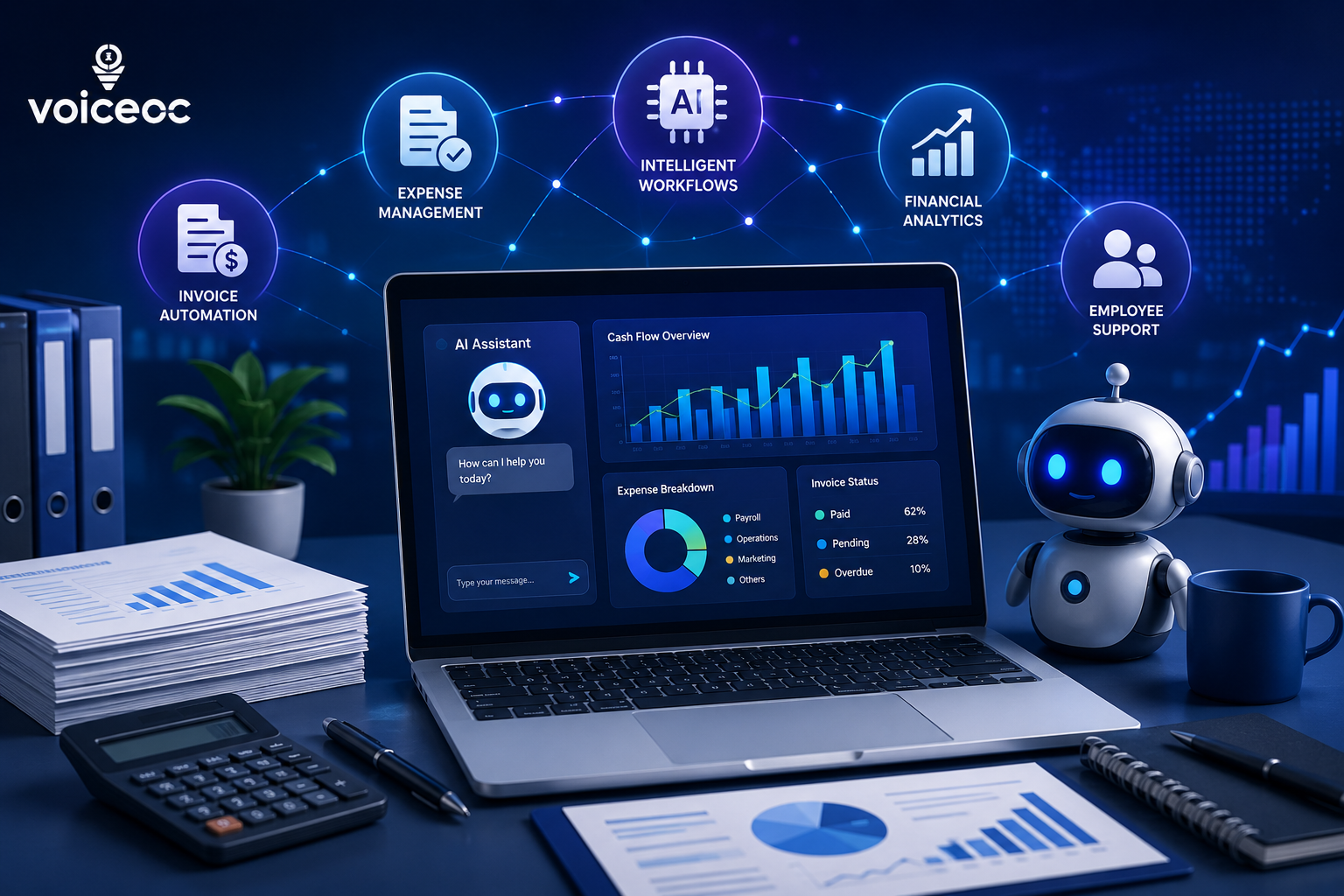
Artificial Intelligence (AI) is no longer just a buzzword in finance—it's becoming an essential part of how modern finance teams operate. As organizations handle increasing transaction volumes, tighter compliance requirements, and growing expectations for faster financial reporting, traditional manual processes are proving difficult to sustain.
From processing invoices and managing employee expense claims to responding to finance-related queries and forecasting budgets, finance professionals spend a significant amount of time on repetitive administrative tasks. These processes not only consume valuable resources but also increase the risk of human error, delayed approvals, and compliance issues.
To explore about AI Finance Automation Tool, fill up the form today and our team will connect with you shortly!
This is where AI finance automation is making a measurable difference. Today's AI-powered platforms can automate routine workflows, analyze financial data in real time, route approvals intelligently, and provide instant support through conversational AI assistants. Instead of replacing finance professionals, AI enables them to focus on higher-value activities like financial planning, strategic analysis, risk management, and business growth.
According to Gartner, AI and automation are becoming key priorities for finance leaders as organizations look to improve operational efficiency, reduce costs, and accelerate decision-making. Likewise, Deloitte reports that finance functions are increasingly investing in intelligent automation to streamline processes and improve accuracy across financial operations.
In this guide, we'll explore how AI is transforming finance teams, the key areas where automation delivers the biggest impact, and the best AI tools for finance teams in 2026 to help organizations modernize their financial operations.
Why Is AI Becoming Essential for Finance Teams?
Finance departments have traditionally relied on spreadsheets, manual approvals, emails, and repetitive data entry to manage daily operations. While these methods worked in the past, they often struggle to keep pace with today's fast-moving business environment.
Modern finance teams are expected to close books faster, ensure regulatory compliance, manage vendor relationships, support employees, and provide leadership with accurate financial insights, all while operating with limited resources.
Some of the biggest challenges finance teams face include:
- Manual invoice processing that slows down payment cycles
- Lengthy approval workflows for expenses and purchase requests
- High volumes of employee finance queries
- Difficulty tracking finance tickets across multiple communication channels
- Increasing compliance and audit requirements
- Human errors caused by repetitive data entry
- Limited visibility into workflow bottlenecks
These challenges not only reduce productivity but can also impact cash flow, vendor relationships, and employee satisfaction.
AI addresses these pain points by automating repetitive tasks, intelligently routing requests, extracting information from financial documents, and providing real-time insights for better decision-making.
Some of the biggest advantages of implementing AI finance software include:
- Faster invoice approvals
- Reduced manual workload
- Improved financial accuracy
- Better compliance and audit readiness
- Real-time financial reporting
- Enhanced employee and vendor experiences
- Increased operational efficiency
Rather than replacing finance professionals, AI acts as a digital assistant that handles repetitive administrative work while allowing finance teams to focus on strategic initiatives such as budgeting, forecasting, financial analysis, and business planning.
As AI capabilities continue to evolve, organizations that embrace automation today will be better positioned to improve efficiency, reduce operational costs, and stay competitive in the years ahead.
Key Areas Where AI Transforms Finance Operations
AI is creating value across nearly every finance function by automating repetitive processes and improving decision-making. Here are some of the most impactful areas where AI tools for finance teams are driving transformation.
Invoice Processing
Invoice processing is one of the most time-consuming tasks for finance departments. Employees often spend hours manually reviewing invoices, validating information, matching purchase orders, and obtaining approvals.
AI-powered invoice processing solutions use Optical Character Recognition (OCR) and machine learning to automatically extract invoice data, verify details, detect duplicate invoices, identify discrepancies, and route approvals to the appropriate stakeholders.
This significantly reduces processing time while minimizing costly manual errors.
Accounts Payable and Accounts Receivable Automation
Managing incoming and outgoing payments requires constant monitoring and coordination.
AI simplifies both accounts payable (AP) and accounts receivable (AR) by automating payment scheduling, invoice matching, vendor communications, payment reminders, and collection workflows.
For AP teams, automation ensures invoices are processed on time, reducing late payment penalties and strengthening supplier relationships. For AR teams, AI helps improve cash flow by automating payment reminders and identifying overdue accounts that require immediate attention.
Expense Management
Employee expense reimbursement is another area where finance teams often face delays and administrative burdens.
AI-powered expense management tools can automatically scan receipts, categorize expenses, detect policy violations, flag suspicious transactions, and accelerate approval workflows.
This not only speeds up reimbursement cycles but also helps organizations maintain better financial control and compliance with internal policies.
Financial Reporting and Forecasting
Preparing financial reports traditionally requires collecting data from multiple systems, reconciling records, and analyzing large datasets.
AI automates much of this process by consolidating financial data, identifying anomalies, generating reports, and providing predictive insights based on historical trends.
Finance leaders can use these insights to make faster, data-driven decisions, improve budget planning, and anticipate future financial risks with greater confidence.
Finance Ticket and Employee Query Automation
Finance departments receive hundreds of internal requests every month, ranging from payroll questions and reimbursement status updates to procurement approvals and vendor payment inquiries.
Responding to these requests manually often leads to delays and increased workloads for finance teams.
Modern AI-powered finance assistants use conversational AI to instantly answer common employee questions, create finance tickets, route requests to the appropriate department, track ticket status, and notify employees about updates automatically.
Platforms like Voiceoc take this a step further by combining conversational AI with intelligent workflow automation, enabling organizations to manage finance queries, automate approvals, and streamline internal financial support through a single AI-powered platform.
Must Know: Top IT Ticketing Tools to Support Business Operations
Top 8 AI Tools for Finance Teams in 2026
Choosing the right AI solution depends on your organization's size, existing technology stack, automation goals, and operational challenges. While some platforms specialize in invoice processing or expense management, others provide end-to-end finance workflow automation, AI-powered support, and intelligent ticket management.
Here are eight of the best AI tools helping finance teams work smarter in 2026.
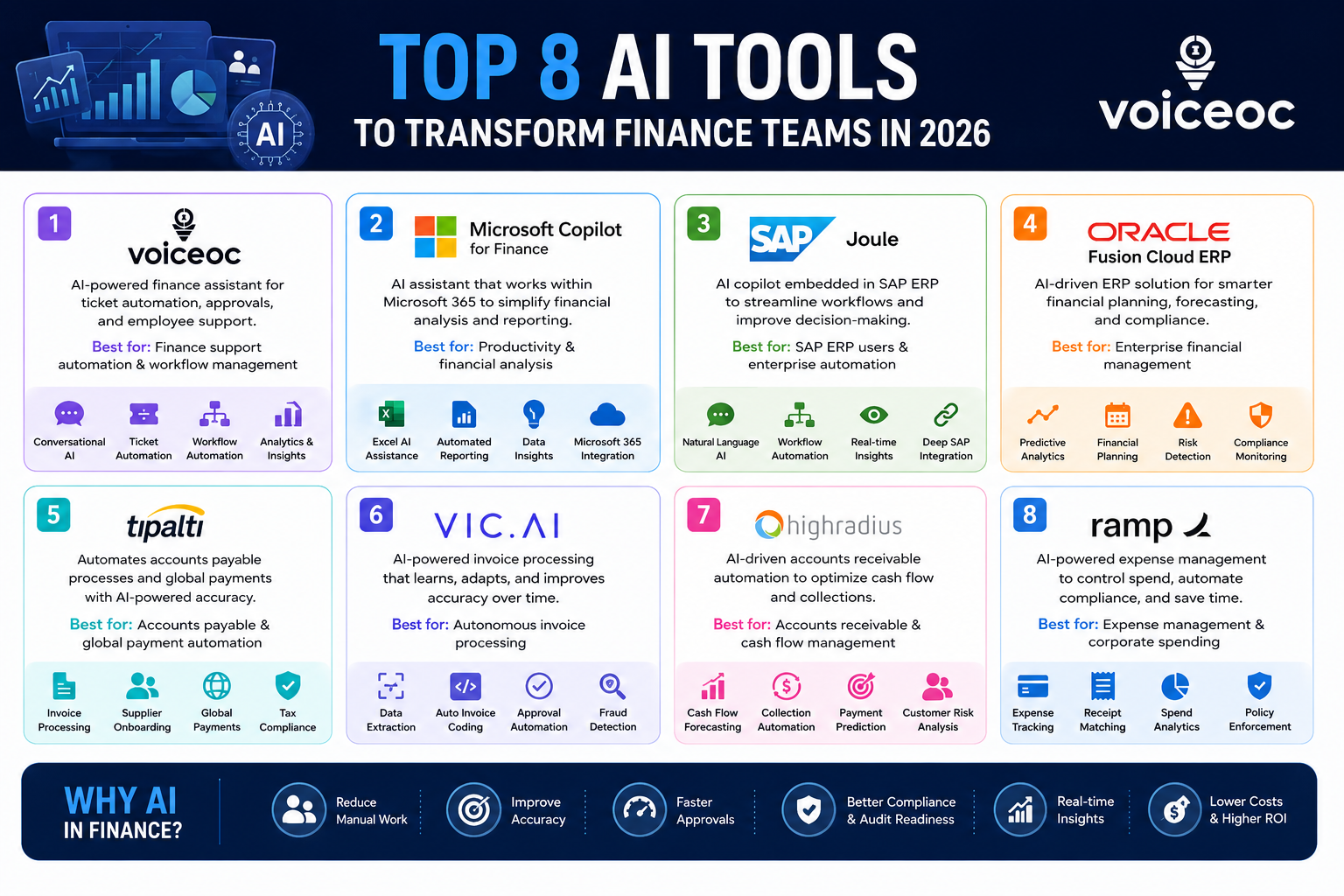
1. Voiceoc
Best For: AI-powered finance workflow automation, finance ticket management, and conversational employee support.
As finance teams become responsible for managing increasing volumes of employee requests, approvals, vendor inquiries, and internal workflows, organizations need more than traditional finance software. They need an intelligent platform that can automate communication and repetitive processes while improving the overall employee experience.
Voiceoc HR Automation delivers exactly that by combining conversational AI, workflow automation, and intelligent finance support into a single platform.
Key Features
- AI-powered finance assistant
- Automated finance ticket creation and routing
- Voice and chat-based employee support
- Invoice and approval workflow automation
- Intelligent query categorization
- Multi-channel communication
- Real-time analytics and reporting
- Enterprise system integrations
- AI-driven workflow orchestration
Why Finance Teams Choose Voiceoc?
Instead of manually responding to repetitive questions like reimbursement status, invoice approvals, payroll inquiries, or procurement requests, Voiceoc enables employees to receive instant answers through AI-powered conversations.
Finance teams benefit from:
- Faster response times
- Reduced manual workload
- Automated ticket routing
- Improved employee satisfaction
- Better visibility into finance operations
- Scalable automation across departments
For enterprises looking to modernize internal finance operations, Voiceoc offers a flexible and intelligent automation platform that extends beyond traditional finance software.
To connect with Voiceoc experts, schedule a 30-min free consultation on Finance Automation Tool!
2. Microsoft Copilot for Finance
Best For: Organizations already using Microsoft Dynamics 365 and Microsoft 365.
Microsoft Copilot for Finance brings generative AI directly into everyday finance workflows. By integrating with familiar applications like Excel and Outlook, it helps finance professionals analyze data faster, automate repetitive tasks, summarize financial information, and improve productivity without switching between multiple applications.
Key Features
- AI-powered financial analysis
- Intelligent Excel assistance
- Automated report generation
- Email summarization
- Financial data insights
- Integration with Microsoft ecosystem
Strengths
- Familiar user experience
- Strong productivity enhancements
- Seamless Microsoft integration
Consideration
Its full potential is realized within organizations already invested in Microsoft's business ecosystem.
3. SAP Joule
Best For: Large enterprises running SAP ERP solutions.
SAP Joule is SAP's AI copilot designed to simplify enterprise operations through natural language interactions and intelligent automation. Finance teams can quickly retrieve insights, automate workflows, and access financial information without navigating complex ERP interfaces.
Key Features
- AI-powered ERP assistance
- Financial data summarization
- Workflow automation
- Intelligent reporting
- Business process recommendations
Strengths
- Deep SAP integration
- Enterprise-grade security
- Simplified financial operations
Consideration
Best suited for organizations already using SAP solutions.
4. Oracle Fusion Cloud ERP AI
Best For: Large organizations seeking AI-driven ERP automation.
Oracle Fusion Cloud ERP AI helps finance teams automate routine financial processes while improving forecasting, reporting, and compliance. The platform uses machine learning to identify anomalies, predict financial outcomes, and streamline business workflows.
Key Features
- AI-driven forecasting
- Intelligent financial planning
- Automated reconciliation
- Predictive analytics
- Continuous risk monitoring
Strengths
- Advanced enterprise capabilities
- Strong financial planning tools
- Scalable architecture
Consideration
Ideal for organizations with complex enterprise finance requirements.
5. Tipalti
Best For: Accounts payable automation and global payment management.
Managing supplier payments across multiple countries can quickly become complex. Tipalti simplifies accounts payable by automating invoice processing, payment approvals, tax compliance, and vendor onboarding.
Key Features
- Automated invoice processing
- Global payment support
- Supplier onboarding
- Tax compliance management
- Payment reconciliation
Strengths
- Excellent AP automation
- Supports international businesses
- Reduces payment errors
Consideration
Focused primarily on accounts payable rather than complete finance workflow automation.
6. Vic.ai
Best For: Autonomous invoice processing.
Vic.ai leverages artificial intelligence to automate one of finance's most repetitive tasks, invoice management. Its machine learning capabilities allow it to classify invoices, identify coding patterns, recommend approvals, and continuously improve accuracy over time.
Key Features
- AI invoice coding
- Automated approvals
- Intelligent document processing
- Fraud detection
- Machine learning optimization
Strengths
- High automation accuracy
- Significant reduction in manual data entry
- Continuous learning capabilities
Consideration
Best suited for organizations handling high invoice volumes.
7. HighRadius
Best For: Accounts receivable and cash flow optimization.
HighRadius focuses on helping finance teams improve cash flow through intelligent receivables automation. Using AI, it predicts payment behaviors, automates collections, prioritizes customer accounts, and provides actionable insights to reduce outstanding receivables.
Key Features
- AI-powered collections
- Cash flow forecasting
- Payment prediction
- Customer risk analysis
- Automated AR workflows
Strengths
- Strong receivables automation
- Better working capital management
- Improved collection efficiency
Consideration
Primarily designed for AR operations rather than end-to-end finance automation.
8. Ramp AI
Best For: Expense management and corporate spending control.
Ramp has evolved beyond a corporate card platform by incorporating AI into expense management and financial operations. It helps businesses automate expense categorization, identify unusual spending patterns, enforce company policies, and generate financial insights.
Key Features
- AI expense categorization
- Receipt matching
- Spending analytics
- Budget tracking
- Policy enforcement
Strengths
- User-friendly interface
- Excellent expense visibility
- Faster reimbursements
Consideration
Most beneficial for organizations prioritizing spend management and employee expenses.
How Do These AI Tools Compare?
While each platform offers valuable capabilities, they serve different finance needs.
- Voiceoc is ideal for organizations looking to automate finance support, employee queries, approvals, and end-to-end workflow automation with conversational AI.
- Microsoft Copilot for Finance enhances productivity within the Microsoft ecosystem.
- SAP Joule and Oracle Fusion Cloud ERP AI are powerful options for enterprises already using their respective ERP platforms.
- Tipalti and Vic.ai excel in invoice and accounts payable automation.
- HighRadius specializes in receivables and cash flow management.
- Ramp AI focuses on intelligent expense management and corporate spending.
The best choice ultimately depends on your organization's priorities, whether that's automating internal finance support, streamlining invoice processing, improving cash flow, or optimizing expense management.
Must Know: Top 7 Tools for Financial Services Ticket Management (2026)
How to Choose the Right AI Finance Tool?
Selecting the right AI finance software is about more than choosing the platform with the most features. The ideal solution should align with your organization's workflows, integrate with your existing systems, and deliver measurable business value. Before making a decision, finance leaders should evaluate the following factors.
1. Automation Capabilities
The primary goal of implementing AI is to eliminate repetitive manual work. Look for a platform that can automate key finance processes such as invoice approvals, expense management, payment reminders, finance ticket routing, and financial reporting. The more workflows AI can handle, the greater the efficiency gains.
2. Integration with Existing Systems
Your AI solution should integrate seamlessly with your ERP, accounting software, HRMS, CRM, and communication platforms. Smooth integrations reduce manual data entry, improve data accuracy, and enable end-to-end workflow automation without disrupting existing processes.
3. Security and Compliance
Finance teams manage highly sensitive financial and employee data. Choose an AI platform that offers enterprise-grade security, role-based access controls, audit trails, encryption, and compliance with industry regulations. A secure platform protects both organizational data and customer trust.
4. Scalability
As your business grows, your finance operations become more complex. An AI platform should be able to handle increasing transaction volumes, additional workflows, and multiple business units without compromising performance.
5. User Experience
Adoption is one of the biggest challenges with new technology. Look for a solution with an intuitive interface, conversational AI capabilities, and minimal learning curve. Employees are more likely to use a platform that simplifies their daily work rather than adding complexity.
6. Analytics and Reporting
Real-time dashboards and actionable insights help finance leaders monitor workflow performance, identify bottlenecks, and make informed decisions. AI-powered reporting also supports better forecasting and continuous process improvement.
Why Businesses Choose Voiceoc for Finance Automation?
Modern finance teams need more than isolated automation tools; they need a connected platform that streamlines communication, automates workflows, and delivers faster support across the organization. This is where Voiceoc stands out.
Voiceoc combines Conversational AI, workflow automation, and intelligent finance ticket management into a unified platform that helps organizations simplify finance operations while enhancing the employee experience.
With Voiceoc, employees can instantly receive answers to common finance-related questions, such as reimbursement status, payroll inquiries, invoice approvals, procurement requests, or vendor payment updates, through AI-powered chat and voice assistants. When human intervention is required, the platform automatically creates and routes finance tickets to the appropriate team, ensuring faster resolution and improved accountability.
Beyond employee support, Voiceoc enables finance teams to automate approval workflows, reduce repetitive administrative tasks, and gain real-time visibility into finance operations through advanced analytics and reporting.
Key Benefits of Voiceoc
- AI-powered finance assistant for instant employee support
- Automated finance ticket creation and intelligent routing
- Voice and chat-based conversational AI
- Workflow automation for approvals and finance requests
- Real-time dashboards and performance analytics
- Enterprise integrations with existing business systems
- Reduced response times and operational costs
- Scalable solution for growing organizations
By automating routine finance operations, Voiceoc allows finance professionals to focus on strategic initiatives such as budgeting, forecasting, compliance, and financial planning rather than spending valuable time on repetitive administrative tasks.
Frequently Asked Questions
- What are the best AI tools for finance teams?
Some of the leading AI tools for finance teams in 2026 include Voiceoc, Microsoft Copilot for Finance, SAP Joule, Oracle Fusion Cloud ERP AI, Tipalti, Vic.ai, HighRadius, and Ramp AI. Each platform specializes in different areas, such as workflow automation, invoice processing, expense management, or accounts receivable automation.
- How does AI improve finance operations?
AI improves finance operations by automating repetitive tasks, accelerating approvals, reducing manual errors, improving compliance, generating real-time insights, and enhancing employee support. This enables finance teams to work more efficiently while focusing on strategic financial initiatives.
- Can AI automate invoice processing?
Yes. Modern AI platforms use technologies such as Optical Character Recognition (OCR) and machine learning to extract invoice data, validate information, identify discrepancies, and automatically route invoices for approval. This significantly reduces manual effort and speeds up payment cycles.
- Which AI finance tool is best for enterprise organizations?
The right solution depends on your business needs. Organizations looking for ERP-centric automation often choose SAP Joule or Oracle Fusion Cloud ERP AI, while businesses seeking conversational AI, finance ticket automation, and intelligent workflow management may find Voiceoc to be a strong fit.
- Is AI finance software suitable for small and mid-sized businesses?
Absolutely. Many AI finance tools offer scalable solutions that can help businesses of all sizes automate repetitive finance tasks, improve operational efficiency, reduce costs, and support future growth.
Conclusion
Artificial intelligence is redefining how finance teams operate. From automating invoice processing and expense management to streamlining approvals and improving financial reporting, AI enables organizations to reduce manual work, enhance accuracy, and make faster, data-driven decisions.
However, not all AI tools are built for the same purpose. Some specialize in accounting, while others focus on accounts payable, receivable, or expense management. The key is to select a solution that aligns with your organization's operational needs, integrates with existing systems, and can scale as your business grows.
For organizations looking to modernize finance operations beyond traditional automation, Voiceoc offers a comprehensive platform that combines conversational AI, intelligent workflow automation, and finance ticket management. By simplifying employee support, automating repetitive processes, and providing real-time operational insights, Voiceoc empowers finance teams to work more efficiently and focus on driving strategic business outcomes.
As AI continues to evolve, organizations that invest in intelligent finance automation today will be better equipped to improve productivity, strengthen compliance, and build a more agile finance function for the future.







.svg)
.svg)