
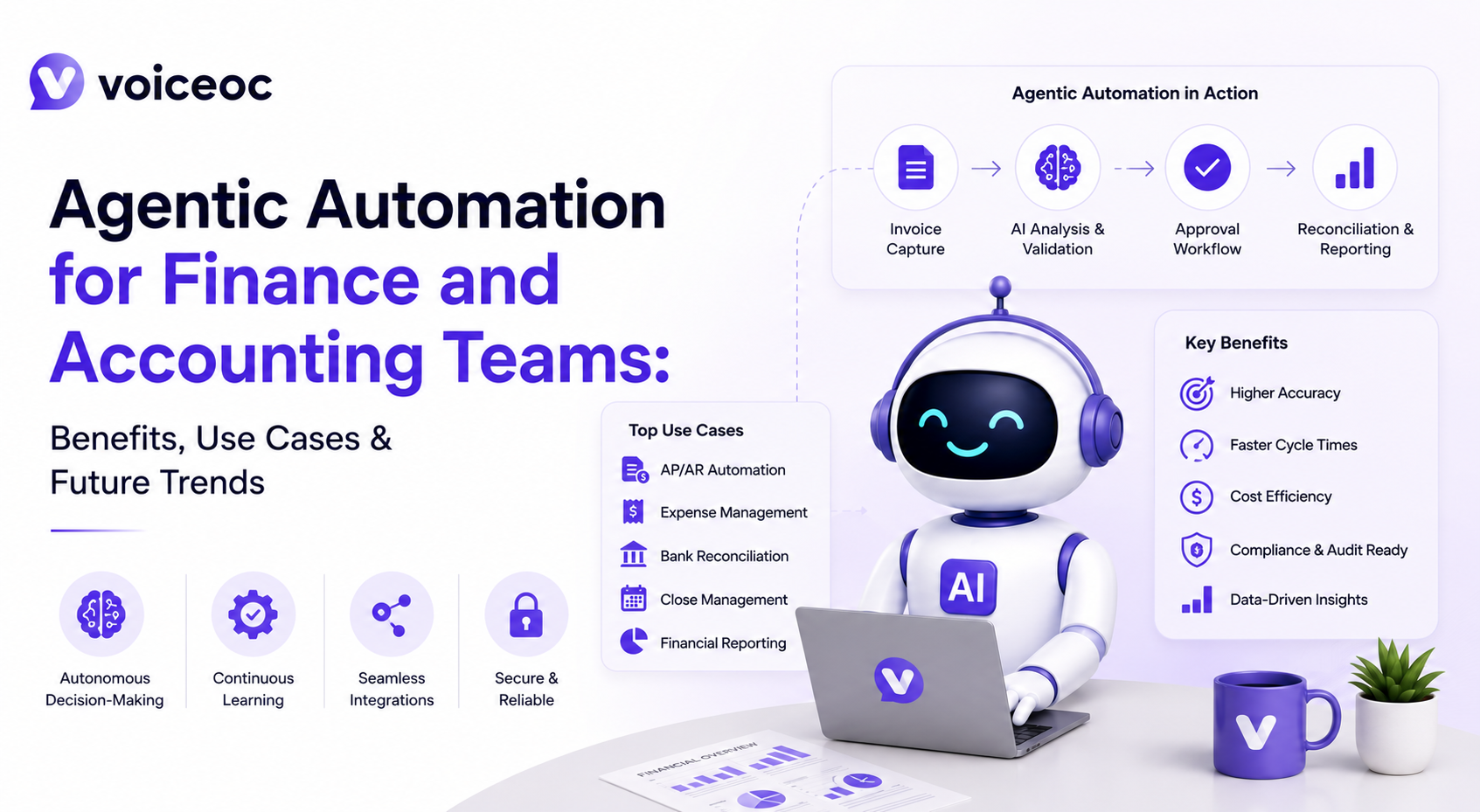
Finance teams have always been expected to do more with less. But in 2026, the pressure has intensified. Employees expect instant responses to payroll questions. Vendors want real-time payment updates. Managers need faster budget approvals. Meanwhile, finance departments are juggling compliance requirements, increasing workloads, and limited resources.
The result? Traditional finance support processes are struggling to keep up.
Many organizations still rely on shared inboxes, spreadsheets, manual routing, and disconnected ticketing tools to handle finance-related requests. While these methods may have worked in the past, they often lead to delayed responses, missed deadlines, duplicated work, and employee frustration.
This is where AI in Financial Services is making a meaningful difference.
From fraud detection and forecasting to customer service and compliance monitoring, artificial intelligence is transforming how financial operations function. One area experiencing rapid growth is the use of the AI finance ticketing system, a smarter approach to managing finance requests through automation, intelligent routing, and self-service capabilities.
Rather than requiring finance teams to manually review every inquiry, AI can categorize tickets, prioritize urgent issues, recommend solutions, and even resolve routine requests without human intervention.
According to Deloitte, organizations that effectively implement automation within finance functions can significantly improve efficiency while enabling finance professionals to focus on higher-value strategic work.
In this guide, we'll explore how AI Finance Automation is reshaping finance support operations, why businesses are investing in it, and how organizations can prepare for the future of finance service delivery.
Must Know: Explore IT Support & IT Ticketing System
What Is Finance Ticketing Automation?
Finance ticketing automation refers to the process of managing, tracking, and resolving finance-related requests using a centralized ticketing platform enhanced by automation technologies.
Whenever employees, customers, or vendors submit a financial inquiry, the system creates a "ticket" that follows a predefined workflow until resolution.
Common finance tickets include:
- Invoice status inquiries
- Expense reimbursement requests
- Payroll questions
- Tax-related clarifications
- Budget approval requests
- Vendor payment updates
- Purchase order inquiries
- Financial reporting support
- Accounts payable and receivable requests
- Employee deductions and benefits questions
Traditionally, these requests arrive through multiple channels, including email, phone calls, messaging apps, and internal portals. Finance teams manually review and assign each request, often resulting in delays and inconsistent service experiences.
Finance ticketing automation simplifies this process by introducing rules-based workflows. However, modern organizations are taking it a step further through AI Financial Automation, enabling systems to understand requests, make decisions, and automate responses intelligently.
Traditional Ticketing vs. AI-Powered Ticketing Systems
At first glance, both systems may appear similar because they organize requests into tickets. The real difference lies in how those tickets are handled.
Traditional Ticketing Systems
Traditional finance ticketing solutions typically rely on human intervention throughout the process.
A finance employee may need to:
- Read each request individually.
- Determine its category.
- Assign it to the appropriate team member.
- Follow up on status updates.
- Manually close the ticket once resolved.
While functional, these workflows consume valuable time and increase the likelihood of human error.
Common limitations include:
- Slow response times
- Lack of prioritization
- Inconsistent resolutions
- Limited scalability
- Increased administrative burden
- Difficulty meeting service-level agreements (SLAs)
As ticket volumes grow, these inefficiencies become more visible.
AI-Powered Ticketing Systems
An AI finance ticketing system uses technologies such as natural language processing (NLP), machine learning, and intelligent automation to streamline the entire lifecycle of a finance request.
Instead of waiting for a human to intervene at every step, AI can:
- Understand the intent behind requests.
- Categorize tickets automatically.
- Prioritize urgent cases.
- Route inquiries to the right teams.
- Recommend responses.
- Resolve repetitive issues instantly.
- Escalate only when necessary.
This approach significantly improves speed, consistency, and efficiency.
Simply put, AI doesn't replace finance professionals; it removes repetitive work so they can focus on activities that require judgment, analysis, and strategic thinking.
Why Finance Teams Need AI-Powered Ticketing Automation in 2026?
Finance leaders today face a unique challenge: they must deliver exceptional service while simultaneously controlling costs.
Several trends are accelerating the adoption of AI Automation Financial Services solutions.
1. Growing Ticket Volumes
As businesses expand, finance teams handle an increasing number of requests from employees, vendors, suppliers, and leadership teams.
Without automation, even simple inquiries can overwhelm support staff.
A payroll question that takes five minutes to resolve may seem insignificant. But when hundreds of similar requests arrive each month, the operational impact becomes substantial.
2. Employees Expect Faster Support
Today's workforce is accustomed to immediate answers.
Employees can order food, track deliveries, and access banking services instantly from their smartphones. They increasingly expect the same experience when interacting with internal departments.
Waiting several days for an update on an expense reimbursement no longer feels acceptable.
Organizations that fail to meet these expectations risk lower employee satisfaction and reduced productivity.
3. Finance Talent Should Focus on Strategic Work
Finance professionals possess valuable expertise that extends far beyond answering repetitive questions.
Their time is better spent on:
- Financial planning and analysis
- Scenario modeling
- Risk management
- Budget optimization
- Strategic decision-making
- Business partnering
By automating routine tickets, organizations enable finance teams to contribute where they add the most value.
4. Compliance Requirements Continue to Increase
Finance operations are subject to strict regulatory standards and internal controls.
Manual processes often make it difficult to maintain consistent documentation and audit trails.
Automated workflows help ensure that every action is tracked, recorded, and executed according to predefined rules.
This supports stronger governance while reducing compliance risks.
Statistics Highlighting the Rise of AI in Financial Services
The shift toward automation isn't driven by hype alone. Organizations are seeing measurable benefits.
Consider these findings:
- According to McKinsey, automation technologies have the potential to automate a significant portion of repetitive activities performed within finance functions.
- Deloitte reports that finance automation initiatives can improve productivity and allow teams to redirect efforts toward strategic priorities.
- Research from Gartner suggests that employees increasingly expect consumer-grade experiences from internal support teams, including finance departments.
- IBM notes that AI adoption continues to accelerate across industries as organizations seek efficiency gains and enhanced decision-making capabilities.
These trends demonstrate why AI Finance Automation has moved from being a competitive advantage to becoming a business necessity.
Companies that embrace intelligent finance operations are better positioned to scale efficiently while improving stakeholder experiences.
What Is an AI Finance Ticketing System?
An AI finance ticketing system is an intelligent platform designed to automate the intake, management, routing, and resolution of finance-related requests.
Unlike conventional ticketing tools, these systems continuously learn from interactions and improve over time.
Their goal isn't simply to track requests.
Their goal is to solve them faster and smarter.
Core Components of an AI Finance Ticketing System
Intelligent Ticket Intake
Requests can be submitted through multiple channels, including:
- Employee portals
- Chat interfaces
- Mobile applications
- Collaboration platforms such as Microsoft Teams and Slack
The system captures and consolidates all requests into a centralized workspace.
Natural Language Understanding
AI interprets the intent behind human language.
For example, if an employee writes:
"Has my travel reimbursement been processed yet?"
the system recognizes it as an expense-related inquiry without requiring the employee to select the correct category manually.
Automated Categorization
The AI identifies ticket types and classifies them accurately.
Examples include:
- Payroll
- Accounts payable
- Procurement
- Expenses
- Budget approvals
- Vendor management
This eliminates manual sorting.
Intelligent Routing
Tickets are automatically directed to the appropriate finance specialist or workflow based on predefined rules and historical patterns.
Urgent requests receive priority attention.
Self-Service Resolution
Routine questions can often be answered instantly using knowledge bases and automated workflows.
Employees receive answers without waiting for human assistance.
Escalation Management
Complex issues are seamlessly transferred to finance experts with relevant context attached.
Nothing falls through the cracks.
Reporting and Analytics
Leaders gain visibility into:
- Ticket volumes
- Resolution times
- Frequently asked questions
- SLA performance
- Team productivity
- Emerging operational trends
These insights support continuous improvement initiatives.
How an AI Finance Ticketing System Works?
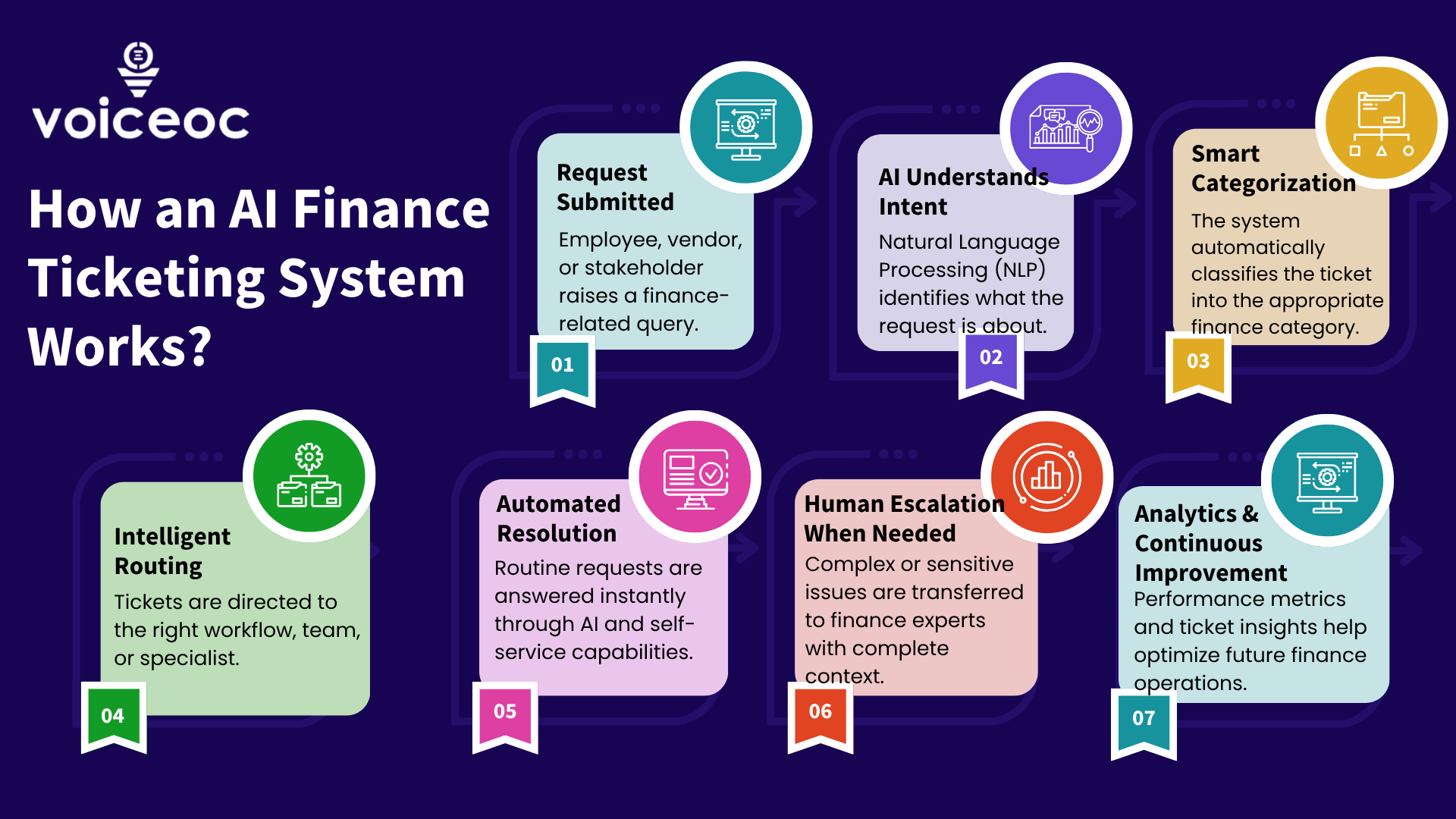
Understanding the workflow helps illustrate why these systems deliver better outcomes.
Step 1: A Request Is Submitted
An employee, customer, or vendor raises a finance-related question.
Step 2: AI Analyzes the Request
Natural language processing identifies the issue and its urgency.
Step 3: The Ticket Is Categorized
The system automatically assigns the correct category.
Step 4: Resolution Begins
Simple requests receive immediate responses through automation or self-service resources.
Step 5: Human Escalation Happens When Needed
Complex matters are routed to finance professionals equipped with all relevant details.
Step 6: Insights Are Captured
Every interaction contributes to reporting dashboards and future optimization opportunities.
This intelligent workflow forms the foundation of modern AI Financial Automation, enabling finance teams to deliver faster, more accurate, and more scalable support experiences.
Benefits of AI Finance Automation for Financial Services
While the technology behind automation is impressive, business leaders ultimately care about outcomes. The real value of AI Finance Automation lies in its ability to improve efficiency, enhance employee experiences, and help finance teams operate more strategically.
1. Faster Ticket Resolution
One of the biggest advantages of implementing an AI finance ticketing system is speed.
In traditional environments, employees often wait hours—or even days—for answers to simple questions. AI reduces these delays by automatically categorizing requests, providing instant responses to common inquiries, and escalating only the cases that require human attention.
Faster resolutions help organizations:
- Improve service-level agreement (SLA) performance.
- Reduce employee frustration.
- Minimize disruptions to daily operations.
- Increase confidence in finance support teams.
2. Increased Operational Efficiency
Finance teams spend a significant portion of their day handling repetitive tasks.
These may include:
- Checking invoice statuses.
- Responding to payroll inquiries.
- Sharing reimbursement updates.
- Redirecting requests to the appropriate stakeholders.
Through AI Financial Automation, these routine processes can be handled automatically, allowing finance professionals to focus on activities that require critical thinking and business expertise.
3. Lower Operational Costs
Automation helps organizations optimize resources without compromising service quality.
By reducing manual workloads and improving productivity, businesses can:
- Handle growing ticket volumes without expanding support teams.
- Lower administrative expenses.
- Reduce overtime costs.
- Improve cost efficiency across finance operations.
4. Enhanced Accuracy and Compliance
Manual processes are susceptible to errors, especially when teams are managing hundreds of requests simultaneously.
AI-driven workflows help ensure consistency by:
- Following predefined business rules.
- Maintaining detailed audit trails.
- Standardizing responses.
- Supporting regulatory compliance initiatives.
This is particularly valuable in highly regulated industries where documentation and accountability are essential.
5. Improved Employee Experience
Employees don't distinguish between customer experiences and workplace experiences anymore. They expect the same convenience from internal services.
An AI-powered finance support model provides:
- 24/7 assistance.
- Self-service options.
- Faster updates.
- Transparent request tracking.
- Consistent communication.
As a result, employees spend less time chasing answers and more time focusing on productive work.
6. Better Decision-Making Through Analytics
Every ticket contains valuable operational insights.
AI-powered reporting enables finance leaders to identify:
- Frequently occurring issues.
- Seasonal trends.
- Process bottlenecks.
- Resource constraints.
- Opportunities for continuous improvement.
These insights transform support data into strategic intelligence.
High-Impact Use Cases of AI in Financial Services
The practical applications of AI in Financial Services extend well beyond customer-facing experiences. Finance teams can use AI-powered ticketing automation to streamline numerous internal processes.
Accounts Payable Support
Accounts payable teams frequently receive requests related to invoices and vendor payments.
AI can automate:
- Invoice status inquiries.
- Payment confirmation requests.
- Duplicate invoice identification.
- Vendor communication workflows.
This reduces manual follow-ups while improving vendor relationships.
Expense Management Assistance
Expense-related questions are among the most common employee requests.
An AI finance ticketing system can:
- Provide reimbursement status updates.
- Explain expense policies.
- Guide employees through submission processes.
- Automate approval workflows.
Employees receive timely answers without overwhelming finance teams.
Payroll Query Resolution
Payroll inquiries often require immediate attention.
AI can support requests such as:
- Payslip access.
- Tax deduction explanations.
- Benefit-related questions.
- Payroll processing updates.
Simple questions can be resolved instantly, while more sensitive matters are escalated appropriately.
Procurement and Vendor Support
Procurement and finance teams work closely together.
AI can streamline:
- Purchase order inquiries.
- Vendor onboarding requests.
- Contract-related questions.
- Approval status tracking.
This improves cross-functional collaboration.
Financial Reporting Assistance
Employees and managers regularly request access to reports and financial data.
Automation can assist with:
- Report retrieval requests.
- Data access guidance.
- Reporting process support.
- Frequently asked reporting questions.
This reduces administrative burdens on finance analysts.
Internal Finance Help Desks
Many organizations are creating centralized finance support functions.
Using AI Automation Financial Services, these teams can provide faster assistance while maintaining consistency across the enterprise.
How to Successfully Implement an AI Finance Ticketing System?
Technology alone doesn't guarantee success. Organizations need a thoughtful implementation strategy.
Step 1: Assess Existing Processes
Start by evaluating current finance workflows.
Identify:
- High-volume requests.
- Repetitive activities.
- Common pain points.
- Existing response times.
Understanding the current state establishes a baseline for improvement.
Step 2: Prioritize High-Impact Use Cases
Not every process should be automated immediately.
Focus first on areas with:
- High ticket volumes.
- Clear business rules.
- Significant manual effort.
- Frequent employee inquiries.
Early wins help build organizational confidence.
Step 3: Integrate Existing Systems
Your AI solution should connect seamlessly with tools already in use.
Examples include:
- ERP systems.
- Payroll platforms.
- Expense management software.
- Procurement solutions.
- Collaboration tools.
Integrated experiences improve adoption and efficiency.
Step 4: Build a Strong Knowledge Base
AI performs best when supported by accurate information.
Develop clear documentation covering:
- Policies.
- Procedures.
- Frequently asked questions.
- Escalation protocols.
Regular updates keep responses relevant and reliable.
Step 5: Monitor Performance Metrics
Track measurable outcomes such as:
- Average response time.
- Resolution time.
- Ticket deflection rates.
- Employee satisfaction scores.
- SLA compliance.
- Escalation percentages.
Data-driven monitoring supports continuous optimization.
Step 6: Scale Gradually
Once initial workflows demonstrate value, expand automation across additional finance functions.
A phased approach reduces risk and improves long-term success.
Common Challenges and How to Overcome Them
Although the benefits are substantial, organizations should be prepared for potential obstacles.
Resistance to Change
Employees may worry that automation will replace their jobs.
Address these concerns by emphasizing that AI enhances human capabilities rather than eliminating them.
Data Security Concerns
Finance data is highly sensitive.
Choose solutions that prioritize:
- Encryption.
- Role-based access controls.
- Compliance standards.
- Audit capabilities.
Integration Complexities
Disconnected systems can slow implementation.
Selecting flexible platforms with integration capabilities simplifies deployment.
Maintaining Accuracy
AI systems require ongoing refinement.
Regular reviews and feedback loops ensure responses remain accurate and aligned with business needs.
The Future of AI in Financial Services
The next phase of finance transformation will extend beyond basic automation.
Emerging trends include:
Hyperautomation
Organizations will combine AI, robotic process automation, analytics, and workflow orchestration to automate end-to-end processes.
Conversational Finance Support
Employees will increasingly interact with finance through chat and voice interfaces rather than traditional portals.
Predictive Ticket Resolution
AI systems will proactively identify recurring issues and recommend solutions before employees submit requests.
Personalized Support Experiences
Responses will be tailored based on employee roles, locations, and historical interactions.
Autonomous Finance Operations
As capabilities mature, finance functions will become increasingly self-managing, allowing teams to devote more time to strategic initiatives.
Businesses that embrace these innovations early will be better positioned to remain competitive.
How Voiceoc Helps Modern Finance Teams Deliver Better Support?
Finance leaders need more than isolated automation tools. They need a platform that simplifies support while enhancing the employee experience.
Voiceoc enables organizations to modernize finance operations through intelligent, AI-powered workflows.
Voiceoc's Finance Automation Capabilities
Voiceoc helps businesses streamline finance support by offering:
- Intelligent finance ticket management.
- Omnichannel employee assistance.
- Automated query resolution.
- Smart ticket routing and prioritization.
- Seamless escalation workflows.
- Integration with enterprise systems.
- Real-time analytics and reporting.
- 24/7 support availability.
Whether employees need updates on reimbursements, answers to payroll questions, or assistance with finance policies, Voiceoc delivers fast and consistent experiences across the channels they already use.
Why Organizations Choose Voiceoc?
Businesses choose Voiceoc Finance AI Automation because it helps them:
- Improve response and resolution times.
- Reduce repetitive workloads.
- Increase finance team productivity.
- Enhance employee satisfaction.
- Strengthen operational efficiency.
- Scale support without increasing headcount.
Instead of replacing finance professionals, Voiceoc empowers them to focus on higher-value work that drives business outcomes.
Conclusion
The role of finance is evolving rapidly.
Today's finance teams are expected to provide strategic insights while simultaneously delivering exceptional support experiences. Unfortunately, manual ticket handling processes often prevent them from achieving both goals.
This is why AI Finance Automation has become a priority for forward-thinking organizations.
An effective AI finance ticketing system can reduce response times, improve compliance, enhance employee satisfaction, and free finance professionals from repetitive administrative tasks.
The future of AI in Financial Services isn't about removing the human element from finance. It's about giving finance teams the tools they need to work smarter, respond faster, and contribute more strategically to the organization.
Organizations that begin their automation journey today will be better prepared for the demands of tomorrow.
With platforms like Voiceoc, businesses can transform finance support from a reactive function into a proactive driver of efficiency, productivity, and employee experience.
Frequently Asked Questions
1. What is an AI finance ticketing system?
An AI finance ticketing system uses artificial intelligence to automate the intake, categorization, routing, and resolution of finance-related requests, improving efficiency and response times.
2. How does AI Finance Automation improve finance operations?
It reduces manual workloads, speeds up resolutions, improves accuracy, enhances compliance, and enables finance teams to focus on strategic initiatives.
3. Is AI financial automation secure?
Yes. Modern solutions incorporate encryption, role-based permissions, audit trails, and compliance controls to protect sensitive financial information.
4. What finance processes can be automated using AI?
Organizations can automate payroll inquiries, expense reimbursements, accounts payable requests, vendor support, procurement questions, and financial reporting assistance.
5. How long does it take to implement an AI finance ticketing system?
Implementation timelines vary depending on complexity, integrations, and organizational readiness. Many businesses start with a phased rollout targeting high-volume use cases.
6. What are the biggest benefits of AI in Financial Services?
Improved efficiency, lower costs, faster service delivery, enhanced employee experiences, stronger compliance, and better data-driven decision-making.
7. Can AI ticketing platforms integrate with existing finance software?
Yes. Most enterprise-grade solutions integrate with ERP systems, payroll applications, expense tools, procurement platforms, and collaboration software.
8. How can Voiceoc support finance automation initiatives?
Voiceoc helps organizations automate finance support workflows through intelligent ticket management, omnichannel assistance, smart routing, analytics, and 24/7 employee support experiences.







.svg)
.svg)