

Finance teams are under constant pressure to do more with less. From processing invoices and managing vendor payments to preparing financial reports and ensuring compliance, finance departments handle hundreds of repetitive tasks every day. While these processes are critical, they are also time-consuming, prone to human error, and difficult to scale as organizations grow.
This is where AI-powered finance workflow automation is making a significant impact. Instead of relying on manual approvals, spreadsheets, and email chains, organizations are increasingly using artificial intelligence to automate routine financial operations, accelerate approvals, and provide real-time insights.
The adoption of AI in finance is accelerating worldwide. According to McKinsey, generative AI has the potential to create $200 billion to $340 billion in annual value for the banking sector alone through productivity improvements and automation. Similarly, Deloitte's State of AI in the Enterprise research shows that finance remains one of the fastest-growing business functions for AI investments, with organizations focusing on operational efficiency, compliance, and decision support.
Fill up the form today and our Voiceoc AI experts will connect you shortly on HR, IT, and Finance Automation!
Whether you're a growing business looking to simplify accounting operations or an enterprise managing complex financial workflows, choosing the right automation platform can dramatically improve efficiency while reducing operational costs.
In this guide, we'll explore the best AI tools for finance workflow automation in 2026, compare their capabilities, and help you identify the right solution for your organization.
What Is Finance Workflow Automation?
Finance workflow automation is the process of using software and artificial intelligence to automate repetitive financial tasks, approvals, and business processes. Instead of manually routing invoices, validating expenses, or following up on approvals, automated systems handle these tasks with minimal human intervention.
Traditional finance processes often involve multiple departments, lengthy approval cycles, and repetitive data entry. These manual workflows can slow decision-making, create bottlenecks, and increase the risk of errors.
Modern AI-powered finance automation platforms go beyond simple rule-based automation. They use technologies such as machine learning, optical character recognition (OCR), natural language processing (NLP), and conversational AI to understand documents, classify requests, extract financial data, and route work to the appropriate stakeholders.
Some of the most common finance workflows organizations automate include:
- Invoice processing and approval
- Accounts payable and receivable
- Employee expense management
- Vendor onboarding and support
- Purchase order approvals
- Financial reporting
- Budget requests
- Compliance documentation
- Internal finance helpdesk requests
By automating these repetitive activities, finance teams can dedicate more time to strategic planning, forecasting, and business growth rather than administrative work.
Why AI Is Transforming Finance Operations?
Artificial intelligence is no longer just a competitive advantage; it's becoming an operational necessity. As finance departments manage increasing transaction volumes and stricter regulatory requirements, AI enables organizations to work faster, smarter, and more accurately.
One of AI's biggest strengths is its ability to eliminate repetitive manual work. Tasks that previously required hours of data entry or document verification can now be completed in minutes using intelligent automation. AI can automatically extract information from invoices, validate payment details, detect duplicate submissions, and trigger approval workflows without requiring constant human involvement.
Accuracy is another major benefit. Manual financial processes are vulnerable to typing mistakes, misplaced documents, and approval delays. AI significantly reduces these risks by applying consistent rules and validating information before processing transactions.
AI also enhances compliance by maintaining detailed audit trails and ensuring workflows follow predefined approval policies. This makes it easier for finance teams to meet internal governance standards and regulatory requirements.
Beyond automation, AI provides actionable insights. Instead of waiting until the end of the month for reports, finance leaders can monitor budgets, spending patterns, cash flow, and operational performance in near real time, enabling faster and more informed decision-making.
Key industry statistics:
- According to McKinsey, AI and automation could generate up to $340 billion annually in value for the banking sector through improved productivity and operational efficiency.
- PwC estimates that AI could contribute up to $15.7 trillion to the global economy by 2030, with financial services among the industries expected to benefit the most.
- Research from Gartner indicates that finance leaders continue to increase investments in AI-driven automation to improve efficiency, strengthen compliance, and support better business decisions.
These trends demonstrate that AI is no longer limited to large financial institutions. Organizations of all sizes are adopting intelligent automation to streamline finance operations and remain competitive.
Key Features to Look for in AI Finance Automation Tools
Not every automation platform delivers the same capabilities. When evaluating AI tools for finance workflow automation, businesses should focus on features that improve efficiency while integrating seamlessly with existing financial systems.
Look for platforms that offer AI-powered invoice processing with OCR technology to automatically capture and validate invoice data. Intelligent workflow automation should support configurable approval routing, ensuring requests reach the right stakeholders without manual intervention.
Integration is equally important. The best solutions connect with popular ERP and accounting platforms such as SAP, Oracle, Microsoft Dynamics, NetSuite, and QuickBooks, eliminating data silos and reducing duplicate work.
Organizations should also prioritize solutions with AI chat assistants and voice agents that can answer employee and vendor finance queries, provide payment updates, and automate routine support requests.
Finally, enterprise-grade security, analytics dashboards, compliance reporting, and scalable workflow customization are essential features for organizations planning long-term digital transformation.
Best AI Tools for Finance Workflow Automation (2026)
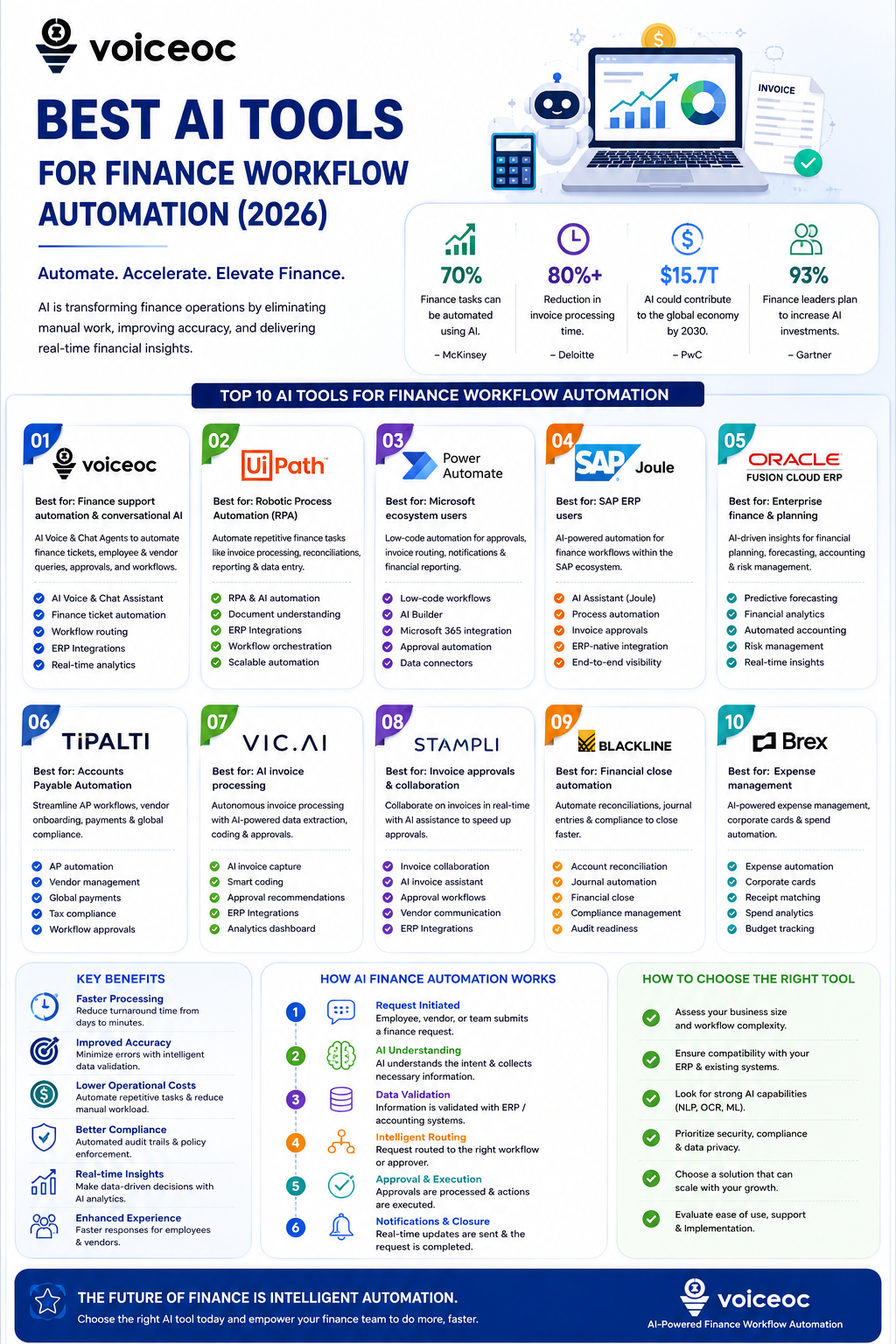
Choosing the right AI platform depends on your organization's size, existing technology stack, and automation goals. Some solutions specialize in robotic process automation (RPA), while others focus on accounts payable, invoice processing, or conversational AI. Below are ten of the best AI tools helping finance teams automate workflows in 2026.
1. Voiceoc
Best for: AI-powered finance workflow automation, finance ticket management, and conversational AI support.
Voiceoc is more than a traditional workflow automation platform. It combines AI voice agents, conversational AI, and intelligent workflow automation to help finance teams manage employee requests, vendor inquiries, and finance support tickets from a single platform.
Unlike conventional automation tools that only move data between systems, Voiceoc understands conversations, gathers missing information, routes requests to the appropriate finance team, and keeps users informed throughout the process. Whether it's an employee asking about expense reimbursement, a vendor requesting invoice status, or a finance team handling payment approvals, Voiceoc automates the entire interaction.
The platform also integrates with enterprise applications, enabling organizations to automate workflows without disrupting existing ERP or accounting systems.
Key Features
- AI Voice Agent and AI Chat Assistant
- Intelligent finance ticket automation
- Vendor and employee finance support
- Automated workflow routing
- Omnichannel communication
- ERP and business application integrations
- Analytics dashboard for finance operations
- Enterprise-grade security and compliance
Pros
- Combines conversational AI with workflow automation
- Reduces manual finance support workload
- Improves response time for employees and vendors
- Highly scalable for enterprise organizations
2. UiPath
Best for: Enterprise robotic process automation.
UiPath is one of the most recognized names in robotic process automation (RPA). It enables finance teams to automate repetitive processes such as invoice entry, reconciliations, report generation, and accounts payable workflows.
Its AI-powered document understanding capabilities help extract data from invoices and financial documents while reducing manual data entry. UiPath also integrates with leading ERP platforms, making it suitable for organizations with complex financial operations.
Key Features
- AI document processing
- Invoice automation
- ERP integrations
- Workflow orchestration
- Intelligent bots for repetitive finance tasks
3. Microsoft Power Automate
Best for: Businesses using the Microsoft ecosystem.
Microsoft Power Automate allows finance teams to automate approvals, notifications, invoice routing, and document management without extensive coding.
Its seamless integration with Microsoft 365, Teams, SharePoint, Dynamics 365, and Power BI makes it particularly valuable for organizations already invested in Microsoft's technology stack. AI Builder further enhances automation by enabling document processing and intelligent form recognition.
Key Features
- Low-code workflow automation
- AI Builder
- Approval automation
- Microsoft 365 integration
- Financial reporting automation
4. SAP Joule & SAP Build Process Automation
Best for: Large enterprises running SAP ERP.
SAP continues expanding its AI capabilities through Joule, its generative AI assistant, and SAP Build Process Automation. Together, these tools automate procurement, invoice approvals, finance requests, and ERP workflows while providing intelligent recommendations to finance professionals.
Organizations already using SAP benefit from native integrations and enterprise-grade scalability.
Key Features
- AI assistant for SAP users
- Finance workflow automation
- Invoice approvals
- ERP-native automation
- Process orchestration
5. Oracle Fusion Cloud ERP AI
Best for: Enterprise finance and planning.
Oracle Fusion Cloud ERP includes embedded AI that helps automate financial planning, forecasting, account reconciliation, and risk management.
The platform analyzes financial trends, identifies anomalies, and provides predictive insights that support faster decision-making. Its automation capabilities reduce manual effort while improving reporting accuracy across finance teams.
Key Features
- AI-powered forecasting
- Financial analytics
- Intelligent recommendations
- Automated accounting processes
- Enterprise ERP integration
6. Tipalti
Best for: Accounts payable automation.
Tipalti specializes in automating the accounts payable lifecycle, from invoice capture to supplier payments. It simplifies vendor onboarding, tax compliance, approval workflows, and global payment processing.
For organizations managing large supplier networks, Tipalti helps reduce manual processing while improving payment accuracy and visibility.
Key Features
- AP automation
- Global payment support
- Vendor onboarding
- Tax compliance
- Automated approval workflows
7. Vic.ai
Best for: AI-powered invoice processing.
Vic.ai uses artificial intelligence to automate invoice coding, approval recommendations, and payment processing. Instead of relying solely on predefined rules, the platform continuously learns from historical accounting data to improve decision-making.
This significantly reduces manual review time while increasing invoice processing accuracy.
Key Features
- Autonomous invoice processing
- Machine learning
- Smart invoice coding
- Payment recommendations
- Finance analytics
8. Stampli
Best for: Collaborative invoice management.
Stampli focuses on simplifying invoice approvals through collaboration. Finance teams, managers, and vendors can communicate directly within invoice workflows, eliminating lengthy email chains.
Its AI assistant helps identify missing information, recommend approvers, and speed up invoice processing.
Key Features
- AP collaboration
- AI invoice assistant
- Approval automation
- Vendor communication
- ERP integrations
9. BlackLine
Best for: Financial close automation.
BlackLine helps organizations automate account reconciliations, financial close processes, journal entries, and compliance reporting.
The platform is particularly valuable for finance departments seeking to shorten month-end and year-end closing cycles while maintaining accuracy and audit readiness.
Key Features
- Financial close automation
- Account reconciliation
- Journal automation
- Compliance management
- Financial reporting
10. Brex AI
Best for: Expense management and corporate spending.
Brex combines AI with corporate spend management to automate expense tracking, receipt matching, policy enforcement, and employee reimbursements.
Finance teams gain better visibility into company spending while reducing manual administrative work.
Key Features
- AI expense management
- Corporate cards
- Receipt automation
- Spend analytics
- Budget tracking
Which Tool Is Right for Your Business?
Each platform addresses a different aspect of finance automation.
- Voiceoc is ideal for organizations looking to automate finance support, employee and vendor interactions, and workflow management through conversational AI.
- UiPath excels in robotic process automation for repetitive finance tasks.
- Microsoft Power Automate is a strong choice for businesses using Microsoft 365.
- SAP Joule and Oracle Fusion Cloud ERP AI are best suited for enterprises already invested in those ERP ecosystems.
- Tipalti, Vic.ai, Stampli, BlackLine, and Brex AI each provide specialized capabilities for accounts payable, invoice automation, financial close, and expense management.
The best solution ultimately depends on your existing systems, automation priorities, and long-term digital transformation goals.
How Does AI Finance Workflow Automation Work?

Although every organization has different financial processes, most AI-powered workflow automation platforms follow a similar pattern.
- An employee, customer, or vendor submits a finance request through chat, email, voice, or a self-service portal.
- AI analyzes the request using Natural Language Processing (NLP) to understand the intent.
- The platform collects the required information and validates it against ERP or accounting systems.
- The request is automatically routed to the correct finance workflow or approver.
- AI sends status updates and notifications throughout the approval process.
- Once approved, the workflow is completed automatically and recorded for auditing and reporting.
This eliminates repetitive manual work while ensuring faster processing and improved transparency.
Benefits of Using AI Finance Automation Tools
AI has become a strategic investment for finance teams because it improves efficiency without compromising accuracy. Instead of spending valuable time on repetitive administrative work, finance professionals can focus on planning, forecasting, and business growth.
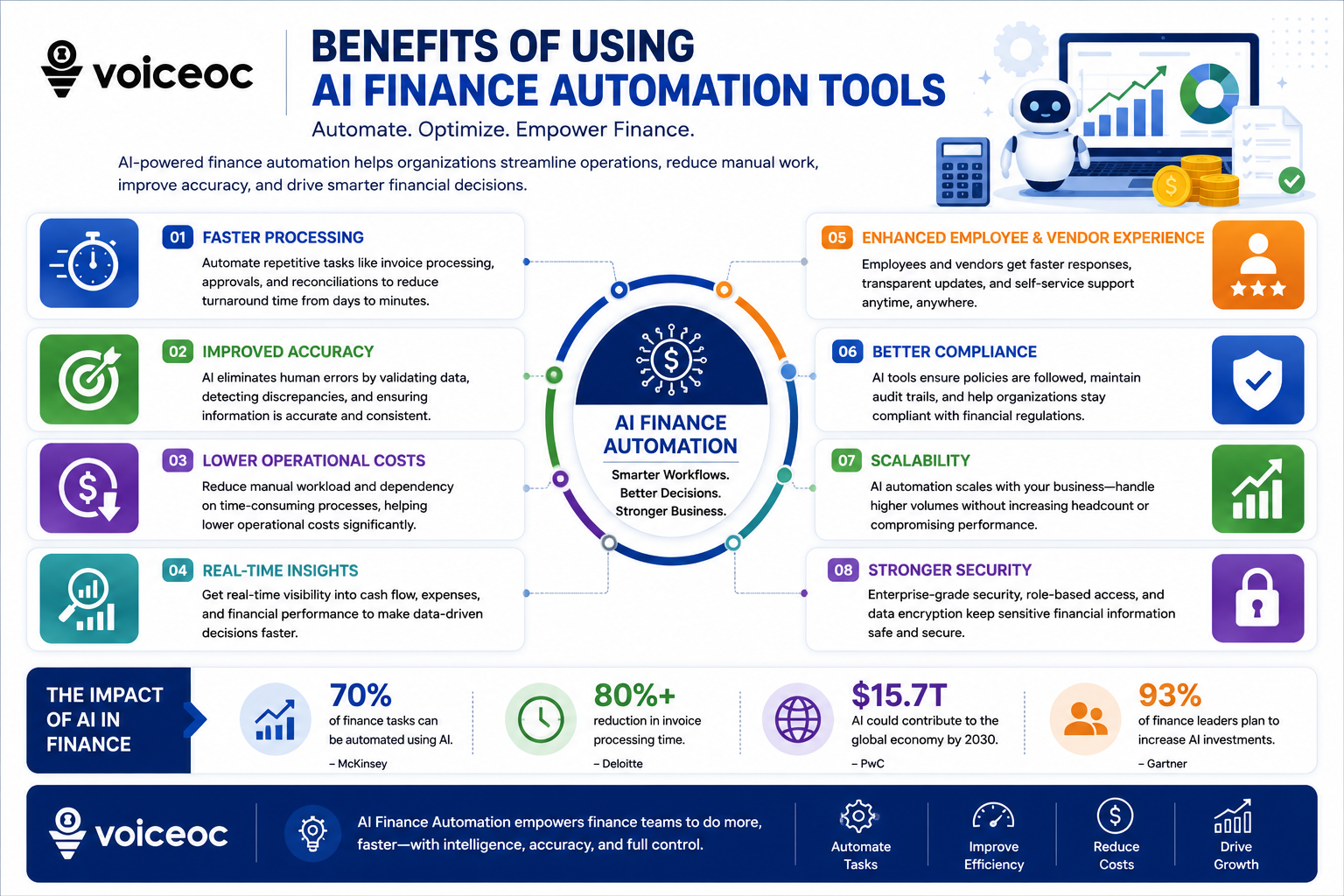
Some of the biggest benefits include:
Faster Processing
AI automates repetitive tasks such as invoice approvals, expense verification, and payment processing, reducing turnaround times from days to hours or even minutes.
Improved Accuracy
By eliminating manual data entry and applying predefined business rules consistently, AI significantly reduces human errors and duplicate transactions.
Lower Operational Costs
Automation minimizes repetitive work, allowing finance teams to handle increasing workloads without proportionally increasing headcount.
Better Compliance
AI maintains audit trails, enforces approval policies, and helps organizations comply with financial regulations and internal governance standards.
Enhanced Employee and Vendor Experience
Employees receive faster responses to finance-related queries, while vendors benefit from improved visibility into invoice and payment statuses.
Real-Time Financial Insights
Modern AI platforms provide dashboards and analytics that help finance leaders monitor spending, identify trends, and make faster, data-driven decisions.
How to Choose the Right AI Finance Automation Tool?
Selecting the right platform depends on your organization's current processes and future growth plans. Before making a decision, consider the following factors:
- Business Size: Choose a solution that can scale as your finance operations grow.
- ERP Compatibility: Ensure the platform integrates with systems such as SAP, Oracle, Microsoft Dynamics, NetSuite, or QuickBooks.
- AI Capabilities: Look beyond basic automation for intelligent routing, conversational AI, predictive insights, and document processing.
- Security & Compliance: Verify that the solution supports enterprise-grade security, role-based access, encryption, and compliance requirements.
- Ease of Integration: A platform should work with your existing technology stack without requiring major infrastructure changes.
- Customization: Every finance department has unique workflows. Choose a solution that allows flexible workflow configuration and approval rules.
- Analytics: Reporting and performance dashboards help measure automation success and identify areas for continuous improvement.
Why Businesses Choose Voiceoc for Finance Workflow Automation
As finance teams become more digital, automation is no longer limited to invoice processing or approvals. Organizations also need a smarter way to handle finance-related conversations, employee requests, vendor inquiries, and internal support tickets.
This is where Voiceoc delivers a distinct advantage.
Voiceoc combines Conversational AI, Voice AI, and intelligent workflow automation to create a seamless finance support experience. Employees can ask questions about reimbursements, budgets, purchase requests, or payment status through natural conversations, while vendors can receive instant updates on invoices and payments without waiting for manual responses.
The platform intelligently understands requests, gathers missing information, verifies data, routes tickets to the appropriate finance team, and keeps users updated throughout the process. This significantly reduces repetitive administrative work while improving response times and operational efficiency.
Why organizations choose Voiceoc:
- AI Voice Agent for finance support
- AI Chat Assistant for employees and vendors
- Intelligent finance ticket automation
- Automated workflow routing
- Omnichannel communication
- ERP and enterprise application integrations
- Real-time analytics and reporting
- Enterprise-grade security
- 24/7 automated support
- Scalable automation for growing businesses
Rather than replacing finance professionals, Voiceoc empowers them by automating repetitive work and allowing teams to focus on higher-value financial planning and strategic initiatives.
Frequently Asked Questions
1. What is finance workflow automation?
Finance workflow automation uses software and artificial intelligence to automate repetitive financial processes such as invoice approvals, expense management, accounts payable, reporting, and compliance, reducing manual effort and improving efficiency.
2. Which AI tool is best for finance workflow automation?
The best solution depends on your business requirements. Organizations seeking conversational AI, finance support automation, and intelligent workflow routing can benefit from Voiceoc, while platforms like UiPath, Tipalti, and Oracle Fusion Cloud ERP AI specialize in other aspects of finance automation.
3. Can AI integrate with ERP and accounting software?
Yes. Most enterprise AI platforms integrate with leading ERP and accounting systems, including SAP, Oracle, Microsoft Dynamics, NetSuite, and QuickBooks, allowing businesses to automate workflows without replacing existing infrastructure.
4. Is AI finance automation secure?
Reputable finance automation platforms offer enterprise-grade security features such as encryption, role-based access control, audit trails, and compliance support to help protect sensitive financial information.
Conclusion
Finance teams are expected to process more transactions, maintain stricter compliance, and deliver faster business insights than ever before. Relying on manual workflows is no longer sustainable in an increasingly digital business environment.
AI-powered finance workflow automation enables organizations to streamline operations, improve accuracy, reduce costs, and enhance the experience for both employees and vendors. Whether you're automating invoice processing, managing finance approvals, or providing instant support through conversational AI, choosing the right platform can significantly improve operational efficiency.
Among the leading solutions available in 2026, Voiceoc stands out by combining intelligent workflow automation with AI-powered voice and chat assistants, helping organizations automate finance support, accelerate ticket resolution, and deliver a modern finance experience.
If you're ready to modernize your finance operations, Voiceoc provides the tools needed to build faster, smarter, and more efficient finance workflows.







.svg)
.svg)